Image to help understand the article
Award-winning Korean drama
South Korean filmmaker Hong Sang-soo’s “Right Now, Wrong Then” received the Golden Leopard, the top prize at Switzerland’s Locarno Film Festival, in 2015. Its lead actor, Jung Jae-young, also won the festival’s best actor award for his performance as an art-house film director whose chance meeting with a painter unfolds twice in subtly different ways.
Written and directed by Hong, the 120-minute romantic drama opened in South Korean theaters on Sept. 24, 2015. Korea’s film authorities classified it for adults only. Kim Min-hee co-stars as painter Yoon Hee-jung, alongside a supporting cast that includes Youn Yuh-jung, Gi Ju-bong, Choi Hwa-jung, Yoo Jun-sang, Seo Young-hwa and Go Ah-sung.
The same day, told twice
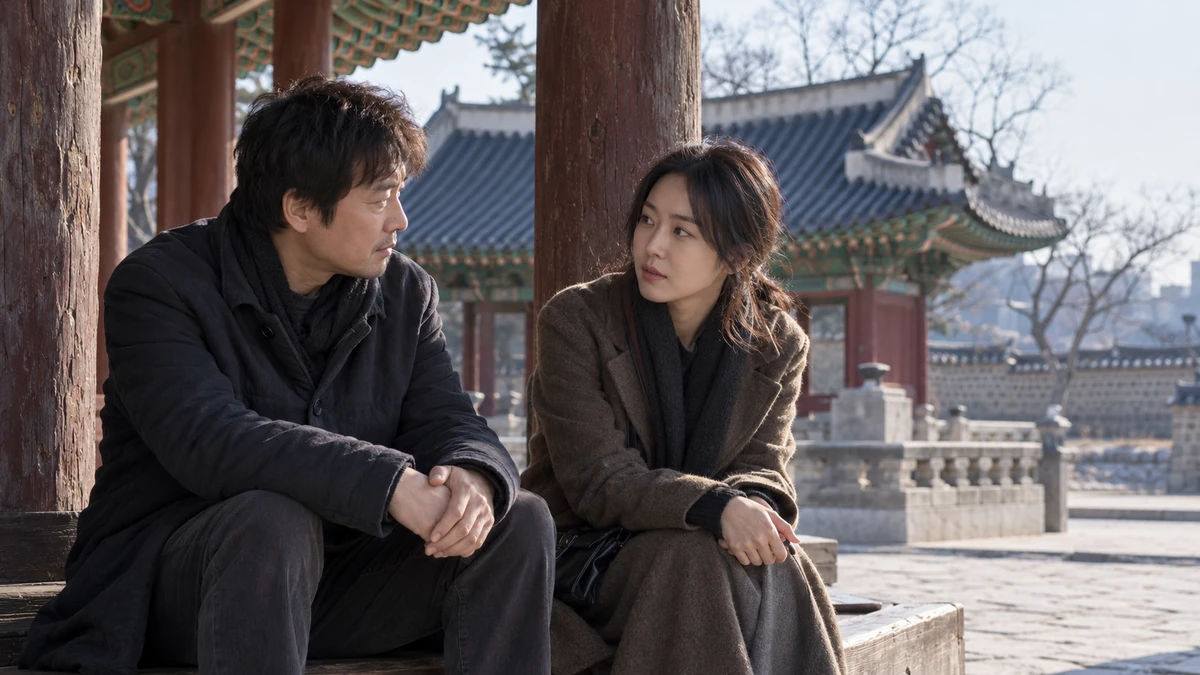
The film is divided into two parts, “Right Then, Wrong Now” and “Right Now, Wrong Then.” Both begin with filmmaker Ham Chun-su arriving in Suwon, a city south of Seoul, to screen one of his movies. With time to spare, he meets Hee-jung at a Buddhist temple, joins her for coffee and visits her studio before the pair begin drinking soju, Korea’s widely consumed distilled liquor.
The people and locations remain largely the same, but changes in what the characters say — and what they choose to reveal — send the encounters in different emotional directions. In the first version, Chun-su praises Hee-jung’s paintings and declares his attraction without initially telling her that he has a wife and two children. The omission catches up with him at a gathering with her friends, where his reputation and marital status come to light.
In the second version, Chun-su is more candid. He offers a sharper assessment of Hee-jung’s work, upsetting her, and later admits through tears that he is married even as he says he loves her and wishes he could marry her. Hee-jung responds that she wishes they had met earlier. A ring he says he found on the street briefly becomes, in her telling, their wedding ring.
Small changes, different outcomes
The two visits to Hee-jung’s friends also diverge. The first deteriorates after Chun-su’s familiar compliments and history with women are questioned. In the second, the group initially finds him kinder than his reputation suggests, though the evening turns chaotic when the drunken director begins taking off his clothes.
The following day provides another contrast. In the first half, a hungover Chun-su becomes angry and erratic during a discussion after his screening, then returns to Seoul. In the second, the event goes smoothly, and Hee-jung appears at the theater. They wish each other well, and she promises to watch all his future films before they part.
The repeated structure allows Hong to examine how honesty, timing, posture and seemingly minor choices can reshape a relationship. Rather than presenting one version as a simple correction of the other, the film sets the two encounters beside each other and asks viewers to notice how human behavior changes under slightly altered circumstances.
Festival honors and critical acclaim
Beyond Locarno, “Right Now, Wrong Then” won best feature at the 2015 Gijón International Film Festival, where Jung also received an acting prize. In South Korea, it earned the grand prize from the Busan Film Critics Association and was selected among the year’s top 10 films by the Korean Association of Film Critics. Kim won a Busan critics’ acting award, while Jung collected additional honors from Korean critics, the Asia Pacific Screen Awards and the Wildflower Film Awards. The film also received a special mention at the Florence Korea Film Fest in 2016.
On Rotten Tomatoes, the film holds a 92% approval rating from 49 reviews, with an average score of 7.5 out of 10. Metacritic assigned it a score of 81 out of 100 based on 16 critics, placing it in the category of “universal acclaim.” In 2020, The Guardian ranked it sixth on its list of modern classics of South Korean cinema.
Comments
Post a Comment