Image to help understand the article
A commander in an era of northern invasions
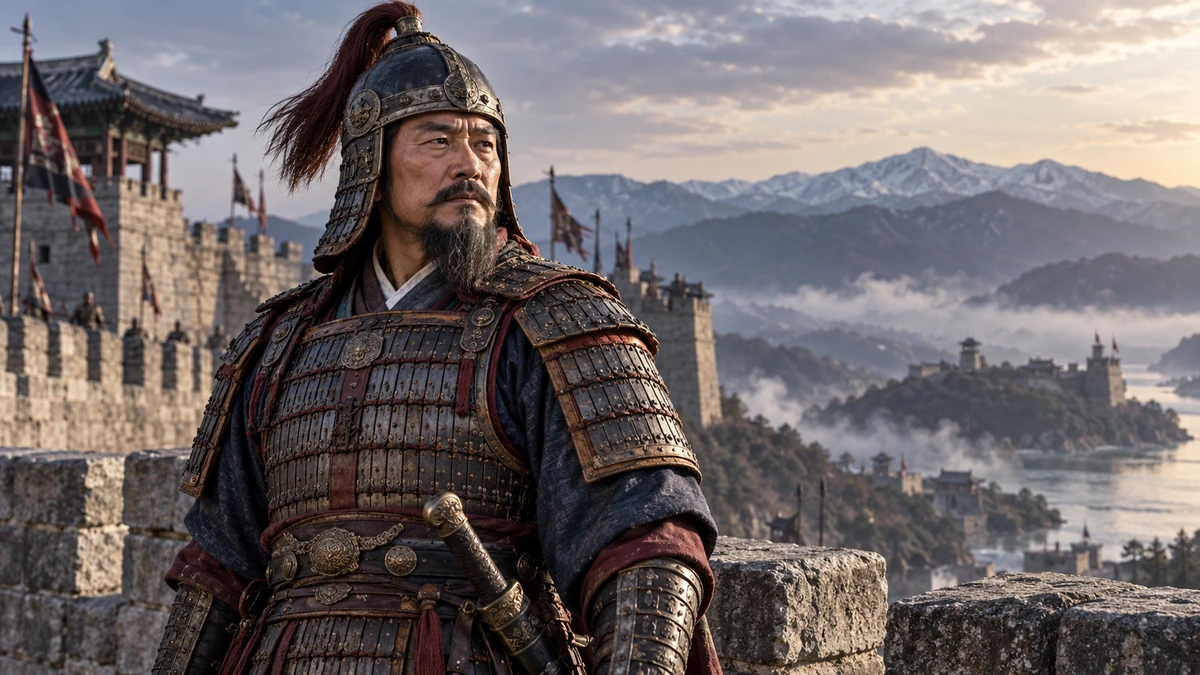
Kim Chwi-ryeo was a military commander of Korea’s Goryeo dynasty who rose to prominence by fighting Khitan forces and suppressing a rebellion near the kingdom’s northern frontier. Born in 1172, he served under King Gojong and helped stabilize the border during a period when Khitan remnants, Mongol armies and other regional powers were competing across Northeast Asia.
Kim came from the Eonyang Kim clan and a family with a record of military and government service. His father, Kim Bu, served as a senior general and minister, and Kim entered office through a system that allowed the sons of ranking officials to receive appointments. He advanced through palace guard and military positions before becoming a commanding general.
Fighting the Khitan advance
In 1216, Khitan forces fleeing Mongol pressure entered Goryeo’s northwestern territory. Led by Geumsan and Geumsi, who claimed royal authority under the name Great Liao, the forces looted settlements and pushed deeper into the kingdom. The Goryeo court organized several field armies, with Kim commanding a rear division.
Kim helped defeat Khitan troops in the northwest but lost his eldest son during the fighting. The invaders crossed the Taedong River, threatened the Goryeo capital of Gaegyeong and captured Cheorwon as they moved south. Goryeo forces suffered defeats, and Kim returned wounded after taking part in the resistance.
After the military government reorganized the army, Kim was appointed to lead a forward force. His troops endured setbacks but also won repeated engagements, pursuing the Khitan army and scoring a major victory at Bakdal Pass. The battered Khitan force eventually crossed the Daegwallyeong mountain range and moved through northeastern territory toward areas inhabited by Jurchen people. Kim’s troops followed as far as the frontier, although illness later forced him to return to Gaegyeong.
The siege of Gangdong Fortress
By 1218, Kim had become a senior general and was appointed deputy commander under Jo Chung for another campaign against the Khitan forces. Pressured by the Goryeo army, the Khitans withdrew into Gangdong Fortress east of Pyongyang.
Mongol troops led by Hacin and an Eastern Jin force commanded by Wanyan Ziyuan also converged on the fortress. In 1219, the three armies mounted a joint siege, compelling the Khitan troops inside to surrender.
After the battle, Goryeo and the Mongols entered what was described as a pact of brotherhood, with Jo and Kim participating at Hacin’s request. The agreement came before the later Mongol invasions that would transform Goryeo’s political and military position.
Suppressing rebellion and securing the border
Kim was later sent against a rebellion in Uiju, a strategically important northern border area. Han Sun and Daji had coordinated their uprising with several neighboring fortresses. Kim initially led the right army and, after being promoted the following year, commanded the central army that completed the suppression. He then dispatched subordinates to eliminate the remaining Khitan groups, helping restore security along the northern frontier.
His wartime record brought a succession of high-level appointments overseeing the military, finances and central administration. When the military government led by Choe U moved the capital from Gaegyeong to Ganghwa Island in 1232 amid the Mongol threat, Kim relocated to the new wartime capital, known as Gangdo, and became the kingdom’s chief minister.
Kim died there on May 21, 1234, at age 63. He was buried that July in Jingang County.
Legacy of strict military leadership
Historical accounts portray Kim as upright, frugal and demanding in his enforcement of military discipline. He was also remembered for treating subordinates fairly and using unconventional tactics in battle. Two of his sons were killed in combat, while other descendants went on to hold senior offices and establish ties to the royal court.
After his death, Kim received the posthumous title Wiyeol and was honored at King Gojong’s ancestral shrine. A monument commemorating him was erected on Ganghwa Island in 1983, and his tomb is designated as a cultural heritage resource by the city of Incheon. He has also appeared as a character in the Korean historical television dramas “Age of Warriors” on KBS and “God of War” on MBC.
Comments
Post a Comment