Image to help understand the article
King Gwangjong, the fourth ruler of Korea’s Goryeo dynasty, inherited a kingdom unified in name but still dominated by powerful regional families. After taking the throne in 949, he pursued a series of reforms targeting those clans’ wealth, private armies and control over government appointments.
His most consequential measures included reviewing the status of people forced into servitude, introducing Goryeo’s first civil service examination and establishing official colors for court dress. Together, the policies helped shift political authority toward the throne, though Gwangjong’s later purges also brought instability and bloodshed.
An Unlikely Successor
Born in 925 to Goryeo’s founder, King Taejo, and Queen Sinmyeongsunseong, Gwangjong was originally named So. As Taejo’s fourth son, he initially appeared unlikely to become king. But the poor health of his older half brother, King Hyejong, and the early death of another brother elevated So and his full brother Yo as leading candidates for the throne.
As a prince, So served as an intermediary between Hyejong and political forces in Seogyeong, a secondary capital in what is now Pyongyang. He also witnessed regional power brokers compete to place princes connected to their own families on the throne.
Yo became King Jeongjong in 945. As his health deteriorated, Jeongjong chose to transfer the throne to So rather than his own son. So became King Gwangjong on the 13th day of the third lunar month in 949.
Gwangjong quickly canceled Jeongjong’s unpopular plan to move the capital to Seogyeong. He also distributed rice to officials according to rank, creating a basis for government salaries, and set the tax obligations of different regions.
Building Support Before Reform
During his early reign, Gwangjong moved cautiously while preparing to strengthen royal authority. He studied a Chinese work recording political discussions between Emperor Taizong of the Tang dynasty and his ministers, using it as a guide to governing and managing court officials.
In 950, Gwangjong proclaimed an independent era name, Gwangdeok, rather than adopting one from a Chinese dynasty. He also ordered fortifications built at Jangcheongjin and Wihwajin. After Later Zhou emerged as a major power in China, however, Goryeo began using its era name in late 951 while maintaining diplomatic ties intended to counter the Khitan and Jurchen peoples.
Gwangjong used Buddhism and public assistance programs to reinforce popular support. He founded temples honoring his parents, promoted reconciliation between two competing Buddhist schools and established the Jewibo, an institution that aided poor and sick people. Even Choe Seung-ro, a later critic of the king, described Gwangjong’s early rule as a prosperous period in which the government did not ignore people of low social status.
Freeing People From Unlawful Bondage
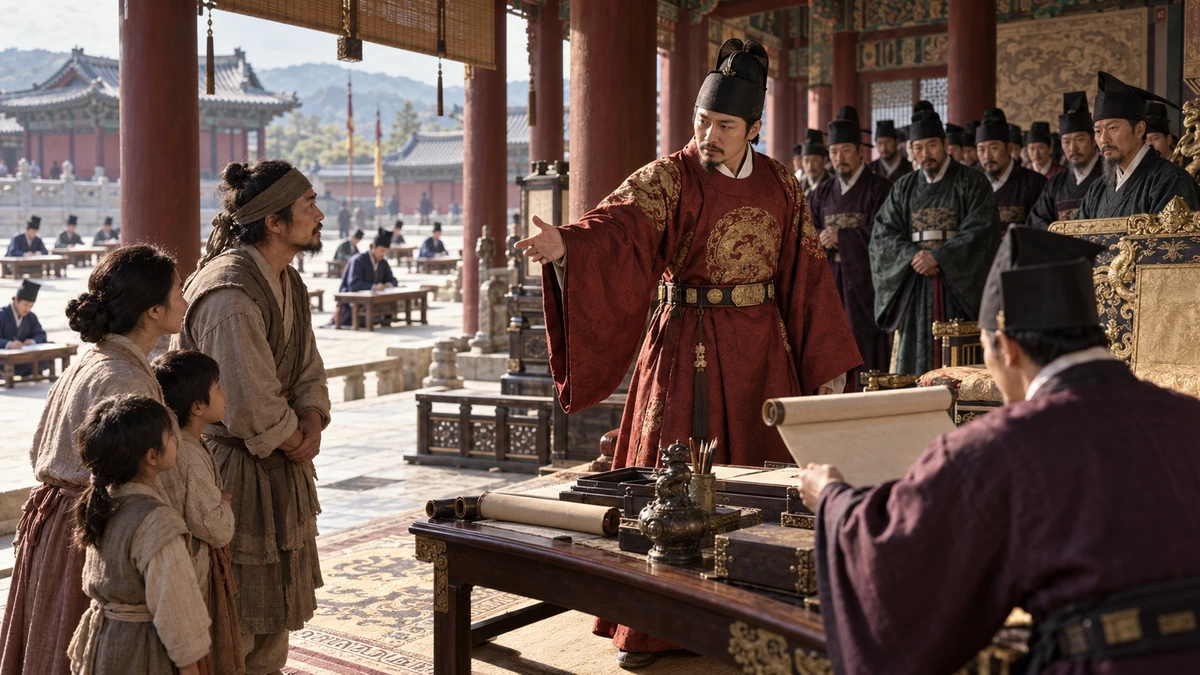
In 956, Gwangjong introduced the Slave Review Act, known in Korean as the nobi angeombeop. The measure allowed authorities to investigate whether people held as nobi — a hereditary class of bonded laborers and servants — had been unlawfully deprived of free status.
Many people controlled by regional clans had been captured during Goryeo’s wars of unification or coerced into servitude. Their labor supported the clans’ farms and income, while some also served in private armed forces.
Under the new system, individuals could report to government offices and seek recognition as free commoners. Gwangjong prohibited owners from blocking those claims and penalized clan leaders who falsely accused applicants of lying. He maintained the policy despite opposition from Queen Daemok.
The measure stripped powerful families of labor, property and potential soldiers. People restored to commoner status instead paid taxes and performed labor service for the state, expanding the central government’s financial and military base.
The reform also generated conflict between former servants and owners and disrupted the existing social order. Clashes between the king’s supporters and regional elites contributed to political turmoil. After the clans regained influence, King Seongjong enacted a policy that returned most of those who had won freedom to nobi status.
Government Jobs Based on Examinations
Gwangjong’s next major reform grew from his relationship with Ssang Gi, a scholar who arrived in Goryeo with an embassy from Later Zhou. With permission from Later Zhou’s emperor, Gwangjong brought Ssang Gi into his government. The scholar had experience administering examinations and shared the king’s interest in political change.
In 958, Gwangjong appointed Ssang Gi to oversee Goryeo’s first civil service examination. The initial test selected seven candidates in several fields, including literary composition and the study of classical texts. Later examinations added questions asking candidates to analyze contemporary problems and propose reforms. The government also established separate examinations for Buddhist monks.
The system challenged regional clans that had secured office through family connections and military power. Newly selected officials often lacked established political networks, making them more dependent on the king. Gwangjong promoted schools and scholarship across the kingdom as he sought to build a civilian bureaucracy centered on the throne.
In 960, he also assigned court dress colors according to official rank. Senior officials wore purple, while lower ranks wore red, deep crimson or green. The rules replaced a system in which clothing could reflect personal wealth more clearly than government position, making the hierarchy of the royal court visible.
That year, Gwangjong declared the capital, Gaegyeong, an imperial capital and adopted another independent era name, Junpung. Goryeo later began using the era name of China’s Song dynasty in late 963.
Centralization Through Fear
Gwangjong’s reforms weakened the regional clans’ economic, military and political foundations and laid groundwork for a more centralized state. The examination system created a lasting route into government service and allowed a new class of officials to emerge outside the established aristocratic networks.
But the king increasingly relied on purges against people he considered threats. His targets included regional leaders, decorated founding officials and members of the royal family. The sons of Kings Hyejong and Jeongjong were executed, as was one of Gwangjong’s half brothers. Even the king’s eldest son and heir came under suspicion.
Gwangjong’s preference for naturalized officials from China also provoked resentment among Goryeo officials. After two men were accused of plotting rebellion in 960, the number of people punished despite being innocent increased. Critics later argued that the king concentrated too heavily on restructuring politics at the center while giving less attention to local administration and broader economic and social institutions.
Gwangjong died at the royal palace in Gaegyeong in 975 and was buried at Heolleung. His reign transformed Goryeo by attacking the clans’ control of people and property, opening government service to examination candidates and imposing a clearer court hierarchy. It also left a darker legacy of executions, suspicion and political unrest.
Comments
Post a Comment