Image to help understand the article
A scholar shaped by Korea’s turbulent final decades
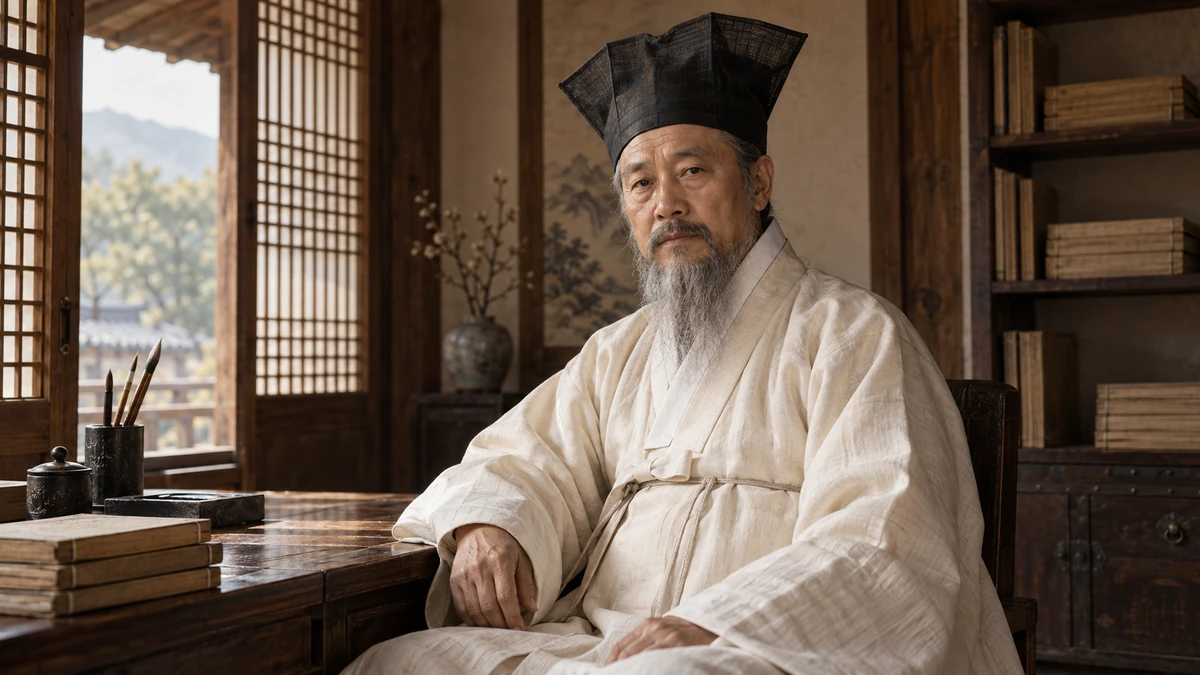
Hwang Hyeon (1855-1910), better known by his pen name Maecheon, was a scholar, poet and chronicler who lived through the final decades of Korea’s old dynastic order and the loss of Korean sovereignty to Japan. Born in Gwangyang in Korea’s southwestern Jeolla region, he spent much of his life in nearby Gurye.
Hwang traveled to Seoul as a young man to take the civil service examinations, the traditional route into government for educated men. He formed close ties with prominent writers including Gang Wi, Yi Geon-chang and Kim Taek-young. In an 1883 examination, Hwang initially placed first in the opening round but was reportedly moved to second because he came from the provinces. Disillusioned with corruption at court, he abandoned the remaining stages and returned home.
Turning away from official life
Hwang passed another preliminary examination in 1885 and, at his father’s urging, entered the higher saengwon examination in 1888, finishing first. But Korea was then struggling with political turmoil, growing Chinese intervention and severe corruption among conservative officials. Hwang again rejected a government career and settled in Gurye.
There, he built a private scholarly life around a library of roughly 3,000 books. He read widely, wrote poetry and prose, studied history and statecraft, and taught students. His writings also reflected his judgments about the political conflicts of the period. After explosives detonated at Unhyeongung Palace in 1892 and more explosives were discovered, Hwang concluded that Queen Min, later known as Empress Myeongseong, had been behind a plot targeting the family of Heungseon Daewongun.
Recording an era of upheaval
The crises intensified in 1894 with the Donghak Peasant Movement, the Gabo Reform and the First Sino-Japanese War. Believing he was witnessing events that future generations needed to understand, Hwang began systematically recording what he experienced or learned from others.
That work produced texts including Maecheon Yarok and Ohagi-mun. Maecheon Yarok, a chronological history of the period, is valued for preserving extensive material on the events surrounding Korea’s political upheaval. His other works include Maecheon-jip, Maecheon Sijip and Dongbi Giryak, reflecting his overlapping roles as poet, writer and historian.
A final protest against the loss of sovereignty
When Japan forced Korea into the 1905 treaty that stripped the country of diplomatic sovereignty, Hwang was outraged. He attempted to leave Korea and join Kim Taek-young, who was then in China, in efforts to restore national sovereignty, but the plan failed.
Japan formally annexed Korea in August 1910. Hwang responded by composing four final poems. On Sept. 7, 1910, 16 days after the annexation treaty was concluded, he died by suicide at his home in Gurye after ingesting a large amount of opium. His final poems were subsequently published in the Gyeongnam Ilbo newspaper, leading to what became known as the paper’s literary censorship incident.
A legacy built on testimony and resistance
Hwang is remembered in South Korea as a scholar, literary figure and patriot who documented a society undergoing profound political upheaval and ultimately chose death as a protest against the loss of national sovereignty. South Korea posthumously awarded him the Order of Merit for National Foundation, Independence Medal, in 1962.
Maecheonsa, a memorial shrine at the site of his former home in Gurye County, honors him with his portrait and memorial tablet, while a nearby exhibition hall preserves personal artifacts. His enduring historical significance rests on two intertwined legacies: the written record he left of Korea’s final years before annexation and his final act of resistance after sovereignty was lost.
Comments
Post a Comment