Image to help understand the article
A poet and official from Seogyeong
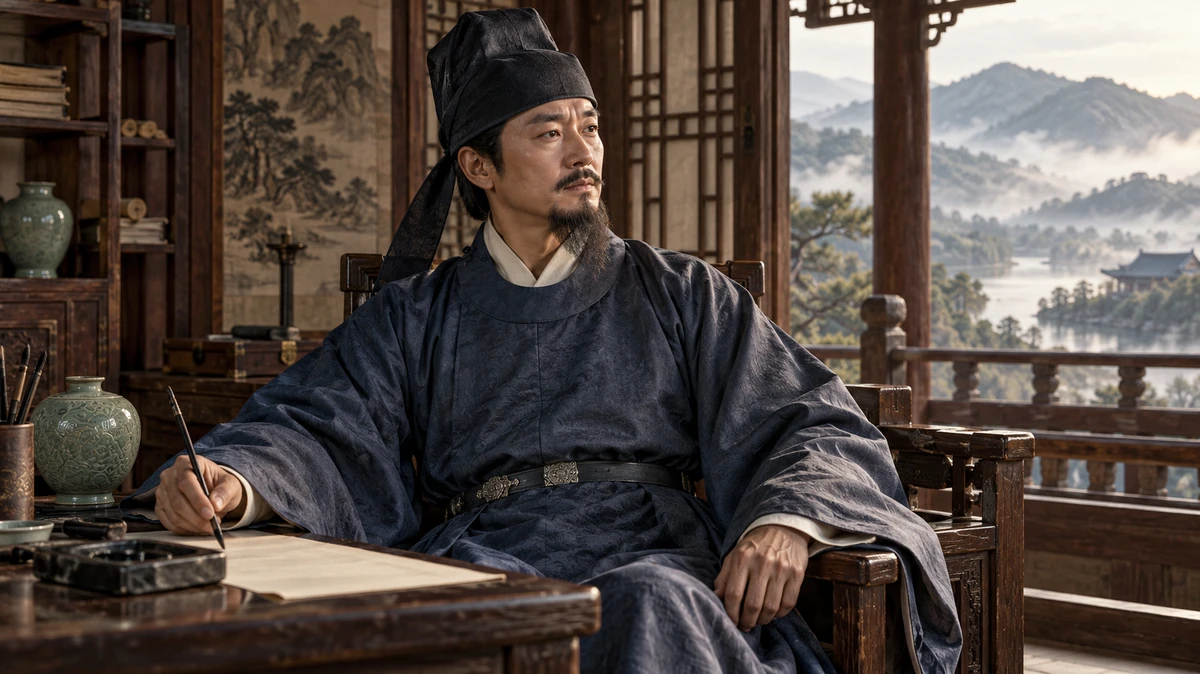
Jeong Ji-sang was a leading poet and government official during Korea’s Goryeo dynasty, serving under Kings Yejong and Injong in the early 12th century. Born in Seogyeong, a secondary capital of the kingdom, he became known for classical Chinese poetry that explored separation, political ambition and his attachment to his prosperous hometown.
His birth year is unknown. Records say he lost his father at an early age and was raised by his mother, a woman from the No family. He was remembered for his strong memory, elegant calligraphy and literary talent. One story, preserved in unofficial history, claims that at age 5 he saw a white heron over a river and compared it to a brush writing the Chinese character for “second” across the water.
Jeong later studied not only literature but also the Book of Changes, Buddhist scriptures and the philosophical traditions associated with Laozi and Zhuangzi. He was reportedly skilled in painting and calligraphy and particularly adept at an ornate form of parallel prose favored by educated officials.
A scholar in the royal court
After placing first in a civil service examination in 1112, Jeong passed a higher literary examination in 1114 and entered government. In 1127, while serving as a royal remonstrance official responsible for criticizing abuses of power, he impeached the influential military figure Cheok Jun-gyeong. Cheok was sent into exile.
Jeong also took part in scholarly discussions before the king. He lectured Injong on a chapter of the Book of Documents, submitted advice on the government’s successes and failures, and debated difficult passages from Confucian classics with other prominent officials. In 1130, acting on royal orders, he wrote a memorial text for the late poet Gwak Yeo.
A capital dispute ends in bloodshed
Jeong’s political fortunes became tied to a movement seeking to transfer the capital from Gaegyeong to Seogyeong. Along with the Buddhist monk Myo Cheong and the official Baek Su-han, he was counted among three influential advocates interested in divination and geomancy. The group also supported adopting an imperial title for the Goryeo ruler and launching a campaign against the Jin dynasty.
Their program brought them into conflict with a Gaegyeong-based faction led by the scholar and official Kim Bu-sik. When Myo Cheong and his supporters raised troops in Seogyeong in 1135, Jeong was identified as a major associate. He was executed on the 10th day of the first lunar month that year.
Historical accounts differ in emphasis. The Encyclopedia of Korean Culture describes Jeong as an active member of the Seogyeong faction who was killed in Gaegyeong after the movement was defeated by forces under Kim. The Goryeosa Jeolyo, an abridged history of the dynasty, says Kim summoned Jeong, Baek Su-han and Kim An before departing for Seogyeong, accused them of secretly cooperating with the rebels and had them killed. It also records a contemporary belief that literary rivalry and accumulated resentment between Kim and Jeong may have played a role.
A rivalry that became legend
Later literary collections transformed the conflict between Jeong and Kim into folklore. One account says Kim wanted to claim as his own a line Jeong had written at a temple: “When the sound of scripture recitation ends, the sky is clear as glass.” Jeong refused, and the story portrays that rejection as the source of Kim’s lasting grudge.
Another tale imagines Jeong returning as a ghost to criticize Kim’s poetry. After Kim wrote that willows were green in a thousand strands and peach blossoms red in ten thousand dots, the ghost supposedly slapped him and asked whether he had counted every strand and blossom. The story then claims Jeong’s ghost killed Kim in a latrine, though the official History of Goryeo contains no such account of Kim’s death.
Poetry of farewell and Seogyeong
Jeong is best remembered for “Sending Off a Friend,” a poem that adopts the voice of a lover facing separation. Images of farewell tears swelling a river year after year convey both grief and anxiety at the departure of someone the speaker does not want to lose.
Seogyeong occupies a central place in his surviving work. Jeong portrayed it as both an ancient political center and a thriving contemporary city. In “Western Capital,” he described busy streets, green windows and red gates, presenting a landscape of wealth and color. Yet references to elite residences and mournful singing also suggest a city shaped by the pleasures of Gaegyeong aristocrats, Jin envoys and powerful local families.
Other poems reveal his interest in escaping worldly ambition. He wrote of wandering through an otherworldly landscape while drunk, dreaming of southern lands in a flower garden, and imagining places associated with immortals. In poems about temples and monks, he expressed admiration for secluded figures untouched by the noise and illusions of ordinary life.
Taken together, his poetry moves between poverty and sorrow, confidence after official advancement, hopes for Seogyeong’s political rise and a desire to live peacefully in nature.
A reputation preserved in surviving poems
Jeong’s collected works, known as the Jeong Sagan Collection, survive only by title. About 20 poems and four paired verses remain through later anthologies and literary compilations. Writers and editors during both the Goryeo and Joseon dynasties continued to rank him among Goryeo’s representative poets despite the official label of traitor attached to his name.
Remembered as one of 12 major poets of the Goryeo period, Jeong left a divided legacy: a court official who challenged powerful figures and debated classical texts before the king, a supporter of the failed Seogyeong movement, and a poet whose depictions of farewell and his native city endured long after the political struggle that led to his death.
Comments
Post a Comment