Image to help understand the article
A Scholar Drawn to New Ideas
Jeong Yak-jeon, a Joseon-era scholar remembered for producing Korea’s earliest major work on fisheries and marine life, was born in 1758 in Majae, in what is now Gwangju, Gyeonggi Province. The son of a former local magistrate, he was the older brother of Jeong Yak-yong, one of Korea’s best-known practical learning scholars.
As a young man in Seoul, Jeong studied the work of the influential thinker Yi Ik and later learned from Gwon Cheol-sin, one of Yi’s intellectual successors. Through members of the Namin political faction who had begun exploring Western knowledge, Jeong encountered Western mathematics, astronomy and Catholicism — ideas then considered foreign and politically sensitive in Korea.
In 1779, he joined a scholarly gathering at Jueosa temple in Yeoju where participants discussed Catholic teachings. He later took part in Korea’s early Catholic community alongside his brothers and other scholars. The group’s activities were discovered by government authorities in 1785, though most participants, including Jeong, escaped punishment at the time.
Public Service and Persecution
Jeong passed an initial civil service examination in 1783 and a higher state examination in 1790, entering government service during the Joseon Dynasty. He held several official posts and in 1798 helped compile a court-commissioned reference work on notable figures from the southeastern Yeongnam region.
His career ended during the Catholic persecution of 1801, known in Korea as the Sinyu Persecution. Jeong and his brother Jeong Yak-yong were both exiled. Jeong was first sent to Sinji Island and later transferred to Heuksan Island after authorities uncovered a letter written by Hwang Sa-yeong, a Catholic and relative by marriage, concerning the persecution.
Jeong was never released. He died June 30, 1816, on Uido, an island in the Heuksan archipelago, after 16 years in exile.
Cataloging the Waters of Heuksan Island
Jeong continued teaching and writing despite his isolation. He established a village school called Bokseongjae for young island residents and produced several books, including works on philosophy, policy and travel. One account, “Pyohaesimal,” recorded the experiences of Moon Sun-deuk, a fish merchant who survived years of drifting at sea.
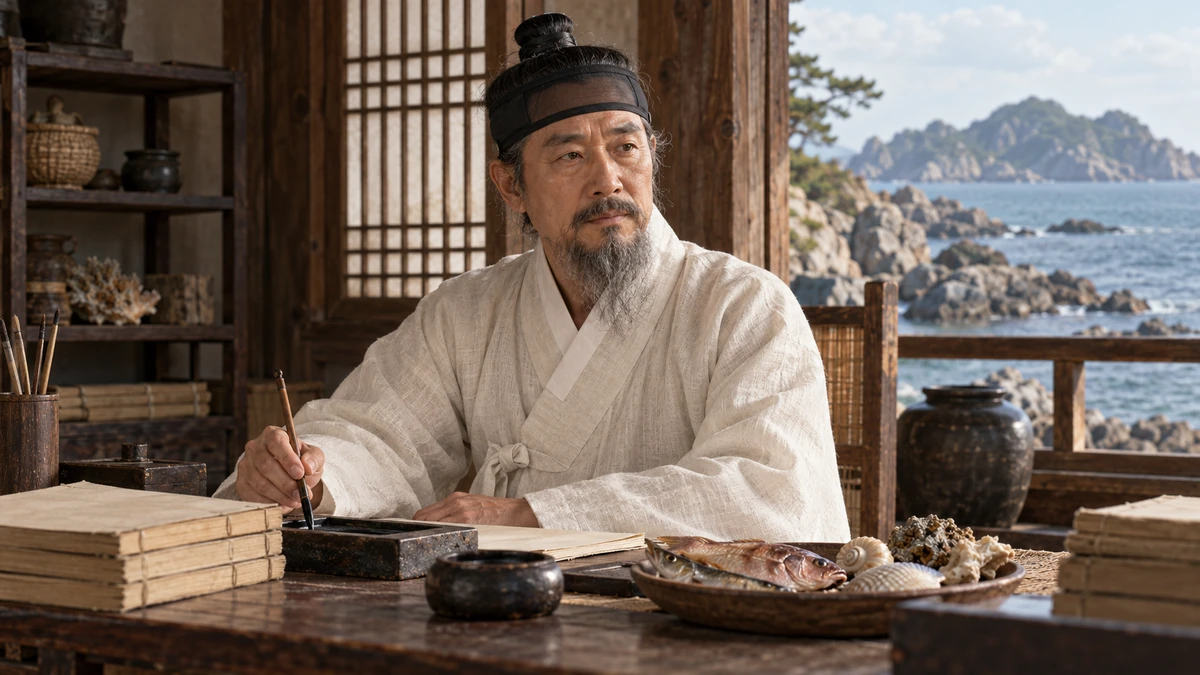
Jeong’s defining achievement was “Jasan Eobo,” a detailed survey of marine organisms found around Heuksan Island. Based on direct observation and collection, the book classified fish, shellfish, seabirds and other forms of sea life. It recorded their names and habitats as well as their appearance, behavior and practical uses.
The Encyclopedia of Korean Culture describes “Jasan Eobo” as Korea’s first fisheries science book. Its systematic field research demonstrated Jeong’s range as a government official, practical learning scholar, writer and naturalist. In another work, “Songjeong Saui,” he criticized the Joseon government’s policies governing pine trees.
A Legacy Beyond Scholarship
Jeong is remembered for closely documenting the ecology of the Heuksan seas while living under punishment far from the political and intellectual centers of the country. His life and writings have since inspired Korean popular culture, including the television drama “The Novel Mokminsimseo,” Kim Hoon’s novel “Heuksan” and the 2021 film “The Book of Fish.”
Comments
Post a Comment