Image to help understand the article
From War and Division to Art
Kim Tschang-Yeul, the Korean artist whose luminous, hyperrealistic water drops brought him international recognition, built his career across South Korea, the United States and France. Known widely as the “water drop painter,” Kim spent decades exploring the boundary between physical matter and illusion.
Kim was born Dec. 24, 1929, in Maengsan County in what is now North Korea. He first encountered visual art through his grandfather, an accomplished calligrapher, and later learned drawing from an uncle. Political turmoil after Korea’s liberation from Japanese colonial rule put him in danger while he was still a teenager. At 16, he fled south alone, leaving school and his family behind. He found his father in Seoul six months later and was reunited by chance with the rest of his family two years after that.
Kim entered Seoul National University’s art school in 1948, but the Korean War interrupted his studies in 1950. He was forced into a volunteer military recruitment unit, escaped while being transferred and hid in an abandoned house until Seoul was retaken. He later joined a police training program to avoid forced labor and continued painting while working as an officer. After the armistice, Seoul National University refused to let him return because of his earlier association with the studio of painter Lee Quede, whose political history had become controversial in divided Korea.
A Place in Korea’s Modern Art Movement
In 1957, Kim and 11 other artists formed a collective that became known as the Korean Contemporary Artists Association. Its first exhibition was held at the U.S. Information Service in Seoul. Later exhibitions helped establish a Korean version of Art Informel, the gestural European movement then influencing international contemporary art.
Kim kept up with developments abroad through Japanese art books while working as a librarian at the police academy. After leaving the police following his marriage, he taught school and continued making art. He represented Korea at the Paris Biennale in 1961, served as a commissioner selecting Korean participants for the 1963 edition and showed work at the São Paulo Biennial in 1965. On the recommendation of pioneering abstract painter Kim Whanki, he also represented Korea at an international gathering of young artists in London.
New York, Nam June Paik and Paris
A Rockefeller Foundation grant brought Kim to the United States in 1966 for a monthlong study program. He remained for four years, supporting himself with jobs that included work at a necktie factory while continuing to paint. From 1966 to 1968, he studied at the Art Students League of New York.
Kim left New York after fellow Korean artist Nam June Paik helped him participate in a Paris avant-garde festival in 1969. He settled near the French capital, joining the generation of Korean artists who developed careers abroad while maintaining ties to the rapidly changing art world in their homeland.
The Morning He Found the Water Drop
In Palaiseau, outside Paris, Kim took over a stable that a young German sculptor had used as a studio. There he met his wife, Martine Jillon, and devoted himself to his work. In 1972, a practical attempt to salvage a failed canvas gave him the subject that would define his career.
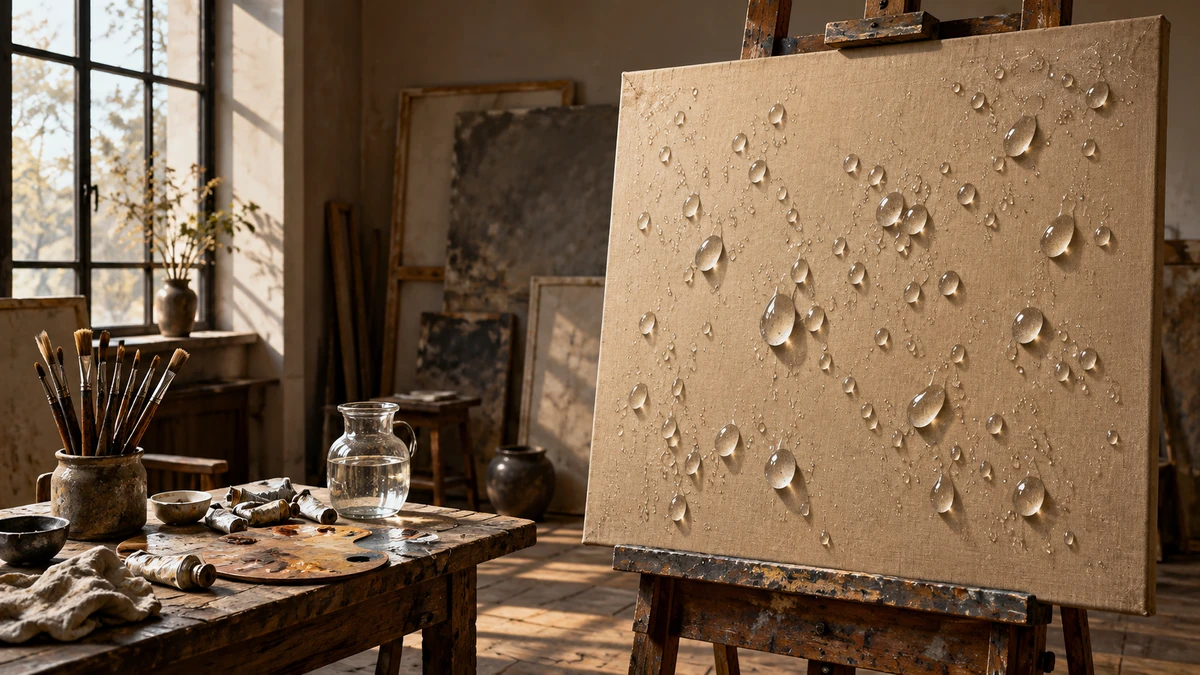
Kim recalled spraying water on the back of a canvas so he could remove and reuse the oil paint. By morning, droplets had formed and were shining in the sunlight. He described the sight as an overwhelming encounter with the fullness of existence.
An exhibition at a nearby antique furniture shop caught the attention of Alain Bosquet, a senior journalist at the Paris newspaper Combat, leading to further press coverage. That same year, Kim made a major debut at the prestigious Salon de Mai with “Event of Night,” a water drop painting. He subsequently exhibited works centered on water drops around the world. A 2004 exhibition at France’s Jeu de Paume museum surveyed three decades of the motif.
Between Reality and Illusion
Before the water drops, Kim described his work from 1965 to 1971 as “lyrical abstraction,” with influences from American Pop Art and minimalism. His “Rite” series arranged repeated forms in mechanical, abstract patterns. During the 1970s, works such as “Event of Night” and “Water Drops” placed one or more droplets across otherwise spare canvases.
In the 1980s, Kim painted jewel-like drops with extreme precision on coarse burlap. The contrast was deliberately impossible: Real water could not remain suspended on such a rough, absorbent surface. The painted drops therefore appeared convincingly physical while also revealing themselves as illusions.
Kim later introduced the “Thousand Character Classic,” a traditional text historically used to teach Chinese characters in Korea and elsewhere in East Asia. The repeated characters evoked Eastern philosophy and memories of practicing calligraphy beside his grandfather. In the “Recurrence” series of the 1990s, the drops became distorted, blurred or partially erased as characters of varying sizes spread across the background.
During the 2000s, Kim expanded his palette and experimented with new forms. “Bell” combined a sky-blue background with the classical text, while “Yellow Earth” used saturated yellow. In the 2004 installation “Meditation,” he suspended large, water-filled glass vessels shaped like droplets from the ceiling with metal cables.
A Global Legacy
Kim said the water drop emerged from his search for an artistic language distinct from the West after years abroad. He connected it to the Buddhist idea of emptiness and the Taoist concept of nothingness. Critic Lee Yil described the drops as trompe l’oeil images produced through invented light and shadow, while artist Lee Ufan said Kim created a new visual experience by layering matter and illusion.
Kim’s works entered collections across South Korea, France, the United States, Japan, Germany, Belgium and Canada. American institutions holding his art include the Albright-Knox Art Gallery, the Hirshhorn Museum and Sculpture Garden and the Detroit Institute of Arts. His works are also held by South Korea’s National Museum of Modern and Contemporary Art and Paris’ Pompidou Center.
The Kim Tschang-Yeul Art Museum opened in September 2016 on Jeju Island, where Kim had once served as a police officer. After returning to South Korea, he lived in Seoul’s Seongbuk-dong neighborhood. He died Jan. 5, 2021, at age 91. His remains were placed in a tree burial at the Jeju museum devoted to his life and work.
Comments
Post a Comment