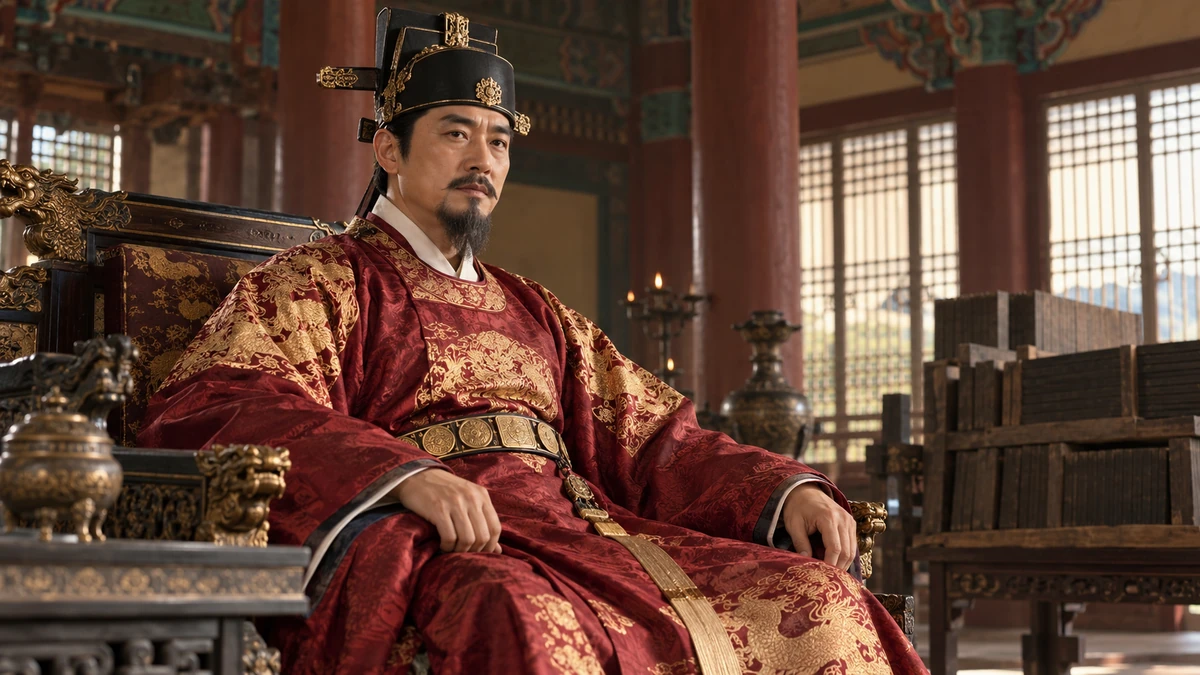
Image to help understand the article
A prince born into royal scandal
King Hyeonjong, the eighth ruler of Korea’s Goryeo dynasty, was born Wang Sun in 992. His father, Wang Uk, was a son of the dynasty’s founder, King Taejo. His mother, Queen Heonjeong, was Taejo’s granddaughter and a widow of King Gyeongjong.
Their relationship posed a grave problem for the royal court: Wang Uk was Queen Heonjeong’s uncle, and the two were not formally married. After the pregnancy became known, King Seongjong exiled Wang Uk to Sasu County, in what is now Sacheon. Queen Heonjeong died shortly after giving birth, leaving Wang Sun to be raised by a nurse.
One court account says the young boy once crawled onto Seongjong’s lap and called him “father.” The king reportedly wept and sent the child to live with Wang Uk. Wang Sun remained with his father until Wang Uk’s death in 996, then returned to the capital, Gaegyeong, the following year.
A monk marked for death
Wang Sun, who held the title Prince Daeryangwon, became caught in a succession struggle when he was about 12. Queen Dowager Cheonchu and Kim Chi-yang sought to place their own son on the throne and had the prince sent to Sunggyo Temple, where he became a Buddhist monk under the name Seonjae.
After repeated assassination attempts, he was transferred in 1006 to Sinhyeol Temple, associated with present-day Jingwansa in Seoul. The temple’s abbot, Master Jingwan, reportedly protected him by digging a hiding place beneath a bed.
In 1009, the military commander Gang Jo overthrew King Mokjong and placed Wang Sun on the throne as King Hyeonjong. Gang then controlled the government until late 1010.
Invasion, defeat and a desperate flight
The Khitan-led Liao dynasty used Gang Jo’s coup as justification to invade Goryeo. Hyeonjong entrusted Gang with an army said to number 300,000, but Goryeo’s forces were defeated and Gaegyeong fell. The king fled south under the protection of the officer Ji Chae-mun, reaching Naju before eventually returning to the capital.
Korean records portray the retreat as one of the most humiliating royal flights in the country’s history. A local official seized the king’s weapons in one county, while armed men fired arrows at him in another. Hyeonjong was separated from his pregnant queen near Gongju, and an official in Jeonju attempted to abduct him. With the central government effectively collapsing, regional commanders continued resisting the invaders.
The war also destabilized politics at court. Facing mounting costs and shortages in official salaries, the government confiscated land allotted to capital military officers in 1014. Generals who had distinguished themselves in battle responded by storming the palace, beating two civilian officials in front of the king and demanding that accomplished military officers be eligible for the same senior ranks as civil officials. Hyeonjong initially agreed.
The following year, however, the king invited leading officers to a banquet in the western capital on the pretext of honoring them. Once they were drunk, royal forces attacked and killed 19 generals. The purge strengthened civilian rule but also demonstrated the severity with which Hyeonjong consolidated power.
Victory at Gwiju
The Liao invaded again in 1018 after demanding that Hyeonjong appear at its court. Goryeo forces led by Gang Gam-chan inflicted a major defeat on the invading army at Gwiju, in a battle remembered as the Great Victory of Gwiju.
The triumph secured Goryeo after years in which Hyeonjong had twice been forced to flee before Khitan invasions. It also marked a dramatic reversal for a monarch whose childhood had been shaped by family tragedy, forced religious life and repeated threats of assassination.
Rebuilding the state
After the wars, Hyeonjong reorganized government institutions, recruited officials and curbed powerful regional families, strengthening both royal authority and centralized administration. He appointed figures connected to the former Silla kingdom, including men associated with his mother’s family, while seeking closer diplomacy with China’s Song dynasty as a counterweight to threats from the Liao and frontier groups.
His government standardized titles for leading local officials in 1022 and expanded Gaegyeong’s administrative divisions in 1024. It also strengthened the capital’s defenses. A roughly 14-mile outer wall was completed in 1029, while palace and imperial compounds were enlarged or constructed during his reign.
Hyeonjong promoted farming, sericulture and horse breeding, and introduced measures intended to distribute taxation more evenly and improve grain collection. He revived the Lotus Lantern Festival and Palgwanhoe, major state ceremonies rooted in Goryeo’s Buddhist traditions.
The king also promoted Confucian learning. He granted posthumous honors to the scholars Seol Chong and Choe Chi-won and established a precedent by enshrining them for rites at the Confucian temple.
Records destroyed during the wars with the Liao were ordered recompiled. Hyeonjong also advanced publication of the first Goryeo edition of the Buddhist canon and directed construction of Hyeonhwa Temple, a major center of doctrinal Buddhism. Together, those projects restored religious and historical foundations damaged by war.
A legacy of survival and restoration
Hyeonjong died in 1031 at age 40. He was buried at Seolleung in what is now Kaepung, and Hyeonjong became his temple name.
He is remembered for guiding Goryeo through invasion and helping rebuild its government, economy, records, religious institutions and capital. His reign also carried a harsher legacy: After conceding to military grievances, he eliminated 19 generals through deception and force. That episode underscored the violence behind his restoration of royal authority and civilian government.
Hyeonjong’s historical stature rests not only on Goryeo’s victory at Gwiju, but also on what followed. Having inherited a court fractured by scandal and a kingdom shaken by war, he worked to reconstruct the institutions that allowed the dynasty to endure.
Comments
Post a Comment