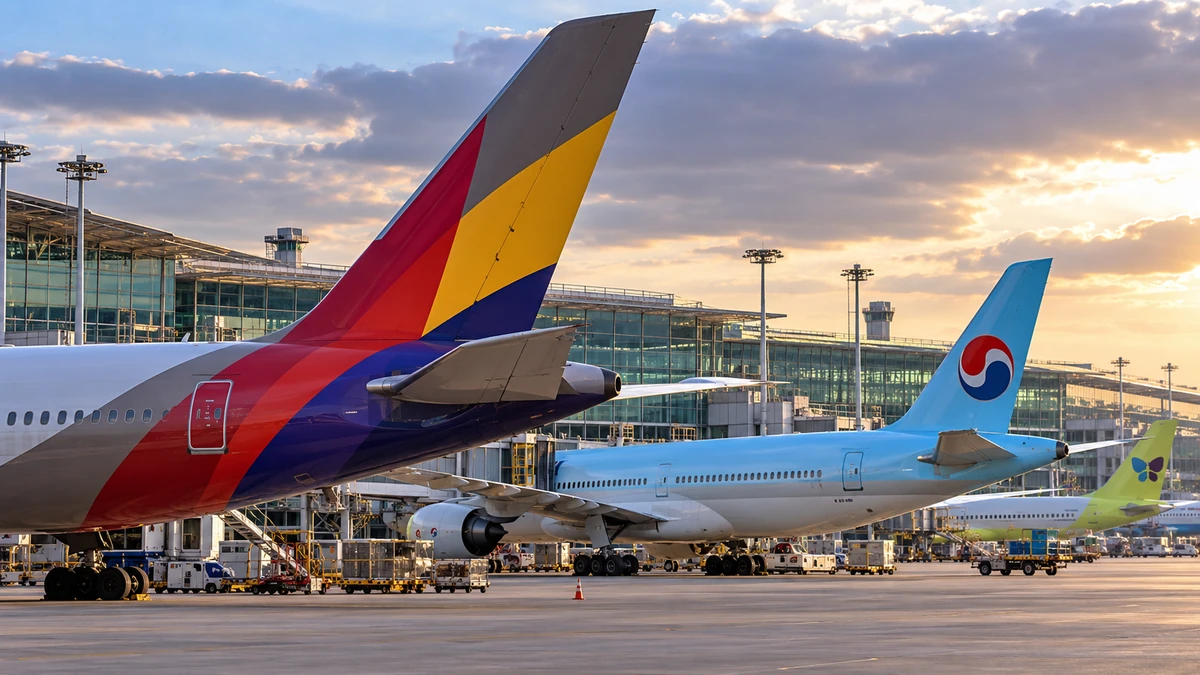
Image to help understand the article
Airlines top regulatory penalty list
Korean Air and Asiana Airlines have been assessed a combined 18.5786 billion won in enforcement charges after failing to comply with conditions imposed on their merger, according to regulatory data disclosed by a South Korean lawmaker.
The two carriers accounted for the three largest company penalties, including enforcement charges, listed by the Korea Fair Trade Commission for the period from 2023 through August 2026. The data was obtained by Rep. Park Hong-bae of the opposition Democratic Party, a member of the National Assembly’s National Policy Committee.
Asiana received the largest single charge: 12.1045 billion won on July 28, 2025. Korean Air ranked second with a 5.8856 billion won charge on Dec. 19, 2025, while another 588.5 million won charge against Asiana on the same day ranked third.
Fare caps and seat requirements
South Korea’s antitrust regulator gave final approval to Korean Air’s acquisition of Asiana in December 2024 but attached safeguards intended to limit consumer harm as competition declined. The airlines cannot raise fares above their 2019 averages adjusted for inflation, and they generally must maintain at least 90% of the seats offered on each route in 2019.
During the first quarter of 2025, the first period covered by the requirements, Asiana exceeded the permitted fare ceiling on four routes: Seoul’s Incheon International Airport to Barcelona, Frankfurt and Rome, and Gwangju to the South Korean resort island of Jeju.
Fares exceeded the allowed levels by between 1.3% and 28.2%, regulators found. Asiana collected about 680 million won in fares above the caps.
The airlines also fell short of the seat requirement on the Incheon-Frankfurt route. From Dec. 12, 2024, through March 28, 2025, Korean Air and Asiana offered only 69.5% of the seats available during the comparable 2019 period. That violation led to the enforcement charges imposed on both companies in December 2025.
Additional penalties remain possible
Korean Air, Asiana and Korean Air’s low-cost affiliate Jin Air are also facing regulatory proceedings over allegations that they reduced capacity on the Cheongju-Jeju route below 90% of 2019 levels between December 2024 and December 2025. The three carriers could face additional enforcement charges if the commission confirms the violation.
Five airlines have separately asked regulators to ease capacity requirements on routes to Guam, a U.S. territory and a popular overseas vacation destination for South Korean travelers. Korean Air, Asiana, Jin Air, Air Busan and Air Seoul want the minimum for the Incheon-Guam and Busan-Guam routes reduced from 90% to 70%, citing weaker demand.
A Fair Trade Commission examiner concluded that the circumstances were not serious or unavoidable enough to justify revising the merger conditions and submitted a recommendation that the request be rejected. The commission has yet to issue its final decision.
Park called the merger conditions a minimum safeguard against harm to consumers. He said Korean Air and Asiana must honor their commitments on fares and seat capacity while benefiting from the consolidation, and urged the commission to strengthen oversight rather than relying only on financial penalties for repeated violations.
Combined airline set for December launch
Asiana, South Korea’s second-largest private airline, was founded as Seoul Air in February 1988 and adopted its current name that August. Korean Air agreed in November 2020 to acquire Asiana for about 1.8 trillion won, and Asiana became a Korean Air subsidiary in 2024.
The carriers plan to complete their merger registration and launch a combined airline on Dec. 17, 2026. Interest has also grown around how Asiana’s remaining frequent-flier miles will be used ahead of the consolidation. Special flights to Japan and China allowing customers to redeem those miles are scheduled for November.
Hanjin Group Chairman Cho Won-tae, who has led the integration, received the Center for Asia Pacific Aviation’s 2026 Asia Airline Executive of the Year award at an industry summit held Oct. 1-2 at New Chitose Airport in Sapporo, Japan. Korean Air announced the honor on Oct. 2.
The judging panel cited Cho’s management during the COVID-19 pandemic and the acquisition and integration of Asiana. After passenger demand collapsed during the pandemic, Korean Air converted passenger aircraft for cargo operations and expanded its freight business.
Cho, who became chairman in 2019, presented the airline’s integration strategy to about 300 aviation executives and international journalists after the ceremony. He also discussed expected route and service changes following the combined carrier’s launch. Cho serves on the International Air Transport Association’s board of governors and previously chaired the board of the SkyTeam airline alliance.
Comments
Post a Comment