Image to help understand the article
Calories and sodium vary by database entry
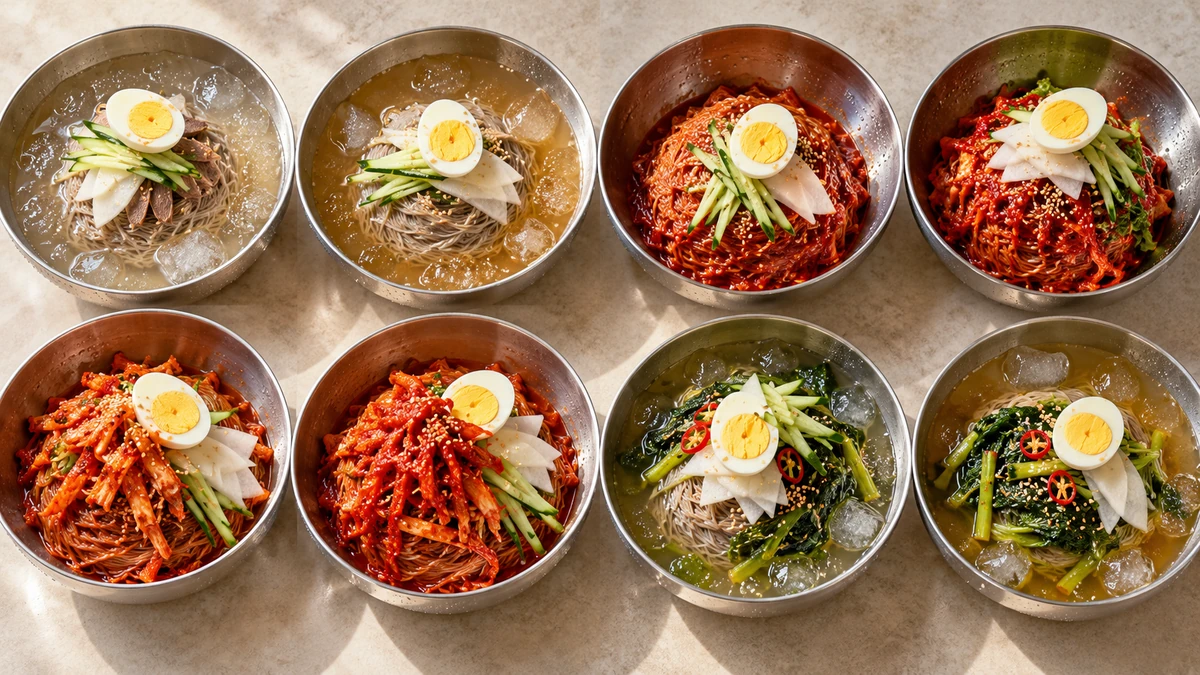
Naengmyeon, a Korean cold noodle dish commonly served in broth or with a spicy sauce, can vary substantially in its nutritional profile, according to South Korea’s Ministry of Food and Drug Safety. A comparison of eight entries in the agency’s Food Nutrition Database found that even dishes in the same broad category — including mul-naengmyeon, or noodles in chilled broth, and bibim-naengmyeon, noodles mixed with a spicy sauce — had different values depending on the specific listing. All figures were calculated per 100 grams.
The lowest-calorie entry was a mul-naengmyeon listing at 55 calories, followed by young-radish naengmyeon at 66 calories. Other entries ranged from 80 to 100 calories, while a hoe-naengmyeon listing made with skate, a type of fish, was highest at 148 calories.
Sodium levels ranged from 99 milligrams in the skate hoe-naengmyeon entry to 426 milligrams in a mul-naengmyeon listing with young radish. Another young-radish variety contained 394 milligrams. The remaining entries ranged from 152 to 294 milligrams.
Fish-topped varieties lead in protein
The skate hoe-naengmyeon entry had the most protein at 5.81 grams per 100 grams, narrowly ahead of a bibim-naengmyeon listing at 5.67 grams. The other varieties contained between 1.96 and 4.7 grams, with the 55-calorie mul-naengmyeon entry also recording the lowest protein level.
The database results underscore the importance of checking the exact food entry rather than relying only on a general dish name. Recipes and listed products within the same naengmyeon category can differ in calories, sodium, protein and other nutrients.
Comments
Post a Comment