Image to help understand the article
Jjajangmyeon, a popular Korean comfort food of noodles served with a thick black bean sauce, can vary sharply in calories and nutrients depending on the product, according to South Korea’s Ministry of Food and Drug Safety.
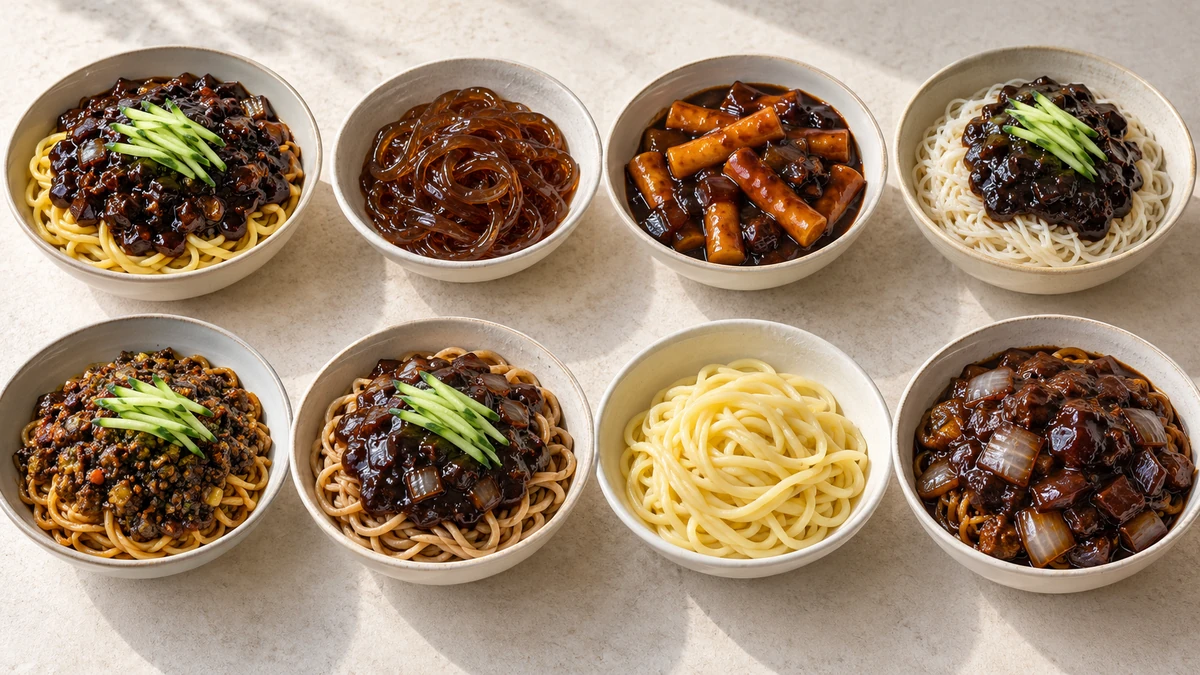
The ministry’s food nutrition database compares eight jjajangmyeon-related items using a standard serving of 100 grams. The entries range from prepared noodle dishes and plain noodles to a tteokbokki product and a cola-flavored gummy candy shaped like jjajangmyeon, so the figures are best understood as product-by-product comparisons rather than equivalents.
Calories and carbohydrates
The soy milk noodle jjajangmyeon had the fewest calories at 86 per 100 grams. It was followed by the cola-flavored gummy candy at 120 calories, Baeknyeon old-fashioned jjajangmyeon at 139 and standard jjajangmyeon at 153.
Plant-based uni jjajangmyeon contained 185 calories, the whole-wheat product 197 and plain jjajangmyeon noodles 278. Night market-style jjajangmyeon tteokbokki — a variation involving Korea’s chewy rice cakes — ranked highest at 373 calories.
Carbohydrates ranged from 14.1 grams in the soy milk noodle product to 67.03 grams in the tteokbokki. Standard jjajangmyeon contained 29.14 grams, while the gummy candy had 30 grams and the plain noodles had 60 grams.
Sodium, protein and sugar
Among products with reported sodium figures, the gummy candy listed none. The whole-wheat jjajangmyeon had 265 milligrams, the plant-based product 319 milligrams, standard jjajangmyeon 411 milligrams and the soy milk noodle version 413 milligrams. Baeknyeon old-fashioned jjajangmyeon contained 772 milligrams, while the plain noodle product had the highest reported amount at 834 milligrams. No sodium figure was provided for the tteokbokki, so it could not be included in that ranking.
The tteokbokki led in protein with 13.2 grams per 100 grams, followed by the plain noodles with 8 grams. Standard jjajangmyeon had 5.3 grams, while the gummy candy had none.
The candy contained the most sugar at 26 grams. The tteokbokki followed at 17.15 grams, while the remaining products ranged from 1.6 grams in the plain noodles to 6.46 grams in Baeknyeon old-fashioned jjajangmyeon.
The figures come from entries in the ministry’s Food Nutrition Database covering survey years from 2022 through 2026. Because every figure is standardized to 100 grams, actual intake will depend on the amount consumed.
Comments
Post a Comment