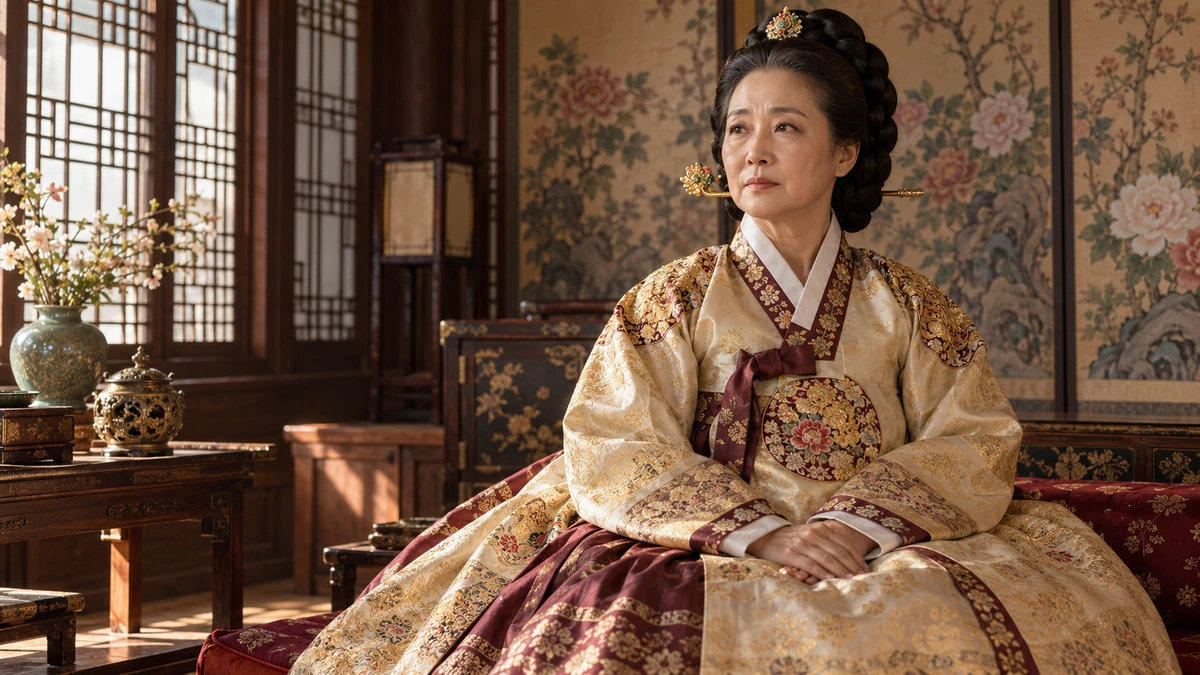
Image to help understand the article
A princess caught in a royal tragedy
Lady Hyegyeong is remembered as one of the most important firsthand witnesses to the private turmoil of Korea’s Joseon Dynasty. The wife of Crown Prince Sado and mother of King Jeongjo, she recorded her husband’s notorious death and roughly six decades of palace life in an autobiographical collection known as the “Memoirs of Lady Hyegyeong,” or “Hanjungnok.”
Born Hong in 1735 in Hanseong, the city now known as Seoul, she was the second daughter of Hong Bong-han and Lady Lee. Her family had distinguished royal connections, but Hyegyeong later wrote that it was not wealthy enough to provide generous wedding goods for either her older sister or herself.
She was selected as Crown Prince Sado’s bride in 1743 and formally became crown princess the following year, at age 10 under the Korean age reckoning used at the time. The royal wedding brought distant relatives to the family home, some reportedly asking the young bride to remember their names now that she was entering the palace.
At the special direction of King Yeongjo, her father taught her Confucian texts intended to shape the education and conduct of elite children and women. She and Sado had two sons. Their first, Crown Prince Uiso, died young. Their second, Yi San, would become King Jeongjo, the 22nd monarch of Joseon.
The death of Crown Prince Sado
The defining catastrophe of Hyegyeong’s life came in 1762. After Na Gyeong-eon submitted accusations describing 10 acts of misconduct by Sado, King Yeongjo personally questioned the accuser and moved against his son. The king stripped Sado of his royal status and ordered him confined inside a wooden rice chest.
Sado remained trapped for eight days during intense summer heat and died of starvation on July 12. Yeongjo posthumously gave his son the name Sado and granted his daughter-in-law the title Hyebin. She subsequently lived outside the palace.
The episode has long been examined not only as a family tragedy but also as part of the factional struggles surrounding the royal court. One interpretation holds that Sado’s troubles became a weapon in a broader conflict between the political network associated with Hyegyeong’s father and opponents of Yeongjo’s policy of balancing rival factions. Numerous petitions from the period accused Hong Bong-han of concealing the crown prince’s misconduct.
Accounts also say Hong tried to contain the scandal, including through bribes, before Na’s accusations made that impossible. According to another story, Yeongjo decided that preserving the monarchy required sacrificing his son while protecting his grandson, the future King Jeongjo, and compelled Hong to accept that course.
Protecting the future king
Hyegyeong feared that her surviving son might follow his father toward ruin. In 1769, when the young Yi San was discovered visiting entertainment houses with companions, she asked her father to intervene. After he initially refused, she began a hunger strike. Hong eventually acted, arranging for the women involved to be sent into exile and for the prince to be informed afterward.
The incident does not appear in the official dynastic annals and is known through Hyegyeong’s memoirs, illustrating both the work’s historical value and the difficulty of assessing a deeply personal account.
Meanwhile, Hong Bong-han faced sustained attacks from court rivals and withdrew from active politics around 1770. His relationship with his half brother Hong In-han was also strained. Jeongjo later said Hong In-han had betrayed his older brother.
The political danger intensified when Yeongjo sought to allow Yi San to govern as regent in 1775. Hong In-han strongly opposed the move, earning the future king’s lasting hostility. After Yi San took the throne, Hong In-han was ordered to take his own life.
Mother of King Jeongjo
Yeongjo died in 1776 at age 83, and Yi San became King Jeongjo at 25. The new king bestowed a higher posthumous title on his father and gave his mother the palace title by which she is best known, Hyegyeonggung, commonly rendered in English as Lady Hyegyeong.
Her position remained complicated. To make his succession politically and ritually acceptable, Jeongjo had been formally adopted into the line of another prince rather than recognized as succeeding directly through Sado. Hyegyeong therefore retained the official status of a crown princess rather than becoming queen dowager. Still, Jeongjo referred to her as his birth mother and treated her in practice with honors comparable to those of a queen dowager.
Although she was the oldest senior woman in the royal household, she ranked below Queen Dowager Jeongsun, who was 10 years younger. Hyegyeong received a series of additional honorific titles during Jeongjo’s reign, including one marking her 60th birthday in 1795.
A memoir shaped by memory and politics
The “Memoirs of Lady Hyegyeong” was not written as a single book. It consists of texts composed over more than a decade for different audiences and purposes, then assembled by a later editor. Together, they offer unusually detailed descriptions of Sado’s death, palace personalities, private conversations and royal family conflicts that cannot be found in official histories.
Hyegyeong wrote another recollection for her 60th birthday. After Jeongjo’s death in 1800, political enemies targeted her birth family: Her younger brother was ordered to die, and her father was again accused of treason. She responded by defending her relatives point by point, citing statements made by Jeongjo and what she presented as established historical facts. Her anger toward the factions she blamed is evident in the writing.
After Jeongjo died and her grandson Sunjo became king, Hyegyeong altered the Chinese characters used for the memoir’s title. Though both versions are pronounced “Hanjungnok,” the change shifted its meaning from a record written in leisure to a record written in sorrow or resentment.
The memoirs’ intimacy makes them indispensable to understanding the royal family, but it also raises questions about motive and reliability. Beginning in 1910, some Korean historians questioned whether Hyegyeong wrote primarily to justify her own conduct and defend her birth family. The work is therefore read both as a rare woman’s account of palace life and as an argument produced amid a bitter political struggle.
Posthumous elevation and cultural memory
Hyegyeong suffered from a chronic illness beginning in 1805 and spent extended periods confined to bed. She died at Changgyeong Palace on Jan. 1, 1816, at age 81 according to the traditional reckoning cited in Korean records. She received the posthumous title Heongyeongbin, with characters honoring intelligence, foresight and vigilance.
She had continued pressing for the restoration of her family’s reputation during the reign of her grandson. Her birth family was formally cleared and rehabilitated in 1814. She also sought punishment for men who had denounced her father near the end of his life; one of them was eventually executed.
Her rank rose further long after her death. In 1899, Emperor Gojong approved a petition elevating Sado, then known posthumously as Crown Prince Jangheon, to the status of king. Hyegyeong was consequently honored as Queen Heongyeong. When her husband was subsequently elevated to emperor as Emperor Jangjo, she became Empress Heongyeong.
She is buried with Jangjo at Yungneung in Hwaseong, south of Seoul. Nearby is Geolleung, the tomb of their son Jeongjo and his wife, Queen Hyoui.
Lady Hyegyeong’s life has remained prominent in Korean popular culture, where the doomed Prince Sado and the reign of Jeongjo have repeatedly inspired novels, television dramas and movies. She was portrayed by Kyeon Mi-ri in the 2007 MBC drama “Yi San,” Moon Geun-young in the 2015 film “The Throne” and Kang Mal-geum in the 2021 MBC series “The Red Sleeve.” Her enduring legacy, however, rests on her own words: a personal record of royal violence, political survival and the struggle to shape how history would remember her family.
Comments
Post a Comment