Image to help understand the article
Strains emerge within South Korea’s governing camp
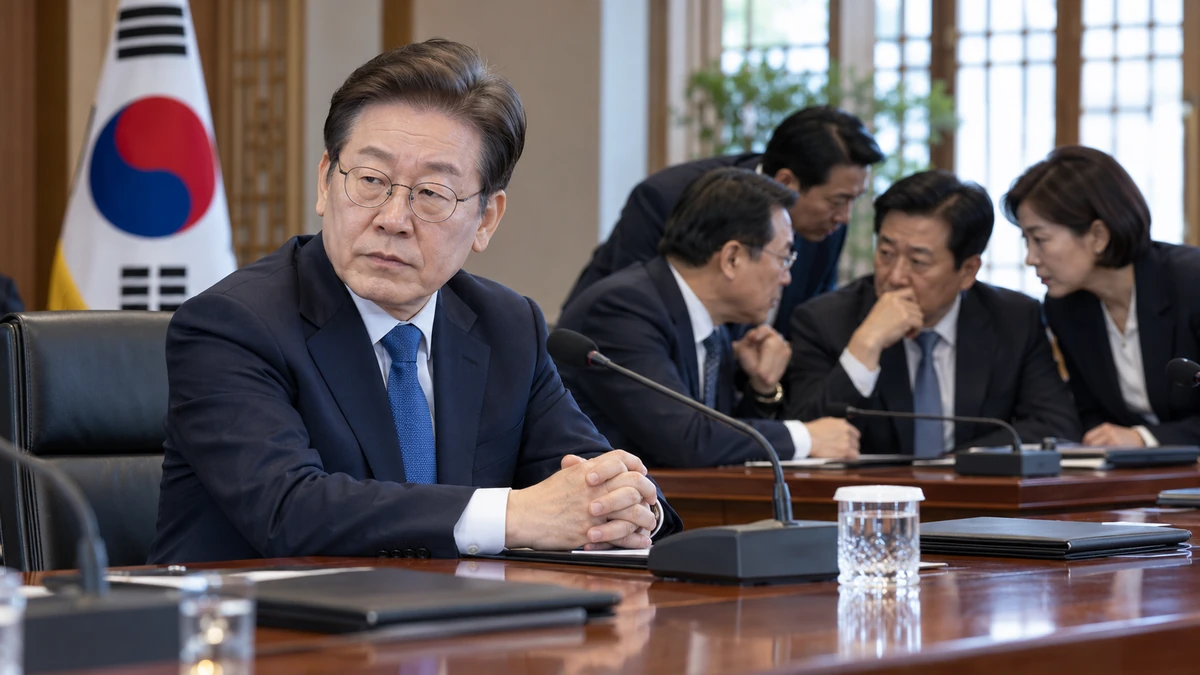
South Korean President Lee Jae Myung is facing growing questions about his political influence as divisions within the governing bloc coincide with a decline in his approval ratings.
A Democratic Party official said Oct. 13 that public opinion toward both Lee and the party had become unfavorable, while disputes among supporters were weakening party unity. The official also suggested that the party was struggling to match the pace of Lee’s increasingly frequent efforts to shape public opinion through social media.
Some party observers say lawmakers closely aligned with Lee, once quick to defend him during political disputes, have responded less forcefully in recent controversies. The change has fueled discussion of an unusually early lame-duck period — a loss of practical influence despite a president retaining the formal powers of office.
Prosecutorial overhaul exposes internal rifts
The tensions have centered partly on an overhaul of South Korea’s prosecution system, a politically charged institution that has long played a prominent role in investigations of public officials and major crimes.
Gov. Choo Mi-ae of Gyeonggi province, Democratic Party lawmaker Kim Yong-min and Rebuilding Korea Party lawmaker Park Eun-jung pushed to eliminate prosecutors’ authority to conduct supplementary investigations. Justice Minister Jeong Sung-ho, a longtime Lee ally, resisted that position but failed to overcome pressure from the party’s more hard-line faction. The authority was ultimately abolished.
A separate dispute followed Lee’s nomination of Kim Ji-yong to lead the Serious Crimes Investigation Agency. Internal opposition to the choice added to concerns that Lee’s ability to hold together his political coalition may be weakening.
Opposition seizes on ‘lame duck’ narrative
Rep. Im Lee-ja, policy chief of the conservative People Power Party, described the administration’s first 500 days as a period of arrogance, incompetence and disorder during a parliamentary meeting Oct. 13. She argued that Lee had accelerated the erosion of his own authority and cited rising Seoul apartment prices, turmoil in the rental market and a nationwide farmland survey as examples of policy failure.
The lame-duck claim has also spread through online videos. One video posted Oct. 12 arguing that Lee was politically isolated had recorded 213,749 views by the following day. Another video released Oct. 7 and describing his condition as an unmistakable lame duck had 191,057 views.
Other clips have explained the term and contrasted a “lame duck” with a “dead duck,” while searches related to the phrase, its origin and its connection to approval ratings have gained visibility. Familiar to American political audiences as a description of an officeholder whose influence is fading, “lame duck” originated as 18th-century British financial slang for a trader unable to pay debts before entering U.S. political usage in the 19th century.
Comments
Post a Comment