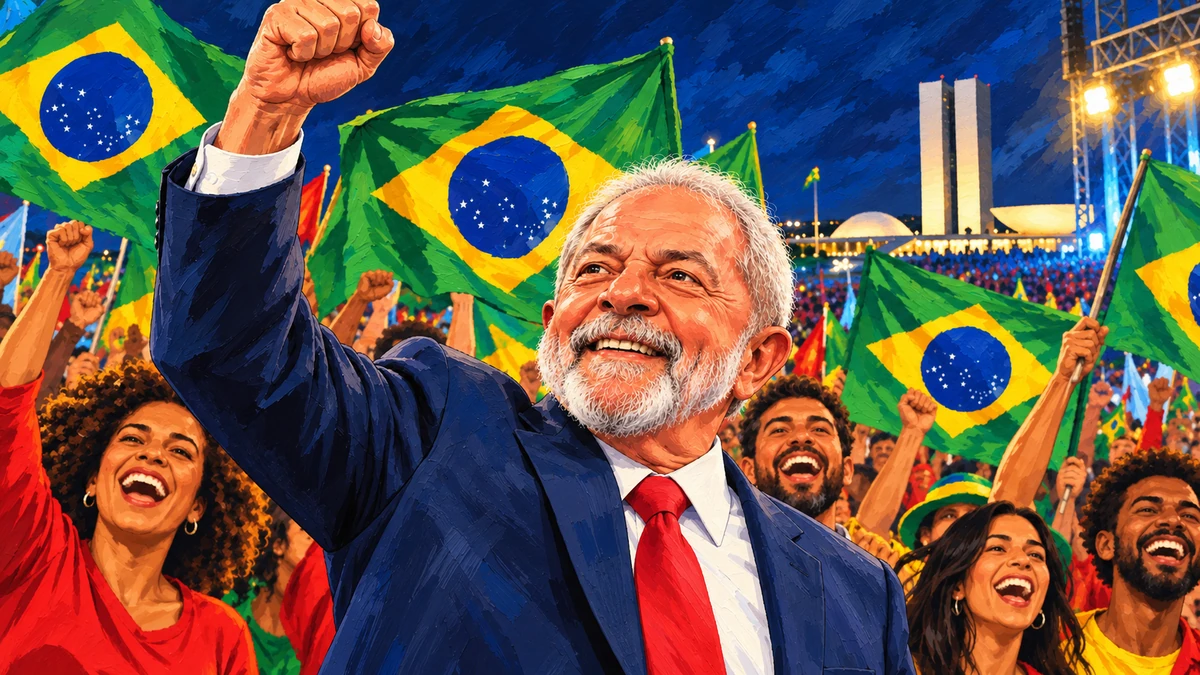
Image to help understand the article
Lula Secures Comeback Victory
Brazilian President Luiz Inácio Lula da Silva won a fourth term after defeating Sen. Flávio Bolsonaro in a closely fought presidential runoff held on the 25th.
With all ballots counted, Lula received 51.79% of the vote to Bolsonaro’s 48.21%, a margin of about 4.4 million votes. The victory marked a dramatic reversal from the first round, when Bolsonaro led with 47.03% to Lula’s 45.16%. Lula gained about 10.3 million additional votes in the runoff, while Bolsonaro added about 3.7 million.
The result was unprecedented in Brazil’s modern democratic era. Since the country adopted its runoff system in 1988, no candidate who finished second in the first round had gone on to win the presidency. Lula, 81, also became the first Brazilian president elected to four terms.
From Factory Worker to Four-Time President
Born into rural poverty and later employed as a factory worker, Lula entered politics after becoming a prominent labor leader in the industrial outskirts of São Paulo in the late 1970s. He lost presidential elections in 1989, 1994 and 1998 before becoming Brazil’s first president from a working-class background in 2002.
After serving the maximum two consecutive terms allowed under the Constitution, Lula returned to power in 2022 by defeating then-President Jair Bolsonaro. His latest victory came on his seventh run for the presidency.
Cost of Living and Public Safety Dominate Campaign
Voters focused heavily on rising living costs, public safety, crime and allegations of corruption. Lula sought to unite the left while appealing to centrists and voters opposed to another member of the Bolsonaro family taking power.
He also relied on his longstanding support among lower-income Brazilians, promising to reduce poverty and expand social programs. His proposals included cutting the standard workweek from 44 hours to 40, making public transportation free nationwide on weekends and increasing existing welfare benefits by 15%. International news organizations, including The Guardian, said pledges such as debt relief for small-business owners and free weekend transit helped mobilize his political base.
Latin American Leaders Welcome Result
Leaders across Latin America congratulated Lula, with messages coming from both ideological allies and more conservative governments. Mexican President Claudia Sheinbaum wrote on X, formerly Twitter, that democracy and the Brazilian people had prevailed. Cuban President Miguel Díaz-Canel called Lula a “brother” and described the outcome as a historic victory.
Uruguayan President Yamandú Orsi said he spoke by phone with Lula and congratulated him on both the result and what he called a celebration of democracy. The presidents of Paraguay, Bolivia and Panama also praised the election and pledged continued cooperation with Brazil.
In South Korea, political parties on the left also welcomed Lula’s victory. Park Sung-joon, chief spokesperson for the Democratic Party, said Brazilian voters had renewed their trust in a leader who remained committed to workers and ordinary people. He highlighted Lula’s relationship with South Korean President Lee Jae Myung, noting that both worked in factories as boys and had discussed their similar backgrounds during a summit in Brasília in July. The Rebuilding Korea Party also issued a congratulatory statement.
Bolsonaro Challenges Extended Voting
Voting was originally scheduled to end at 5 p.m., but Supreme Court Justice Cristiano Zanin ordered polling places nationwide to remain open until 7 p.m. Lula’s campaign had argued that transportation disruptions, severe weather and insufficient public transit in major cities prevented some voters from reaching polling stations. Bolsonaro’s campaign had separately requested extended voting in three states, including São Paulo, because of heavy rain.
After losing, Bolsonaro condemned the nationwide extension and said he would seek to have the election annulled. He did not mention that his own campaign had requested additional voting time in some areas. His legal challenge could delay final resolution of the election and deepen political tensions.
Bolsonaro had hoped to join his father, former President Jair Bolsonaro, as Brazil’s first father-and-son presidential pair. The former president is serving a 27-year prison sentence after being convicted of plotting a coup while contesting his 2022 defeat by Lula.
Result Checks Latin America’s Rightward Shift
Lula’s victory interrupted a string of gains by right-wing movements across Latin America, including in Chile, Argentina, Peru and Colombia. Brazil is South America’s largest country by population and economic output, making the result particularly significant for the region’s political direction.
In his victory speech, Lula declared that Brazil was “no one’s backyard,” signaling potential friction with the United States. Flávio Bolsonaro’s close relationship with President Donald Trump had also drawn attention during the campaign.
Lula said he would govern for all 215 million Brazilians and that the campaign’s rivalries were over. His next term is expected to focus on stronger gun controls, protection of the Amazon rainforest, continued minimum-wage increases and a foreign policy balancing ties across the Global South. He will also face pressure to pay for expanded welfare programs while easing inflation, living costs and concerns about crime.
Comments
Post a Comment