Image to help understand the article
From a village in Jeolla to the monastic life
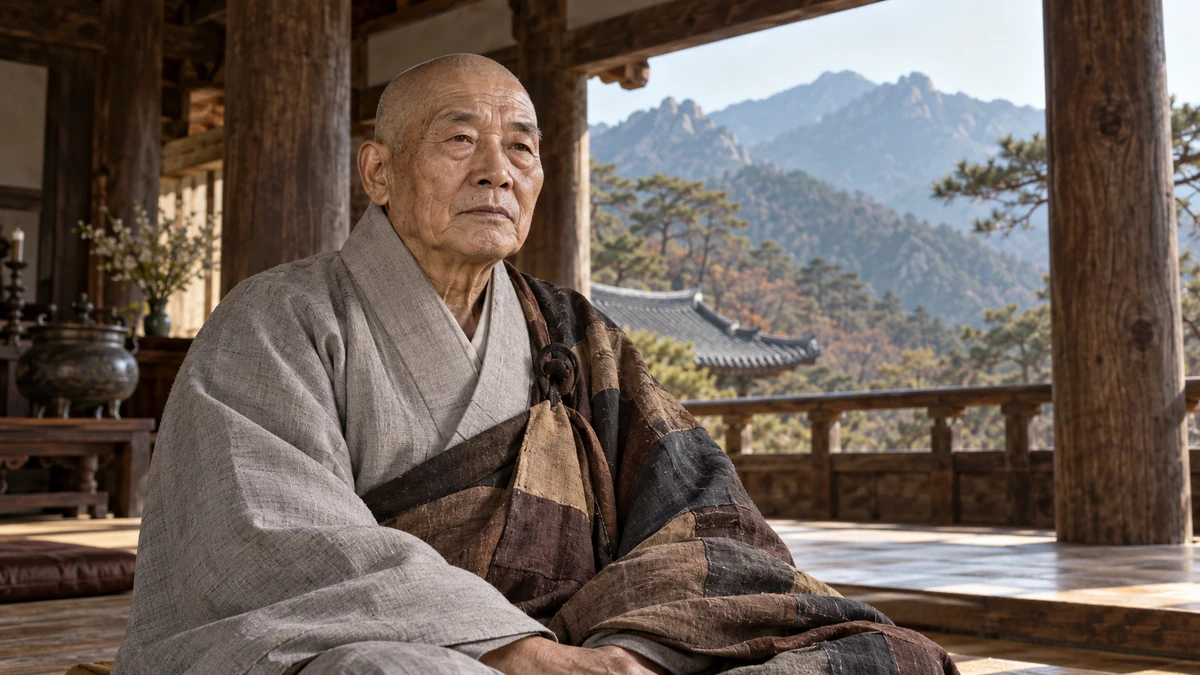
Mangong was a Buddhist monk, independence activist and influential Zen teacher who helped shape modern Korean Buddhism during the final decades of the Joseon Dynasty and Japan’s colonial rule of Korea. Regarded within his tradition as the 76th patriarch after Shakyamuni Buddha, he spread a rigorous form of meditation while resisting colonial policies intended to reshape Korean Buddhist institutions.
He was born Song Do-am on the seventh day of the third lunar month in 1871 in Taein, an area now within Jeongeup in North Jeolla province. His Buddhist name was Wolmyeon, while Mangong was his honorific Dharma title; he is consequently also known as Song Mangong and the Venerable Wolmyeon.
In 1883, after being moved by the sight of a Buddhist statue at Geumsan Temple in Gimje, he decided to leave secular life. He first served as a novice attendant under the monk Jinam at Donghak Temple in Gongju. The following year, under the guidance of the prominent Zen master Gyeongheo, he formally entered the clergy at Cheonjang Temple in Seosan, taking Taeheo as his sponsoring teacher and receiving the novice precepts from Gyeongheo.
A practice centered on the hwadu
Mangong devoted himself to Ganhwa Seon, the Korean form of Zen meditation centered on sustained inquiry into a hwadu — a critical phrase or question intended to break through ordinary, analytical thinking. His own question asked: If all things return to one, where does that one return?
Tradition holds that he experienced a profound awakening at Bonggok Temple in Asan in 1895 after hearing a temple bell at dawn. In 1904, Gyeongheo formally recognized him as a Dharma successor. Mangong later established Geumseondae on Mount Deoksung in Yesan, where he trained a new generation of monks and nuns.
His teaching rejected abstract speculation in favor of direct inquiry undertaken with a mind free of fixed thoughts and attachments. He encouraged students to concentrate on the famous question associated with the Chinese Zen master Zhaozhou: whether a dog has Buddha nature, traditionally answered with the character “mu,” meaning “no” or “not.” Mangong viewed meditation as the essential practice for attaining freedom and compassion.
His methods could be unconventional. He used silence, shouts, blows with a staff, circles and exchanges that disregarded formal logic. He referred to ultimate reality through terms including mind, original nature, Buddha nature, emptiness, the true master and the original face. For Mangong, a person’s genuine nature was no different from the fundamental nature of the universe, and Buddhism’s central task was awakening to one’s own mind.
He taught that practitioners who cast off habits of discrimination and conceptual division could act freely with wisdom and compassion. He also emphasized the need for a qualified teacher, a suitable place to practice and trustworthy companions, placing particular importance on finding a good teacher.
Mangong’s reputation extended beyond monasteries. Women serving in Korea’s royal palace once visited to hear him teach. He responded with a cryptic folk-style verse about a woodpecker making a hole where none existed while a man at home could not find one already there. When his disciples asked for an explanation, Mangong told them the song itself was the teaching.
Rebuilding Korean Zen institutions
Mangong restored or expanded several Buddhist sites, including Sudeok Temple, Jeonghye Temple and Gyeonseong Hermitage on Mount Deoksung, as well as Ganwol Hermitage on Anmyeon Island. The reconstruction of Ganwol Hermitage took place in 1914.
In the early 1920s, he participated in the movement to establish Seonhakwon, an institution created to support Korean Zen practice. He also joined the Seonu Mutual Aid Association, through which Zen monks sought collective economic independence.
In his 1927 work “Hyeonyang Maegu,” Mangong identified himself as the 32nd-generation monk in the Linji tradition, known in Korea as Imje, and declared himself an heir to its style of Zen. When the Joseon Buddhist Seon Research Foundation was established in 1934, he joined its board and later became chairman, with the monk Hanam serving as vice chairman.
Numerous monks studied under Mangong, including Bowol, Jeongang, Yongeum, Gobong, Hyecheon, Geumbong, Hyeam, Chunseong, Geumo, Byeokcho, Seogyeong and Wondam. His female disciples included Beophui, Manseong and Ilyeop. Ilyeop entered his community after resolving to become a nun following a failed relationship, while Mangong declined a similar request from the pioneering artist and writer Na Hye-sok. Chunseong, previously a disciple of the poet and independence activist Han Yong-un, came to Mangong after Han’s death.
Mangong first transmitted the Dharma to his senior disciple Bowol, who died at age 40 in December 1924. In February 1925, Mangong conducted a formal transmission ceremony for Geumo at Jeonghye Temple. In 1929, after recognizing Hyeonmun’s awakening, he gave him the new Dharma name Hyeam and designated him an heir. The lineage is recorded as passing from Gyeongheo, the 75th patriarch, to Mangong, Hyeam and then Myobong.
Resistance to colonial Buddhist policy
Japan formally annexed Korea in 1910 and governed the peninsula until 1945. During that period, the colonial Government-General imposed policies on Korean Buddhist institutions and encouraged their assimilation into Japanese Buddhist practices. Mangong opposed those efforts directly.
In 1937, while serving as head monk of Magok Temple, he confronted colonial officials during a meeting of the abbots of Korea’s 31 principal temples at the Government-General building. Addressing Gov.-Gen. Minami Jiro, Mangong sarcastically proposed praying for former Gov.-Gen. Terauchi Masatake. Although Terauchi had claimed to be a devout Buddhist, Mangong said, he had destroyed Korean Buddhism and would therefore fall into hell; if Korean Buddhists did not save him, Mangong asked, who would?
When colonial authorities imposed the policy of forcing Koreans to adopt Japanese-style names in May 1940, Mangong refused. He withdrew further into meditation and religious practice. At a national gathering of senior monks at Seonhakwon in 1941, he called for preserving the legitimate Korean Buddhist lineage by observing monastic discipline properly and revitalizing Zen.
Death and legacy
During the 1940s, Mangong lived at Jeonwolsa, a hermitage he had built near the summit of Mount Deoksung. He was there when Korea was liberated from Japanese rule in 1945.
On Oct. 20, 1946, according to accounts of his final moments, Mangong looked into a mirror and said, “Mangong, you have worked hard sharing joy and sorrow with me for 70 years.” He then died as though falling asleep. He was 75 and had spent 62 years in the monastic order.
His cremation was held on Mount Deoksung, and a memorial tower containing his remains was erected near Geumseondae. His portrait was enshrined there alongside one of Gyeongheo. Collections of his teachings include “The Recorded Sayings of Mangong,” “Dharma Talks of Mangong” and “Hyeonyang Maegu.”
His life later entered Korean popular culture. Actor Shin Goo portrayed him in the 1990 Buddhist Broadcasting System radio drama “Chronicles of Eminent Monks,” and Jeong Dae-yong played him in the 2002 SBS television series “Rustic Period.”
Through his teaching, temple restoration and resistance to colonial control, Mangong helped revive Korean Zen Buddhism and preserve an influential lineage that remains part of the country’s modern Buddhist establishment.
Comments
Post a Comment