Image to help understand the article
Japanese industrial giant returns to the spotlight
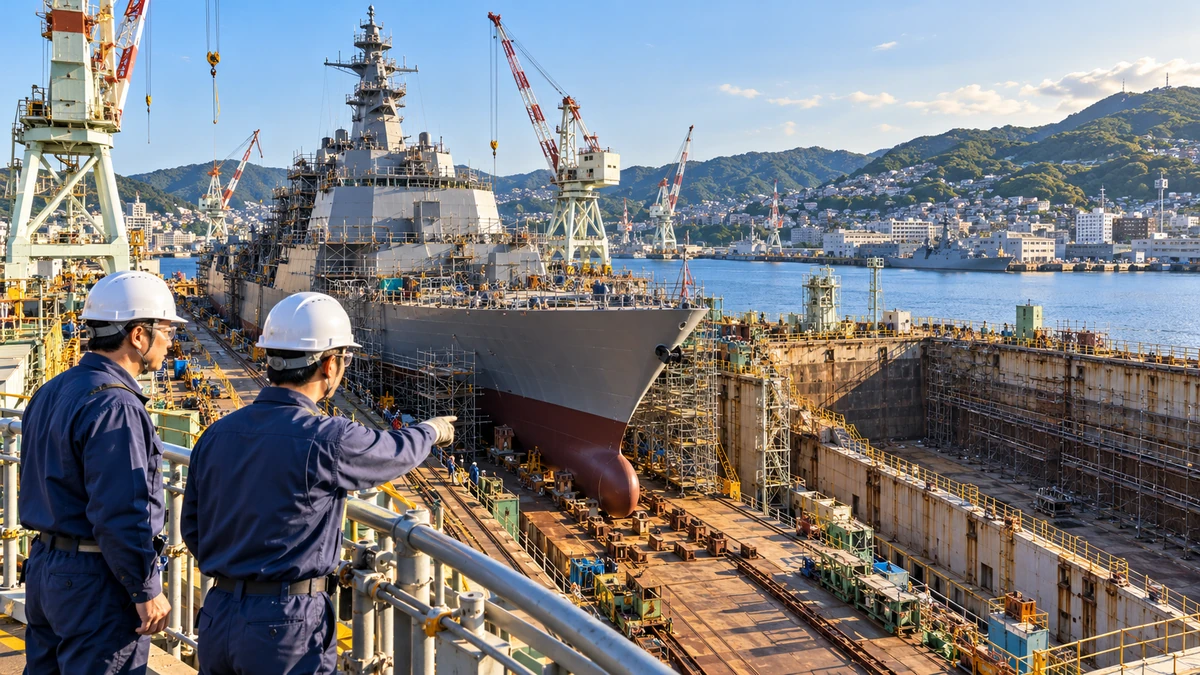
Mitsubishi Heavy Industries Ltd., or MHI, one of Japan’s largest heavy-industry and defense manufacturers, appeared among Google Trends’ rapidly rising search terms on Oct. 19, 2026. The specific reason for the surge in searches was not confirmed. Separately, reports said the company was preparing to reactivate dormant shipbuilding facilities in response to growing demand for naval vessels.
MHI is one of the three core companies of the Mitsubishi Group. Its sprawling manufacturing portfolio includes ships, power plants, military tanks and missiles, space launch vehicles, fighter aircraft and commercial aviation systems. It also makes industrial machinery, wind-power equipment, air conditioners, refrigerators and light-rail systems.
Roots in shipbuilding
The company’s industrial history is closely tied to shipbuilding. Mitsubishi founder Yataro Iwasaki began operating a government-owned facility in 1870 that became the Nagasaki Shipyard, which remained an important shipbuilding center after World War II.
By 1934, Mitsubishi Heavy Industries was the largest private company in imperial Japan, producing equipment including fighter aircraft, trains and warships. During the Korean War in 1950, the company earned substantial revenue from military weapons sales to the United States. Its automotive operations were later separated as Mitsubishi Motors in 1970, while its heavy-vehicle business was spun off as Mitsubishi Fuso Truck and Bus.
From ships and missiles to rockets and aircraft
MHI’s shipbuilding operations include facilities in Shimonoseki and Nagasaki, while power-generation equipment is produced in Kobe and Takasago. Military tanks are manufactured in Sagamihara. The company also produces missiles, excluding anti-tank missiles, and has been involved in Japan’s H-IIA, H-IIB and H3 space launch vehicles.
Its military aviation products include the Mitsubishi F-1 and F-2 fighters, while the F-35A is produced under license. In commercial aviation, MHI manufactures components, fuselage structures and complete aircraft, with related production concentrated around Nagoya in Aichi Prefecture. The company also manufactures and sells air conditioners and refrigerators separately from Mitsubishi Electric, another company within the broader Mitsubishi corporate group.
Past contracts with South Korea
MHI also has a history of business with South Korean public institutions. On Jan. 12, 2009, the Korea Aerospace Research Institute, or KARI, awarded the company a contract to provide launch transportation services for KOMPSAT-3, South Korea’s multipurpose satellite. The agreement, signed in South Korea by MHI President Hideaki Omiya and KARI President Lee Joo-jin, marked MHI’s first satellite launch order from an overseas customer.
The contract also became the subject of controversy in South Korea. Four days later, a Daegu-based civic group supporting former victims of Japan’s wartime military sexual slavery held a news conference criticizing both Japanese Prime Minister Taro Aso’s visit to South Korea and the decision to award the Arirang-3 satellite launch service to Mitsubishi.
In another South Korean project in 2009, a Mitsubishi-Marubeni consortium was selected as the preferred bidder for the turbine-generator portion of Units 9 and 10 at the Dangjin thermal power plant.
A long-standing U.S. connection
MHI’s history also includes a direct American connection. The company generated significant income by selling military weapons to the United States during the Korean War, according to the account. Today, its broad portfolio still spans sectors closely associated with advanced industrial and defense manufacturing, including fighter aircraft, missiles, commercial aviation and space launch systems.
Comments
Post a Comment