Image to help understand the article
One missile flew more than 560 miles
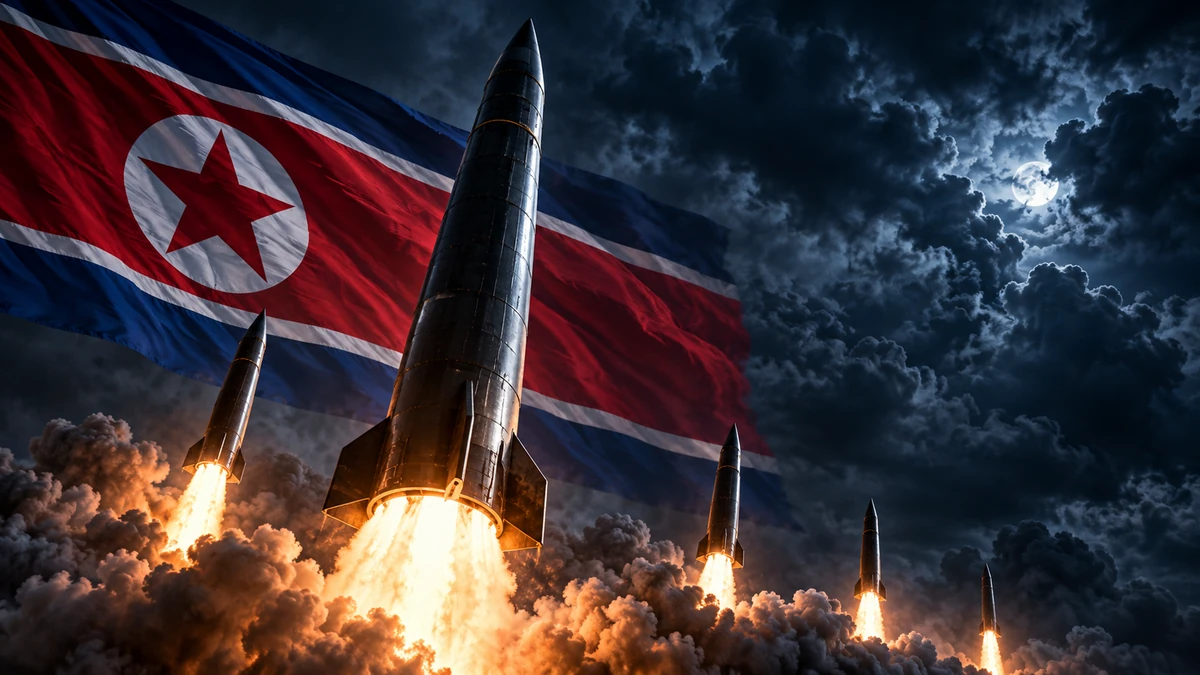
North Korea launched multiple ballistic missiles from the Pyongyang area toward waters off its east coast beginning at about 9:20 a.m. on the 12th, South Korea’s Joint Chiefs of Staff said.
At least one missile traveled more than 900 kilometers, or about 560 miles, according to the South Korean military. Japanese authorities said the projectiles appeared to have fallen outside Japan’s exclusive economic zone, which extends up to 200 nautical miles from its coast.
South Korean officials said North Korea fired several missiles of different types. South Korean and U.S. authorities were conducting a detailed analysis to determine their specifications.
The limited disclosure of the flight distance prompted speculation that North Korea may again have tested a hypersonic weapon designed to maneuver unpredictably and evade detection during the final stage of flight. Officials had not confirmed the missile type.
Launch follows South Korean weapons test
The launches came four days after the South Korean government announced that it had successfully conducted the first test launch of a domestically developed hypersonic glide vehicle. That disclosure was reportedly intended in part as a response to a North Korean land mine explosion involving North Korean troops in the Demilitarized Zone, the heavily fortified border separating the two Koreas.
South Korea’s Joint Chiefs of Staff assessed that the North Korean launch may have been intended as a show of force in response to Seoul’s test and as a demonstration of progress under Pyongyang’s five-year defense development plan.
Hypersonic missiles travel at least five times the speed of sound and can maneuver outside the predictable arc followed by conventional ballistic missiles, making them difficult to track and intercept. The recent tests have highlighted an intensifying competition between the two Koreas over advanced missile technology.
South Korea, U.S. and Japan share launch data
South Korea’s military said it had increased surveillance and readiness for additional launches. South Korea, the United States and Japan were closely sharing information on the North Korean missiles, reflecting the three countries’ coordination in monitoring Pyongyang’s weapons programs.
The launch was North Korea’s 16th ballistic missile test of the year and its first in nine days. It was also the first launch from the Pyongyang area since Aug. 20, when North Korea fired about 10 short-range ballistic missiles believed to be KN-25 weapons, a system often described as a 600-millimeter super-large multiple rocket launcher.
In its previous launch, from the Wonsan area on the east coast, South Korea said a missile traveled more than 700 kilometers. North Korea claimed it had tested an intermediate-range strategic missile carrying a hypersonic warhead that flew 1,000 kilometers, and accused the South Korean military of failing to track the full flight.
North Korean leader Kim Jong Un observed that earlier test, according to Pyongyang, and called for continued efforts to demonstrate the reliability and destructive power of the country’s strategic weapons to its adversaries.
Japan checks for damage
Japan’s Defense Ministry said suspected ballistic missiles were launched in succession at about 9:20 a.m. and 9:40 a.m. The Japan Coast Guard issued alerts to ships in the area and said no damage had been reported as of 10 a.m.
The Japanese government assembled an emergency team at the crisis management center in the prime minister’s office to gather information and assess possible damage. Prime Minister Sanae Takaichi directed officials to analyze the launches, confirm the safety of aircraft and vessels, and prepare for possible emergencies.
Comments
Post a Comment