Image to help understand the article
Brokerages expect a record quarter
Samsung Electronics is expected to report its first quarterly operating profit above 100 trillion won when it releases preliminary third-quarter results this week, according to estimates compiled from South Korean brokerages.
Financial data provider FnGuide put the consensus forecast at 108.1312 trillion won in operating profit on revenue of 201.7276 trillion won. That would represent increases of 788.8% and 134.4%, respectively, from the same quarter a year earlier.
Estimates vary by brokerage and the date of calculation. Yonhap Infomax, using projections from eight securities firms published over the past month, arrived at operating profit of 106.9887 trillion won and revenue of 200.279 trillion won. Individual forecasts included 108 trillion won from Hana Securities and 101.7 trillion won from IBK Investment & Securities.
If the forecasts prove accurate, Samsung would earn roughly 2.5 times its full-year 2024 operating profit of 43.6 trillion won in a single quarter. Combined with first-half operating profit of 146.7 trillion won, its profit for the first nine months would exceed 250 trillion won.
Memory chips drive the gains
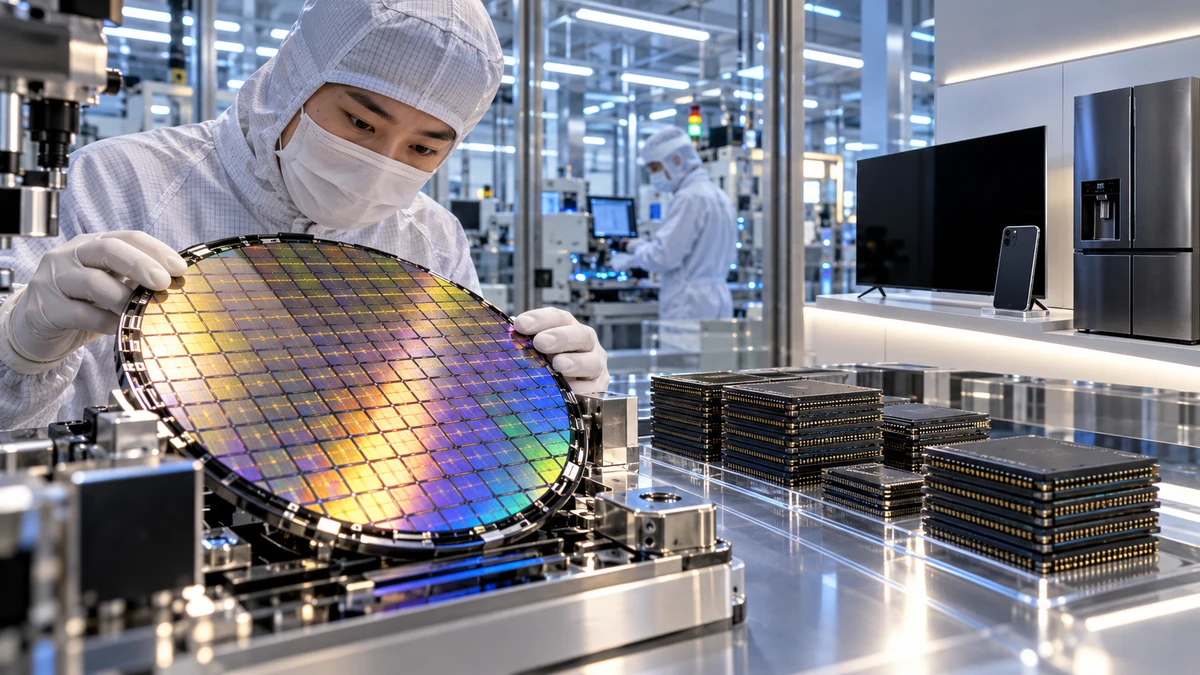
The projected surge is overwhelmingly tied to Samsung's semiconductor business, particularly memory chips used in artificial intelligence data centers. Hana Securities estimated that the memory operation alone generated 110 trillion won in operating profit, exceeding its forecast for the entire company because losses elsewhere would offset part of the chip earnings. IBK estimated operating profit of 101.8 trillion won for Samsung's Device Solutions division.
Industry estimates cited in the report put the semiconductor division's operating margin in the mid-70% range, with the margin for DRAM memory above 80%. Samsung had already posted consecutive quarterly profit records this year, with 57.2 trillion won in the first quarter and 89.5 trillion won in the second.
Demand has been particularly strong for high-bandwidth memory, or HBM, server DRAM and enterprise solid-state drives. Major technology companies are expanding both computing power and storage capacity for AI data centers, prolonging shortages across those categories.
TrendForce estimated that contract prices for conventional DRAM rose 58% to 63% in the second quarter from the previous quarter, while NAND flash prices increased 55% to 60%. It projected more moderate third-quarter gains of 13% to 18% for DRAM and 10% to 15% for NAND. Industry estimates suggest Samsung raised its own DRAM and NAND prices by about 15% to 18% during the quarter.
Samsung began mass-producing and shipping HBM4 in February and has continued increasing deliveries. Brokerages expect third-quarter HBM4 revenue to be more than triple the second-quarter level and predict the newer chips will account for more than 60% of Samsung's HBM revenue in the second half of the year.
Samsung's contract chip manufacturing business may also narrow its losses as production and factory utilization recover. Analysts pointed in particular to increased use of its 4-nanometer process, which produces HBM4 base dies that manage power and signals, as well as processors designed for AI language workloads. More stable manufacturing yields could further improve profitability, with some analysts saying the foundry operation could return to profit before provisions for employee bonuses.
Phones, televisions and appliances struggle
The outlook is sharply different for Samsung's Device Experience division, which includes Galaxy smartphones, televisions and home appliances. Brokerages broadly expect an operating loss of about 2 trillion won, compared with an 800 billion won loss in the second quarter.
Hana Securities projected a 2.1 trillion won loss, while Eugene Investment & Securities and Shinhan Securities each estimated 1.8 trillion won. Rising component costs and higher marketing expenses were cited as the main causes.
The mobile business has been hit especially hard by higher chip prices. Sales of the Galaxy Z Fold8 line have exceeded expectations, but analysts said Samsung's decision to limit price increases while defending market share has added to the division's losses. Promotional spending surrounding the product launch has created another burden. IBK projected a combined operating loss of 1.1 trillion won for the mobile and network businesses.
Televisions and appliances are not expected to provide much relief. Growth in television demand has slowed, while Chinese manufacturers TCL and Hisense are using domestic panel supply chains and lower prices to challenge Samsung in large-screen and premium categories. That competition makes it difficult for Samsung to pass higher memory costs on to television buyers.
An industry official cited in the report warned that the third quarter is normally crucial for Samsung's annual mobile earnings because it captures the impact of new foldable-phone releases. A loss of about 2 trillion won for the broader consumer division during that peak period could make a full-year profit uncertain, particularly as holiday promotions intensify in the fourth quarter.
U.S. tariffs and market conditions
Samsung's home appliances exported to the United States, including refrigerators and washing machines, also face tariff costs. Analysts said reducing expenses and increasing sales may not be enough to restore profitability in that business.
Broader U.S. financial conditions have been more favorable for technology companies. A weaker-than-expected September employment report released in the United States eased concerns about higher interest rates, helping the Nasdaq rise 1.19%.
Still, some brokerages have lowered their Samsung forecasts. BNK Investment & Securities cut its operating-profit estimate to 108.5 trillion won from 114.7 trillion won, citing the stronger South Korean currency and slowing memory-price increases. A stronger won can reduce the value of overseas revenue when it is converted into the Korean currency. High memory prices are also prompting some computer and smartphone manufacturers to reduce the amount of memory installed in certain products, potentially weakening demand.
Bonuses and Korea's reliance on chips
Employee performance bonuses are another variable. Some bonus expenses not recorded in the second quarter are expected to be reflected in the third quarter, putting pressure on margins.
The issue has also reached South Korea's National Assembly. A parliamentary committee overseeing trade, industry and small businesses selected the head of a Samsung Electronics labor union as a witness for an Industry Ministry audit, where lawmakers are expected to examine how the company calculates and distributes performance bonuses.
Samsung's results also illustrate the South Korean economy's heavy dependence on semiconductors. Of the country's $120.94 billion in exports in September, $60.3 billion came from chips. Exports outside the semiconductor sector rose 23%, but swings in memory-chip prices remain powerful enough to shape assessments of the broader economy.
Comments
Post a Comment