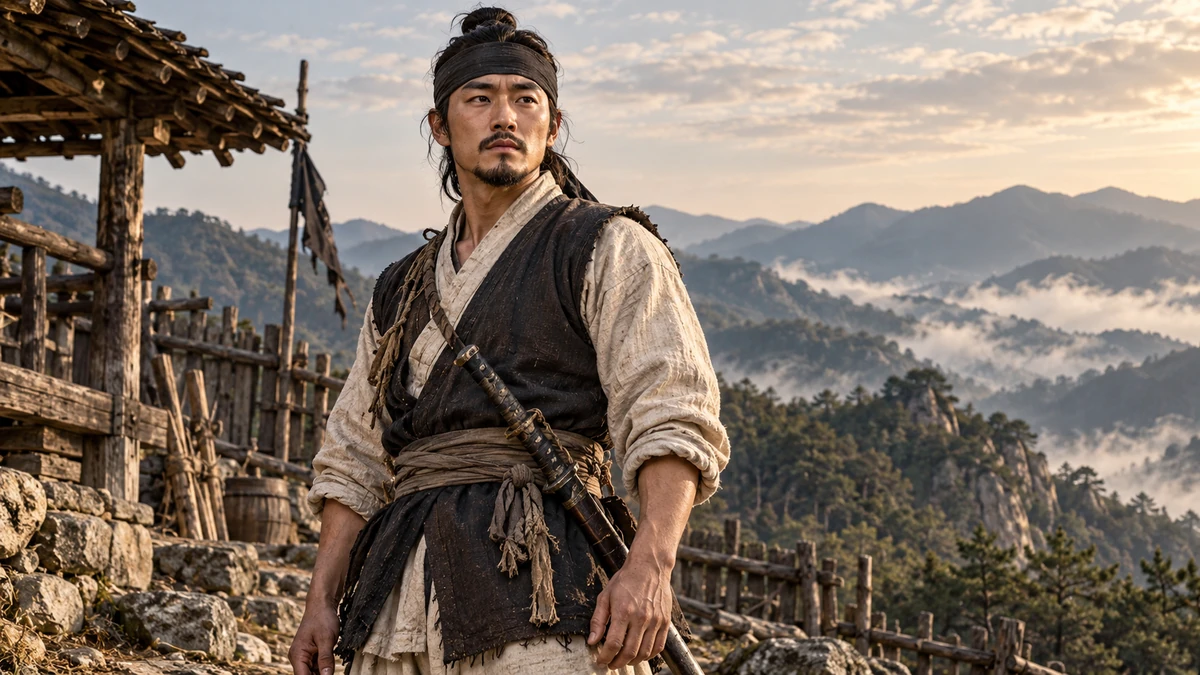
Image to help understand the article
A commander from outside Korea’s elite
Shin Dol-seok was born Nov. 26, 1878, into a farming family in Yeonghae, an area in what is now Yeongdeok County in North Gyeongsang Province. He became one of the most prominent common-born commanders of Korea’s “righteous armies,” civilian militias that fought Japanese forces during the final years of the Korean Empire.
Born Shin Tae-ho, he was also known by several other names. His father was Shin Seok-ju, and his mother belonged to the Bunseong Kim clan. Shin grew up in a region shaped by unrest: An 1871 peasant uprising in Yeonghae resulted in the death of a local magistrate and the burning of a government office. The Encyclopedia of Korean Culture says the area’s resistance to the feudal order helped shape Shin’s opposition to Korea’s class system, while Japan’s encroachment strengthened his anti-Japanese views.
Taking up arms at 19
Militias formed across Korea after the 1895 assassination of Queen Min, later honored as Empress Myeongseong, and a government order requiring men to cut their traditional topknots. On March 13, 1896, the 19-year-old Shin raised a force of about 100 men in Yeonghae.
His emergence was unusual because the early militia movement was led largely by Confucian scholars, members of Korea’s traditional educated elite. Shin’s fighters took control of several areas along North Gyeongsang Province’s east coast before joining forces associated with commanders Yu Si-yeon and Kim Ha-rak. The combined force suffered a major defeat against Japanese troops in Yeongdeok. Kim, gravely wounded, died after throwing himself from a height, and Shin’s unit disbanded.
Shin organized another militia after the Japan-imposed Eulsa Treaty of 1905. Working with his younger brother, Shin Woo-gyeong, he gathered about 100 men in his home village on March 13, 1906, and adopted the title commander of the Yeongneung Righteous Army.
In April, his forces launched a surprise attack at Jangheunggwan in Uljin and destroyed nine Japanese military vessels. In June, they attacked troops in Wonju and forced their surrender. Shin’s operations expanded across the eastern coast of Gangwon Province and into inland North Gyeongsang Province, targeting Japanese garrisons and disrupting the installation of communications lines.
The “Tiger of Mount Taebaek”
After repeated operations, including an attempted joint attack on Sunheung with commander Yi Gang-nyeon, Shin emerged as a leading militia commander in North Gyeongsang Province. His battlefield reputation earned him the nickname “Tiger of Mount Taebaek.”
In 1907, Shin rebuilt his force and attacked government offices in Yeongdeok. As his troops moved to confront Japanese soldiers gathering in Cheongsong, about 3,000 local residents joined them. His militia pursued retreating troops to Jusil in Yeongyang, defeated them after fierce fighting and remained there for more than 10 days to stabilize the community. The force later won another engagement at Samwi in Jinbo.
Fighting continued at Daesanseong in Gyeongju and in areas around Cheongha and Yeongdeok. In October, Shin’s forces raided the Yeonghae police office and secured provisions in Sudong.
That December, militia units from across Korea prepared for an assault on Seoul under commander Yi In-yeong. Representing the Gyeongsang region, Shin headed toward Yangju with about 1,000 fighters, but the advance on the capital never took place. The leadership structure of the 13-province alliance was dominated by commanders from aristocratic and Confucian scholarly backgrounds. Shin and other common-born commanders, including Hong Beom-do and Kim Su-min, were excluded.
Final battles and assassination
After returning to Yeonghae, Shin defeated Japanese troops at Dokgok in Pyeonghae in January 1908. Over the following months, his fighters joined militia units from Andong, Uljin, Samcheok and Gangneung, winning engagements in several eastern mountain communities. At Dogok in Uljin in April, they seized a large cache of Japanese weapons. Fighting continued through September.
As cold weather arrived, Shin dismissed his soldiers with plans to resume operations the following spring. He went into hiding at the Nulgok home of a subordinate, Kim Sang-ryeol, but was assassinated there Nov. 18, 1908.
Historical accounts differ over who killed him and how. One version names Kim Sang-ryeol and his two brothers, while others identify different pairs of brothers or Shin’s cousin Kim Ja-seong. A government record honoring Shin says Kim Ja-seong lured him to a house, where three brothers killed him with an ax and notified Japanese military police. According to the record, they were denied a reward because they had not captured Shin alive.
A legacy that challenged the class system
The Encyclopedia of Korean Culture describes Shin as the first common-born commander to raise a militia during Korea’s late imperial resistance. His force used guerrilla tactics to sustain a long campaign, enforced strict discipline and avoided burdening civilians, earning protection and support from residents in its areas of operation.
But Korea’s rigid class hierarchy followed Shin onto the battlefield. Aristocratic and scholarly commanders often looked down on common-born leaders, hindering efforts to form a unified resistance and limiting the roles commanders such as Shin could play.
Shin was survived by his wife, Han Jae-yeo, his son, Shin Man-i, and an adopted nephew, Shin Byeong-uk. South Korea posthumously awarded him the Presidential Medal of the Order of Merit for National Foundation in 1963. His thatched-roof birthplace in Yeongdeok was restored in 1995.
Comments
Post a Comment