Image to help understand the article
SK weighs fast start for new chip factory
SK Group Chairman Chey Tae-won said the conglomerate intends to build a semiconductor fabrication plant in Gwangju as quickly as possible, although the company has not set a groundbreaking date.
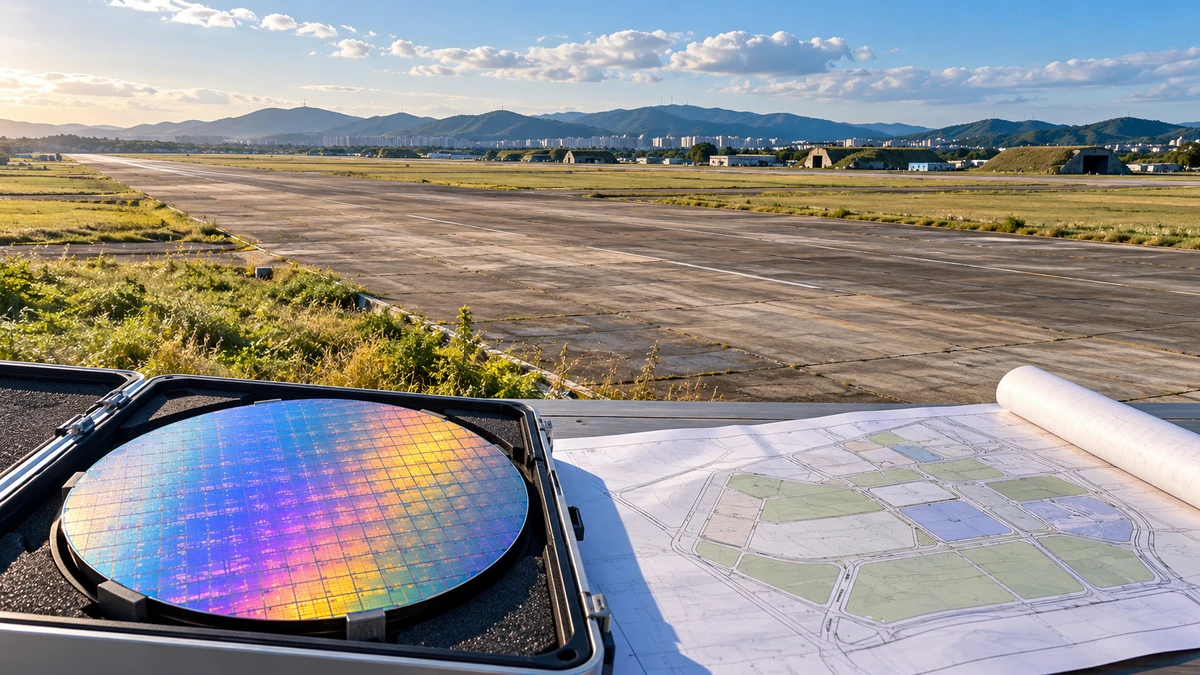
Chey visited the proposed site at Gwangju’s military airport for the first time since plans for a semiconductor cluster in southwestern Korea were announced in June. He inspected areas designated for the fabrication plant, commonly called a fab, as well as an ammunition depot considered a key candidate for early redevelopment.
Senior executives from chipmaker SK Hynix, including CEO Kwak Noh-jung, joined the visit. Chey also received briefings from Mayor Min Hyung-bae on site preparation and essential infrastructure, including electricity, industrial water and transportation links.
Chey said the company would move at “the fastest possible speed” once construction became feasible. He said rapidly growing semiconductor demand requires manufacturers to bring new capacity online sooner, but added that SK must conduct further study before announcing when work will begin.
Construction could start before all utility infrastructure is complete. Chey said initial work, including raising and preparing the land, could proceed if doing so would help the overall schedule, even if water and electricity connections were delayed.
Plant could rival SK’s Yongin complex
SK currently envisions the Gwangju fab at about two-thirds the scale of its semiconductor cluster in Yongin, south of Seoul. Chey said the Gwangju operation could grow larger if more land is available and chip demand continues to rise.
He pointed to the expansion of artificial intelligence as a major driver of semiconductor demand. SK Hynix recently moved up the planned completion of its Yongin cluster from 2045 to 2033, but Chey said additional production sites may still be needed and could be developed alongside Yongin.
SK Hynix executives and officials from construction affiliate SK Ecoplant inspected the military airport site more than 10 times before Chey’s visit. Min said the regional government would support the project by preparing land, power and water infrastructure while also developing a skilled workforce and suitable living conditions for employees.
Four fabs planned in 800 trillion-won project
The national government announced in June that SK Hynix and Samsung Electronics would each build two memory-chip fabs in Korea’s southwestern Honam region. The long-term investment is valued at a combined 800 trillion won, with each company expected to contribute about 400 trillion won.
Authorities selected the area surrounding Gwangju’s military airport in July. The proposed national industrial complex covers 8.2 million square meters, or about 3.2 square miles. The government and regional authorities plan to begin with roughly 2.08 million square meters that can be developed first, including land connected to the planned relocation of the ammunition depot.
Under the current timetable, the airport property would be transferred for construction in 2028, with initial semiconductor production targeted for June 2030. Operating the planned fabs would require about 1.06 million metric tons of water per day and 6.3 gigawatts of electricity.
That schedule remains uncertain because major issues, including relocating the military airport and securing sufficient power and water, have not been resolved.
Location decision draws political scrutiny
The project has also prompted debate over whether the companies had sufficient independence in deciding where to invest. During a National Assembly hearing in April, Chey agreed with the general idea that factories should be built where electricity is available but questioned whether that necessarily meant semiconductor plants should be placed there.
Opposition politicians have raised questions about whether political considerations influenced the rapid change in investment plans. Political leaders in Daegu and North Gyeongsang province also objected after cities including Gumi were excluded from consideration.
Comments
Post a Comment