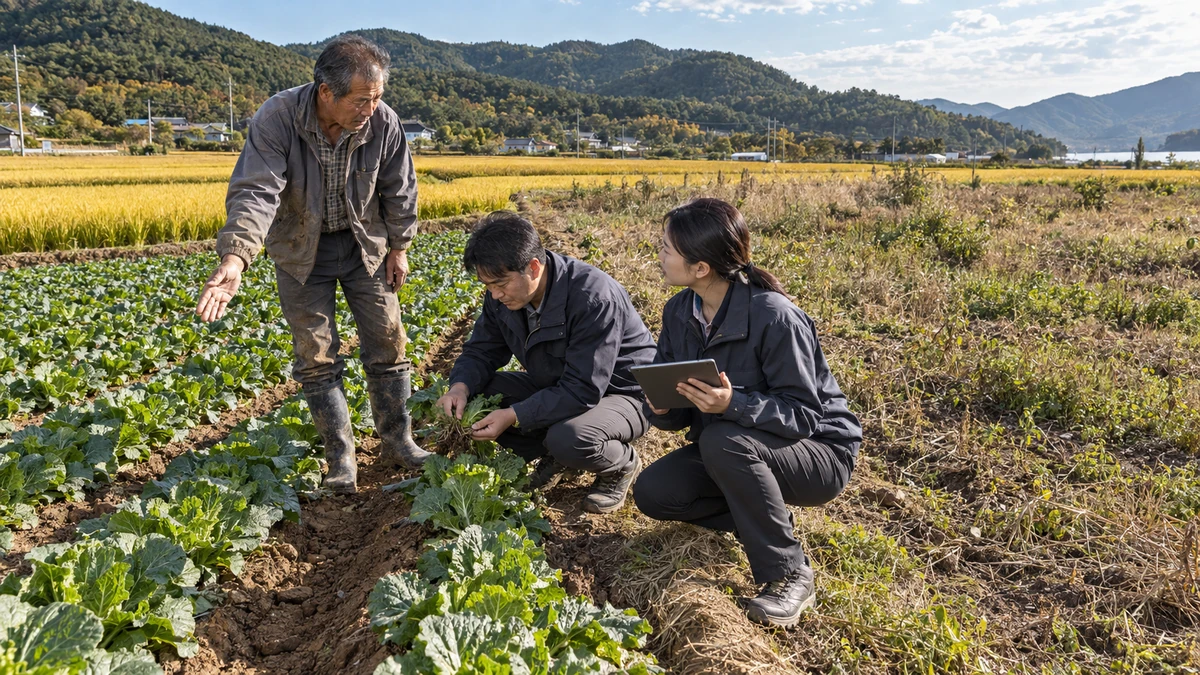
Image to help understand the article
SEOUL, South Korea — Online searches for the Korean term for “cultivation” surged amid controversy over a nationwide farmland survey, as landowners sought to understand how the government determines whether agricultural property is actually being farmed.
Survey Targets Speculation and Illegal Ownership
South Korea’s Ministry of Agriculture, Food and Rural Affairs began a comprehensive review of farmland in May, compiling a database of ownership and land-use records. The survey is intended to identify land that is not being used for agriculture, including property potentially acquired for speculation or held illegally.
Findings released Sept. 23 reportedly classified 27% of the land examined as potentially unlawful. The disclosure heightened concern among farmland owners and prompted searches for terms including “farmland survey,” “meaning of cultivation” and “land cultivation.”
The government says it will distinguish between farmland deliberately left idle after a speculative purchase and property that cannot be cultivated for unavoidable reasons. Owners who cannot farm because of inheritance, advanced age or illness may be offered ways to bring their land into compliance, including placing it under the management of the state-backed Farmland Bank.
President Calls for Flexibility
President Lee Jae Myung said Sept. 29 that the survey’s purpose is to uncover real estate speculation, including cases in which people obtained land by declaring that they would farm it, then left it unused while waiting for its value to rise or converted it to another use.
Lee also instructed government agencies to consider rural realities, such as older farmers relying on others to cultivate their land, and said enforcement should not be applied uniformly.
Older Farmers Fear Losing Their Land
On Ulleungdo, a mountainous island off South Korea’s east coast, reports that owners could be ordered to sell farmland if they were not cultivating it prompted some farmers in their 70s and 80s to clear weeds and brush from hillside plots they had been unable to maintain for years.
One elderly owner who could no longer do the work personally hired three laborers for 300,000 won each per day. The two-day job cost 1.8 million won and was undertaken not to plant crops immediately, but to reduce the risk that the property would be classified as uncultivated.
“It is painful enough that I am too old to farm, but how could I sit still when I am afraid something might happen to my land?” farmer Kim Seong-hwan said. “I have farmed this land all my life, so I am at least cutting the grass because I do not want it to become a problem.”
Ulleungdo has little flat farmland, and machinery cannot reach many of its steep fields. The farmland team at the Ulleung County Agricultural Technology Center said officials need to examine why individual plots are not being used rather than applying the same standards used on the mainland.
Penalties Are Not Immediate
Under South Korea’s Farmland Act, land is not immediately confiscated and owners are not automatically fined simply because a plot is not being used for agricultural management. However, farmland left unused without a legitimate reason can become subject to a formal disposal requirement.
Owners who fail to comply with a disposal order can face annual enforcement penalties of up to 25% of the higher of the property’s appraised value or its officially assessed land value.
The debate has also spread through political commentary videos about active cultivation and the farmland survey. Two videos posted Sept. 27 recorded 48,472 and 63,550 views, respectively, further driving public interest in what legally qualifies as cultivation and how the standards will be enforced.
Comments
Post a Comment