Image to help understand the article
Participation expands beyond health screening patients
South Korea is opening its national biomedical data initiative to all citizens, expanding eligibility beyond people who receive government or comprehensive health screenings.
The ministries of health, science and industry, along with the Korea Disease Control and Prevention Agency, announced the broader enrollment rules for the National Integrated Bio Big Data Project. People who are not scheduled for health screenings may now participate after completing research examinations required by participating institutions.
Officials previously focused recruitment on health screening patients because their medical records were readily available and participation could be incorporated into existing appointments.
Officials donate samples
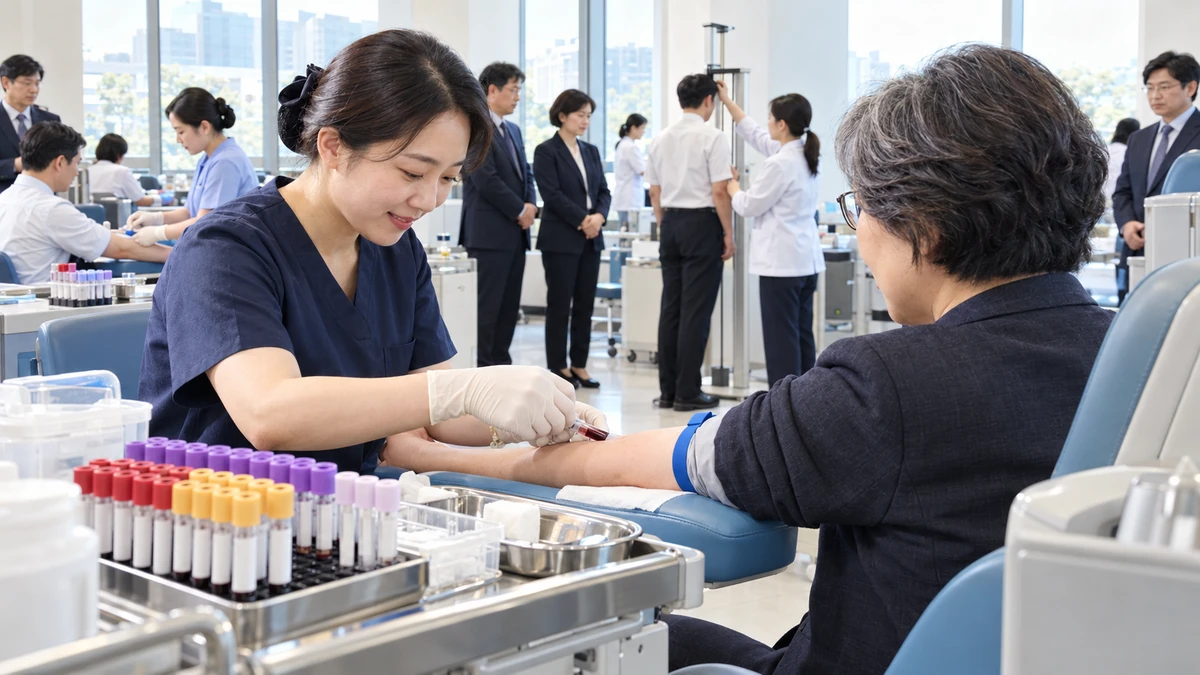
To promote the expansion, 40 policymakers and health officials donated biological data at Severance Hospital in Seoul on Oct. 15. Participants included Health and Welfare Minister Jung Eun-kyeong, Ha Jung-woo, vice chair of the National AI Strategy Committee, Korea Health Industry Development Institute President Ko Sang-baek and Severance Hospital representatives.
The participants provided consent, underwent blood draws and completed body measurements. A policy meeting afterward reviewed the project’s progress, plans for the first release of data in November and ways the database could support medical innovation in the artificial intelligence era.
Jung described the database as a public asset built through individual participation. She said the government would work to ensure the information is used safely and broadly so that advances in health care benefit the public.
Aiming for 1 million participants
The government-led research program is designed to combine donated health, genetic, clinical and public records in a secure platform available to approved researchers. The information could support South Korea’s development of domestically controlled medical AI, new drugs, advanced medical devices and precision medicine, which uses genetic and clinical information to tailor care to individual patients.
The project runs from 2024 through 2032. It aims to collect data from 772,000 people during its first phase, which ends in 2028, and reach 1 million participants by 2032.
Recruitment targets include 585,000 members of the general public, 140,000 people with serious illnesses and 47,000 people with rare diseases. Medical institutions and screening centers will collect blood, urine and tissue samples.
DNA, serum and other biological materials will be stored at the KDCA’s National Biobank of Korea. Participants’ genetic, clinical and public data will be integrated in a separate data bank operated by the Korea Health Information Service. Researchers will be allowed to use the materials and data only after their applications pass a review process.
Comments
Post a Comment