Image to help understand the article
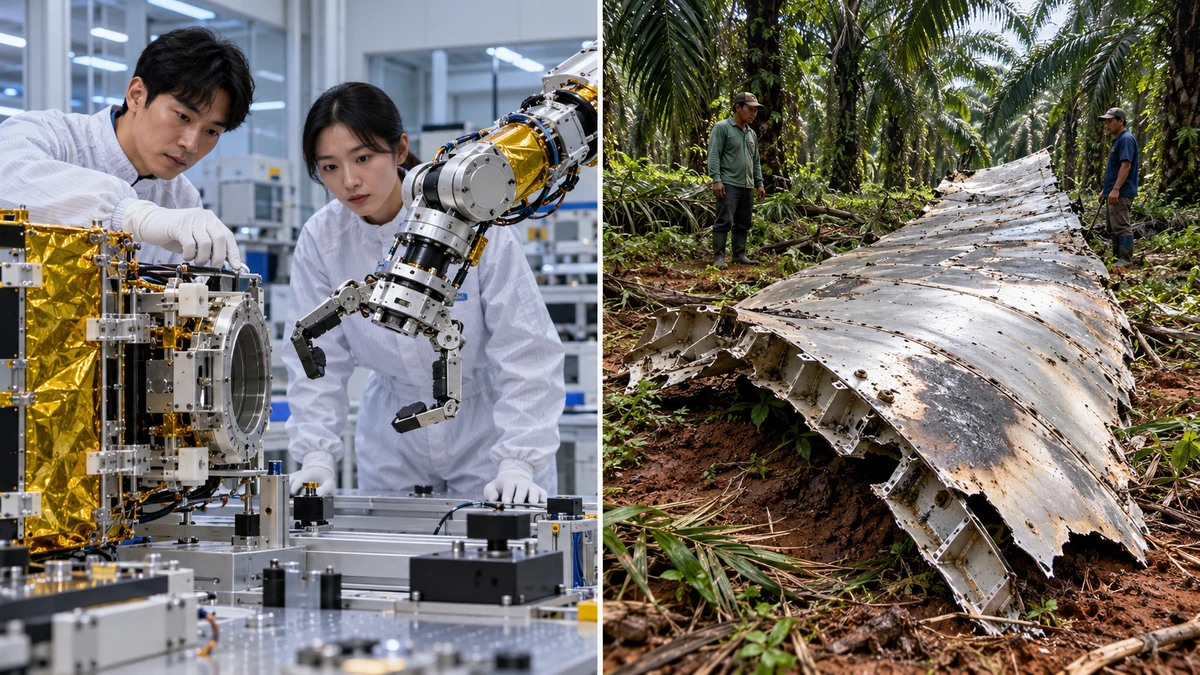
South Korea is preparing to launch a satellite designed to capture and remove space debris, as dramatic footage of Chinese rocket wreckage falling on an Indonesian farm fuels public interest in the growing hazards surrounding Earth.
The Korea AeroSpace Administration said Oct. 26 that its Active Debris Removal Satellite, known as ADR-SAT, had passed a key readiness review at the Korea Advanced Institute of Science and Technology’s Satellite Technology Research Center in Daejeon. Engineers plan to begin assembling the flight model in November ahead of its scheduled launch aboard South Korea’s Nuri rocket in 2027.
A Robotic Cleanup Mission
After reaching orbit on Nuri’s sixth launch, ADR-SAT is expected to approach an inactive satellite, seize it with a robotic arm and gripper, and lower its orbit. Once released, the target would re-enter Earth’s atmosphere and burn up from the heat generated by air resistance.
The concept resembles the cleanup spacecraft depicted in the 2021 South Korean science-fiction movie “Space Sweepers.” The space agency described the mission as a highly difficult demonstration and said it could become the first satellite to capture orbital debris directly in space.
A leading candidate for the initial removal mission is Wooribyeol 3, a South Korean Earth-observation satellite launched in 1999. Its mission ended in 2002, but it has continued orbiting Earth ever since.
A Growing Orbital Hazard
Space debris includes defunct satellites, spent rocket boosters, fragments from collisions or explosions and tools lost by astronauts. More than 4,500 tons of such material is estimated to remain in orbit, including about 23,000 objects measuring at least 10 centimeters, or roughly 4 inches, and 500,000 to 600,000 objects measuring at least 1 centimeter.
Traveling at speeds of 7.9 to 11.2 kilometers per second, even tiny fragments can damage spacecraft. A video recently circulated in South Korea cited a 1983 incident in which a paint chip measuring just 0.2 millimeters left a pit in a window of the space shuttle Challenger. As global satellite launches increase, so does the amount of material left in orbit and the risk of collisions.
Rocket Debris Falls in Indonesia
Interest in the issue surged after video showed fiery wreckage falling over Indonesia. On the night of Oct. 18, a burned metal panel about 9 meters long landed on a palm oil farm in East Kotawaringin, Central Kalimantan province. No injuries were reported.
Indonesia’s National Research and Innovation Agency identified the object as debris from LandSpace’s Zhuque-2E rocket, launched from northwestern China on Oct. 14 by the Chinese private space company.
KBS videos of the fireball and wreckage drew hundreds of thousands of views on YouTube, while shorter clips also circulated on South Korea’s Naver platform. The attention helped push the Korean term for “space debris” into trending searches.
Korea AeroSpace Administration chief Oh Tae-seog said the project would seek to secure domestic technology for approaching, capturing and deorbiting fast-moving debris. He said the capability was intended to strengthen South Korea’s response to orbital threats that could endanger its satellites.
Comments
Post a Comment