Image to help understand the article
South Korea’s food safety regulator has revised its labeling rules to prevent low-sugar foods made with sweeteners from carrying claims that they may help limit increases in blood sugar after meals.
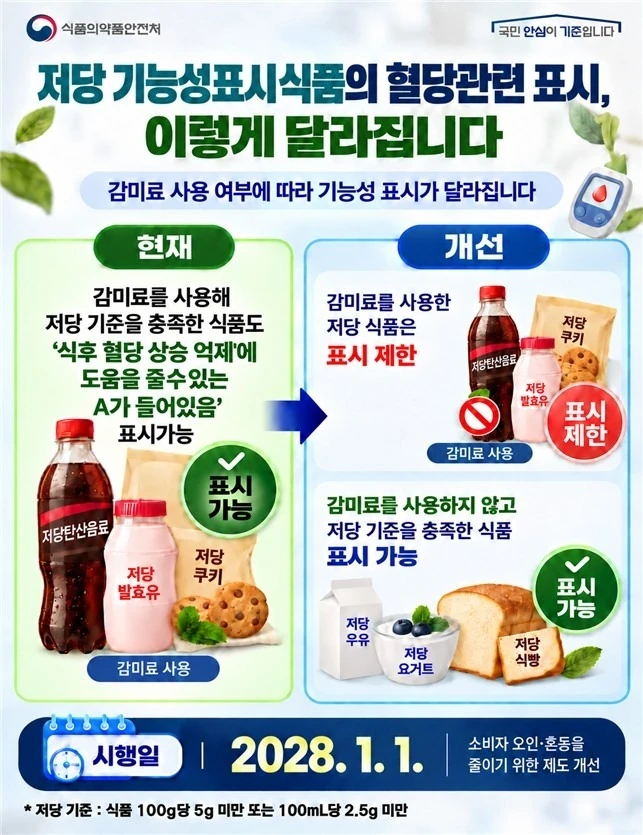
The Ministry of Food and Drug Safety announced the change on the 23rd. The new rule will take effect Jan. 1, 2028.
Which Products Are Covered
The restriction applies to foods that use sweeteners to meet South Korea’s low-sugar standard: less than 5 grams of sugar per 100 grams of food or less than 2.5 grams per 100 milliliters.
Under the existing system, qualifying products may state that they contain a functional ingredient associated with moderating post-meal blood sugar increases, regardless of whether sweeteners were used. Once the revision takes effect, only products that meet the low-sugar standard without sweeteners will be eligible for such labeling.
The ministry cited resistant maltodextrin as an example of a functional ingredient. A product containing it will not be allowed to make a blood sugar-related claim if sweeteners were used to qualify the product as low in sugar. The same claim may remain available when the product meets the standard without sweeteners.
Regulator Seeks to Prevent Confusion
The ministry said consumers could interpret even a statement about the presence of a functional ingredient as meaning that the product itself helps manage blood sugar.
Officials emphasized that the revision does not restrict the use of sweeteners or the sale of low-sugar foods. Instead, it is intended to prevent consumers from being misled when a nutritional characteristic — having relatively little sugar — appears alongside a blood sugar-related functional claim.
Demand has grown for low-sugar products such as soft drinks sweetened with sugar substitutes as more consumers focus on health and weight management. The regulator said blood sugar claims on those beverages could create the impression that drinking them helps control post-meal blood sugar.
Concerns Date to Earlier Labeling Changes
The issue emerged after South Korea introduced a functional-labeling system for conventional foods in December 2020. The policy allowed products that are not classified as health functional foods — a regulated Korean category similar in concept to dietary supplements — to identify approved functional ingredients when certain requirements were met.
That led to products including soft drinks with added functional ingredients, prompting concerns that shoppers could confuse conventional foods with health functional foods.
In a 2022 parliamentary audit, Democratic Party lawmaker Nam In-soon raised the issue using Chilsung Cider Plus as an example. She argued that marketing centered on blood sugar benefits could be interpreted by people with diabetes as encouragement to drink soda. Food safety chief Oh Yu-kyung acknowledged at the hearing that the system needed improvement to reduce the risk of consumer confusion.
The ministry said the revised rules should help consumers understand products more accurately and make informed choices. It also pledged to continue reviewing potentially misleading labels and strengthening trust in the food-labeling system.
Comments
Post a Comment