Image to help understand the article
Lawmakers split over cryptocurrency tax
South Korean lawmakers are divided over whether to begin taxing cryptocurrency gains in January, with supporters arguing that repeated delays have damaged the credibility of tax policy and opponents saying the country still lacks the infrastructure and investor protections needed to enforce the law fairly.
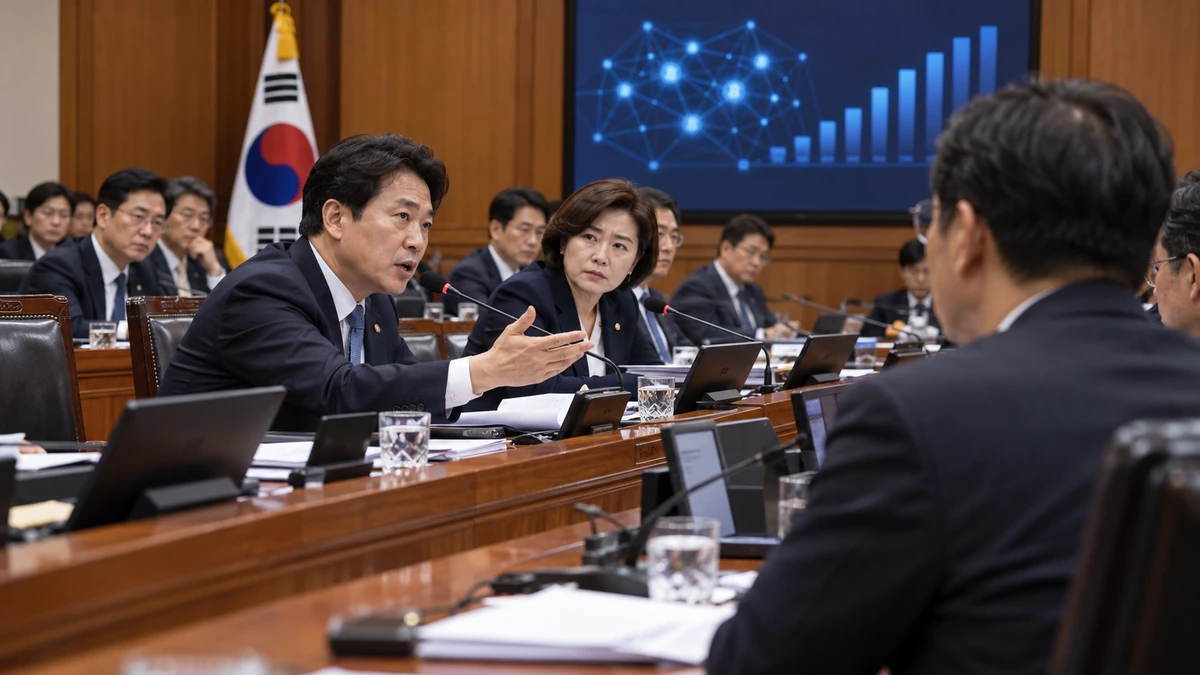
The dispute surfaced during an Oct. 22 National Assembly audit of the Ministry of Finance and Economy. South Korea's annual parliamentary audits allow lawmakers to question government officials and scrutinize policy implementation.
The cryptocurrency tax was created through a 2020 revision to the Income Tax Act. It classifies income from digital assets as miscellaneous income and imposes a 22% tax on annual profits after a basic deduction of 2.5 million won. The tax was originally scheduled to take effect in 2022 but has been postponed three times because of concerns about the tax system and safeguards for investors.
The government is proceeding with administrative preparations for a January rollout, while cryptocurrency companies say the necessary systems are not ready.
Repeated delays draw criticism
Members of the governing Democratic Party are split. Some want the tax implemented quickly, saying another postponement would further undermine policy consistency. Others argue that taxation should wait until South Korea completes its broader legal framework for digital assets.
Democratic Party lawmaker Yoon Hu-duk said the United States, Japan, Germany and Britain already tax cryptocurrency and cited an estimate that 48 countries do so. He criticized officials for raising the same readiness concerns that accompanied earlier delays.
Yoon also argued that repeatedly postponing or abandoning a law approved through bipartisan agreement would weaken trust in South Korea's system of government.
Fellow Democratic Party lawmaker Ahn Do-geol said some lawmakers believe the country should first enact its proposed basic law governing digital assets. He said taxation could begin after rules covering cryptocurrency businesses, user protections and orderly trading are in place.
Oh Ki-hyoung, a senior Democratic Party member on the committee, said officials should apologize if the system remains unprepared after six years of planning. He questioned why the National Tax Service says it is ready while cryptocurrency exchanges say they are not.
Opposition backs another postponement
The opposition People Power Party has adopted delaying the tax as its official position, citing gaps in enforcement infrastructure. Lawmaker Im Lee-ja said domestic exchanges can be required to provide records, while overseas exchanges have no obligation to submit transaction statements to South Korean authorities.
Im said cryptocurrency businesses estimate that building systems to comply with National Tax Service guidance would take at least six to nine months.
Deputy Prime Minister and Finance and Economy Minister Lee Hyoung-il said the government would consider the views of experts, the industry and the National Assembly before making a decision.
Ruling party leans toward fourth delay
Despite divisions within the Democratic Party, momentum is building for a fourth postponement. Thirteen Democratic Party lawmakers introduced legislation on Oct. 16 that would push implementation to 2029 or later.
The debate is also shaped by younger voters, who account for a substantial share of cryptocurrency investors. Recent major polls have placed both the government's approval rating and support for the Democratic Party among voters in their 20s and 30s in the 20% range.
Democratic Party leader Kim Min-seok said the government and lawmakers should reassess market conditions, the views of younger people and whether an effective taxation system is in place. He called for a final review with Lee and said a decision should be reached by the end of the year.
Lawmakers are also considering whether taxing cryptocurrency while delaying a separate tax on financial investment income would raise fairness concerns. One Democratic Party leadership member said more lawmakers favor postponing the cryptocurrency tax and later considering stock and digital-asset taxation together. Some within the broader governing bloc have criticized another delay as postponing efforts to reduce inequality.
Future fund and housing policy also disputed
The audit also featured disputes over the government's proposed 162 trillion-won future response fund. People Power Party lawmaker Park Soo-young argued that the government could spend the money during President Lee Jae Myung's term even though 94% of the fund's projects would extend across multiple years.
Democratic Party lawmaker Moon Jin-seok defended the fund as an investment in future industries that could support the economy after the current semiconductor boom fades.
Lawmakers also clashed over housing policy. People Power Party lawmaker Lee Jong-wook argued that land transaction permits, restrictions on rental businesses and tax policies favoring owner-occupied homes were reducing the supply of properties available in South Korea's monthly and long-term deposit-based rental markets, increasing housing insecurity for people who do not own homes.
Comments
Post a Comment