Image to help understand the article
Labor law divides lawmakers seven months after taking effect
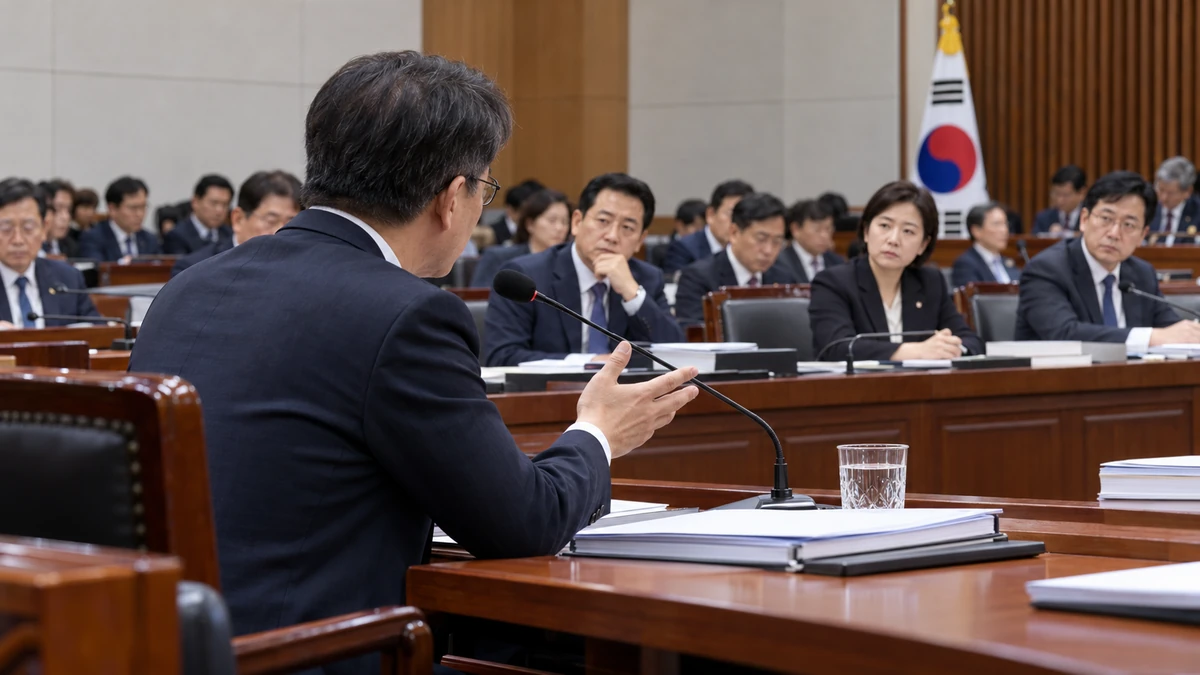
SEOUL, South Korea — The head of South Korea’s National Labor Relations Commission pushed back Thursday against claims that a major expansion of union bargaining rights has caused widespread workplace turmoil, telling lawmakers that critics were exaggerating problems as the system takes hold.
Park Soo-geun made the remarks during a National Assembly audit hearing focused on the law commonly known in South Korea as the “yellow envelope law.” The measure amended two sections of the country’s labor union law, broadening the circumstances in which a lead company can be treated as the employer of subcontracted workers and required to bargain with them.
The law also requires courts to assess individual responsibility and contribution when awarding damages related to labor disputes, rather than imposing blanket liability.
Lawmakers passed the measure on Aug. 24, 2025, with 181 votes. It was promulgated Sept. 12 and took effect March 10, 2026.
Ruling and opposition parties clash over workplace impact
During Thursday’s audit of labor-related agencies, lawmakers debated how authorities determine whether a lead company qualifies as an employer and which issues it must negotiate with subcontracted workers.
The governing Democratic Party argued that the law was settling into place by moving disputes between lead companies and subcontractors into formal bargaining channels. The opposition People Power Party said unclear standards had increased confusion.
People Power Party lawmaker Na Kyung-won said 631 cases involving 179,000 workers and 459 lead-company workplaces showed that conditions had moved beyond confusion and become a “disaster.”
Park rejected that characterization, saying people who viewed the system differently were making the problems appear larger than they were. He described the current period as part of the law’s implementation and said its purpose could be served if workers brought disputes into formal proceedings instead of taking their fight to the streets.
Park said cases before the commission had increased 31%, but matters tied to the new law accounted for only 2.5% of that growth.
He acknowledged that more disputes could emerge next year if ongoing labor-management negotiations fail. No law can be perfect, he told lawmakers.
Most employer-status cases have been resolved
The commission received 631 cases connected to the law between its March 10 implementation and the end of August. Authorities issued decisions in 307 cases, while 273 were withdrawn and 51 remained pending.
As of Aug. 28, 155 lead companies had sought a determination on whether they qualified as employers. Decisions had been completed in 151 cases. Of the 140 companies found to have employer status, 108, or 77.1%, had begun the process of selecting a union bargaining representative.
Park said decisions by regional labor commissions and the national commission agreed about 90% of the time, which he cited as evidence that the standards were being applied consistently.
People Power Party lawmaker Kim So-hee also questioned whether Park’s participation in 36 of 39 appeals reviewed in June and July raised fairness concerns. Park said the cases were difficult after the law took effect and required the participation of all three standing commissioners. He said two outside commissioners had joined reviews since mid-August, addressing most of those concerns.
Public agency relocations may require bargaining
The hearing also addressed the government’s relocation or consolidation of public agencies, a politically sensitive policy in South Korea because moving an institution away from Seoul can significantly affect employees’ commutes, assignments and living arrangements.
Park agreed that such moves could become bargaining issues when they substantially change working conditions. He said a relocation without employee transfers or workforce reassignments would be difficult to imagine.
In a written response to lawmakers, the Labor Ministry said the decision to relocate or merge a public agency was not itself subject to mandatory bargaining. However, unions could negotiate over reassignment standards and procedures, relocation assistance and other changes when effects on working conditions could be objectively anticipated.
Asked whether the national government should be considered the employer of public agency workers, Park said the answer could vary by case.
The law’s impact also dominated a Labor Ministry audit earlier in the week. Lawmakers there noted that lost workdays from labor disputes had reached 489,190 as of September, surpassing the 394,000 recorded during all of the previous year.
Comments
Post a Comment