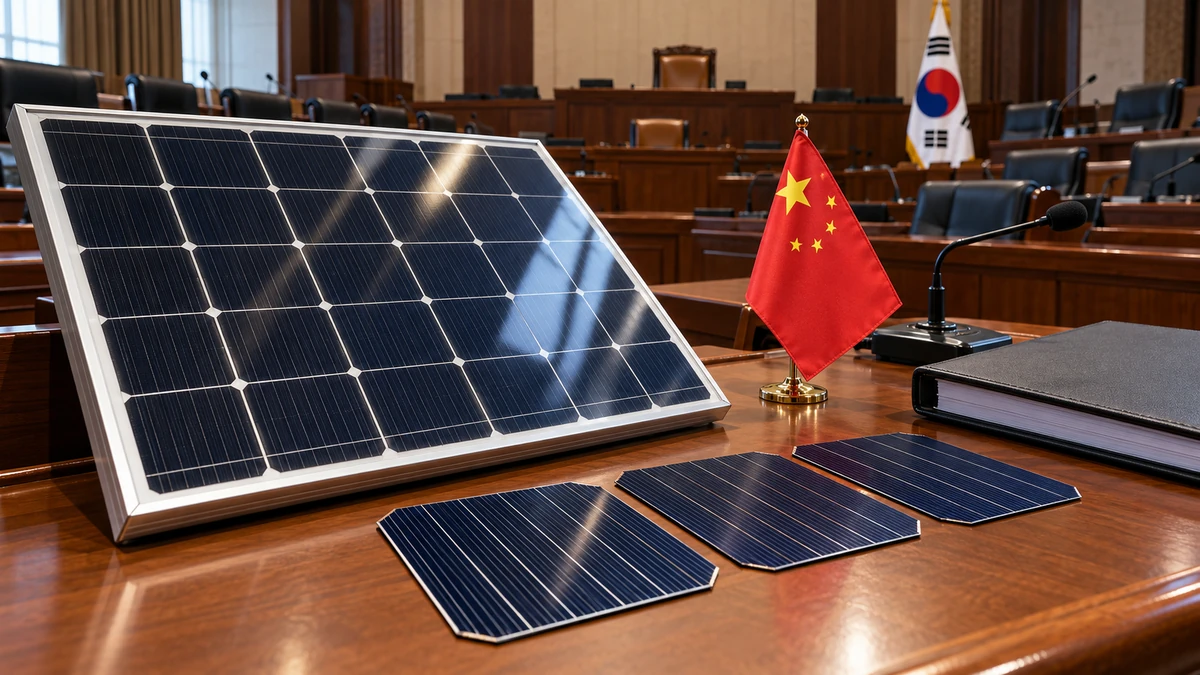
Image to help understand the article
Chinese imports dominate key solar components
South Korea’s dependence on Chinese-made solar equipment emerged as a major energy security issue during an Oct. 6 National Assembly audit, the country’s annual parliamentary review of government agencies and policies.
Lawmaker Na Kyung-won said domestically produced modules accounted for 78.4% of South Korea’s market in 2019, but Chinese products now make up 69.3%. She said Chinese-made cells, the components inside solar modules that convert sunlight into electricity, account for 96.08% of the market.
Na cited workforce reductions at Hanwha Qcells’ plant in Eumseong as evidence that the domestic industry’s competitiveness has weakened. She also questioned whether government subsidies intended to encourage the use of Korean products were working, saying Chinese equipment continued to appear in subsidized projects.
Price gap pressures Korean manufacturers
Climate Minister Kim acknowledged the cost advantage enjoyed by Chinese suppliers, saying their solar modules are roughly 20% to 30% cheaper than Korean products. Projects without government support therefore face a strong incentive to choose Chinese equipment, he said.
Kim said the government encourages projects receiving public support to use domestically produced cells and modules. He also said Hanwha Qcells had recently begun hiring again.
The minister blamed some of the industry’s decline on the previous administration’s emphasis on nuclear power, arguing that its policies weakened renewable energy and eroded the position of Korean solar manufacturers.
Concerns expand to connected inverters
The debate also focused on inverters, which convert electricity generated by solar panels into power that can be used by the electric grid. Lawmaker Lee Jong-bae said all microinverters that received Korean Standards certification over the past five years were Chinese-made, while Chinese products accounted for more than 60% of conventional certified inverters.
Lee warned that communications devices embedded in Chinese-made inverters could pose an energy security risk. He noted that the United States and European Union have restricted imports of some Chinese solar equipment over communications security concerns, while such products can still receive Korean certification and government subsidies.
Citing Korea Energy Agency data, lawmaker Yoon Jae-ok said Chinese products accounted for 95.6% of South Korea’s solar inverters and 79.2% of its modules from January through August 2026. Kim acknowledged that Korean inverter manufacturers had lost ground after years of insufficient investment and said the government was working to develop domestic alternatives as quickly as possible.
Solar development on farmland adds to debate
Interest in solar power also rose after President Lee Jae Myung told a Cabinet meeting the same day that the government should actively consider using farmland for solar generation. Lee had said at a Sept. 29 meeting that installing panels on idle farmland could generate substantially more income than traditional farming and could provide livelihoods if adequate transmission infrastructure were available.
The proposal has drawn opposition. Han Dong-hoon criticized the policy in an Oct. 1 Facebook post, arguing that it conflicts with South Korea’s constitutional principle that farmland should generally be owned by those who cultivate it.
Comments
Post a Comment