Image to help understand the article
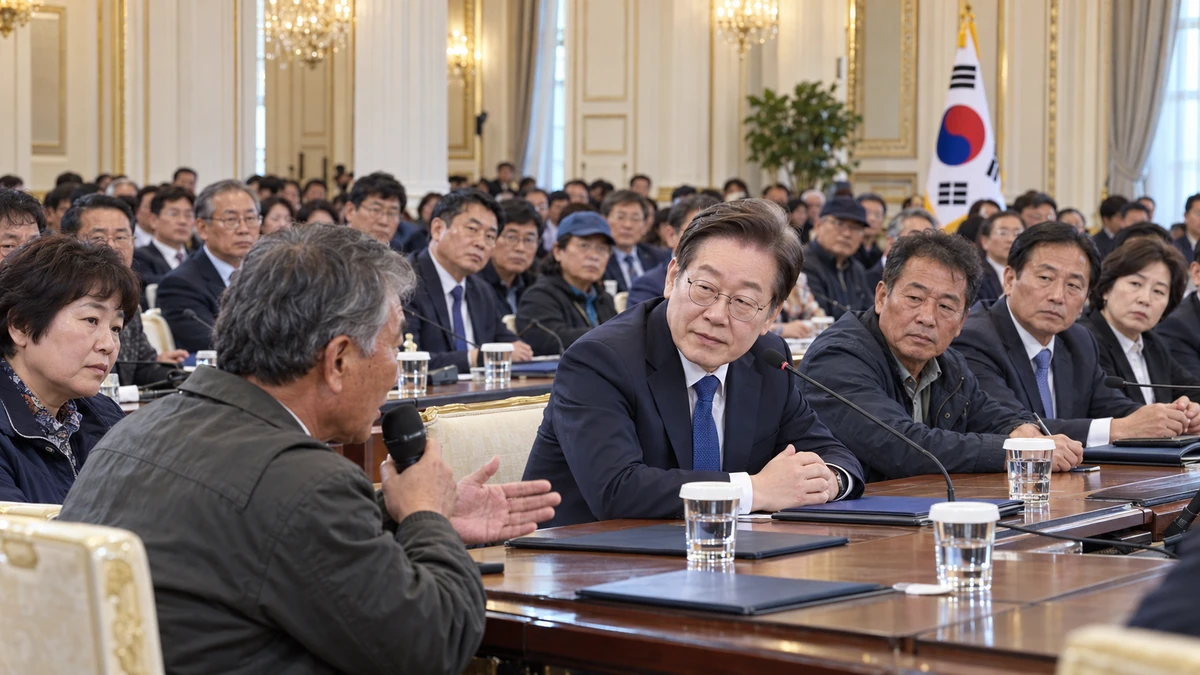
Lee meets directly with farmers and fishers
South Korean President Lee Jae-myung met with more than 110 farmers and fishers at the Blue House state guesthouse on Oct. 26, promising that changes to agricultural and trade policy would not impose unexpected losses on rural communities.
The event, billed as a presidential listening session, was the first large-scale meeting of its kind between a South Korean president and agricultural producers since 2018, according to the presidential office.
Lee described farming, fishing, livestock production and forestry as strategic industries tied to South Korea’s national security and survival. He said his administration was working to ensure that producers receive proper recognition for their labor through programs including a basic-income initiative for rural communities, income from solar-energy projects and a fund to modernize offshore fishing vessels.
Lee also rejected the idea that a smaller group should automatically bear losses because a policy benefits the majority. When particular communities are asked to make unusual sacrifices, he said, they should receive corresponding compensation.
His administration would seek compromise and mutual respect, Lee said, but officials must ultimately make decisions and accept responsibility when competing interests cannot be reconciled.
CPTPP application delayed pending consultations
Lee said the government would not apply this year to join the Comprehensive and Progressive Agreement for Trans-Pacific Partnership, commonly known as the CPTPP. The regional trade pact has raised concerns among South Korean farmers and fishers about increased competition from imported products.
The delay does not mean the government has abandoned the possibility of membership. Lee said he had instructed officials to consult extensively with agricultural communities before determining how to proceed.
Submitting an application would not guarantee approval, Lee said, and negotiations would be unlikely to conclude during his term. He acknowledged that pursuing membership could carry political costs but argued that the government must consider the country’s broader interests as well as the effects on producers.
South Korea cannot depend only on semiconductors, Lee said, but it also cannot rely solely on agriculture. The goal, he said, should be coexistence among the country’s major industries.
Nationwide farmland review draws concern
Lee also sought to reassure landowners about a nationwide farmland survey proposed by Agriculture Minister Song Mi-ryung. He said the review is legally required but has not been conducted for 70 years.
The survey is intended to identify land purchased under agricultural plans but left uncultivated or used for other purposes, Lee said. It is not aimed at inherited property or farmland that families have cultivated for generations, and the government does not intend to confiscate land or impose penalties merely because of the review.
Lee said improper use of farmland, particularly near the Seoul metropolitan area, has contributed to rising real estate prices.
Special legislation planned
The Ministry of Agriculture, Food and Rural Affairs announced Oct. 8 that it would pursue a special law overriding existing farmland rules in ordinary violation cases. Placing property with the country’s farmland bank would not be required to avoid a disposal order.
Cases involving suspected speculation would receive an opportunity for explanation. If authorities confirm that land was acquired through a false farming plan, the case would be handled under the current Farmland Act.
The ministry planned to introduce the special legislation in October and, if possible, complete the National Assembly process by December. Problems identified through the survey and implementation of the temporary law would be reflected in broader revisions to the Farmland Act planned for the first half of 2027.
Comments
Post a Comment