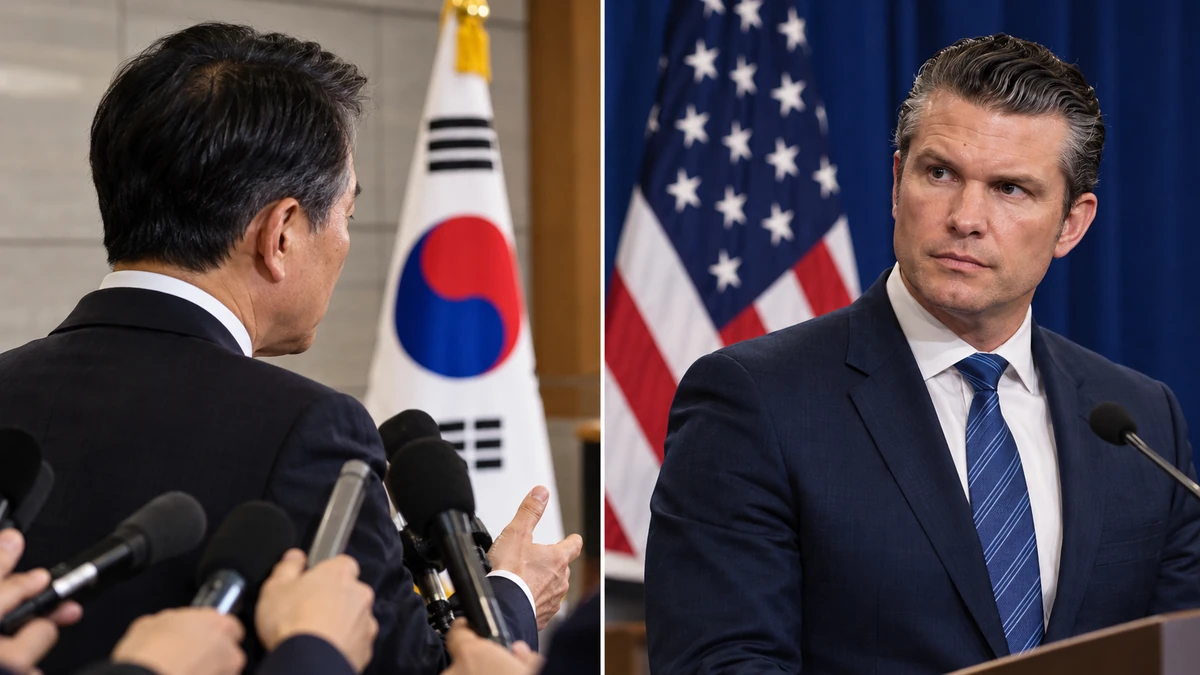
Image to help understand the article
First face-to-face talks under discussion
South Korean Defense Minister Kang Shin-chul and U.S. Defense Secretary Pete Hegseth are working to arrange their first in-person meeting on the sidelines of a regional security conference in the Philippines later this month, Kang said on the 14th.
Kang plans to attend the ASEAN Defense Ministers’ Meeting-Plus, known as the ADMM+, scheduled for around the 27th through the 30th. The gathering brings together defense officials from ASEAN’s 11 member countries and eight dialogue partners, including South Korea and the United States.
It remains unclear whether Kang and Hegseth would hold formal talks or a shorter, informal “pull-aside” meeting. Either format could give them an opportunity to discuss disagreements over the transfer of wartime operational control before the allies’ annual Security Consultative Meeting, or SCM.
Allies differ over conditions for command transfer
Wartime operational control, commonly shortened in South Korea to OPCON, refers to authority over South Korean forces during a war. The transfer from the current U.S.-led command structure is supposed to proceed only after both countries determine that agreed military conditions have been met.
Seoul has sought to complete an assessment of the future Combined Forces Command’s full operational capability at this year’s SCM, then establish a target year for the transfer and recommend it to the two countries’ presidents. The assessment is the second stage of a three-stage process.
The South Korean government considers the assessment effectively complete and is aiming to make 2028, before the end of President Lee Jae Myung’s term, the first year under the new command arrangement. The United States, however, reportedly believes the allies are not yet ready to set a transfer date and has emphasized acquiring essential military capabilities rather than moving according to a fixed timetable.
U.S. Forces Korea said the allies continue to work together to implement their agreements. It noted that their defense chiefs reaffirmed at last November’s SCM that all conditions in the bilateral transition plan must be satisfied.
Kang acknowledged that the two sides have different perspectives but said the gaps are not extensive and that discussions are continuing. A South Korean Defense Ministry official said the remaining differences would be addressed through consultations before the SCM, although two rounds of working-level defense talks in May and September reportedly failed to resolve them.
US commander stresses conditions
Gen. Xavier Brunson, commander of U.S. Forces Korea, reiterated during a U.S. think tank event on the 13th that the transfer must remain conditions-based. He said he would explain to President Donald Trump the risks of proceeding before all requirements are met.
Brunson previously told the House Armed Services Committee that the allies should aim to satisfy the conditions by the first quarter of 2029, later than Seoul’s target of 2028. Failure to complete the second-stage assessment this year could disrupt the South Korean government’s timetable.
Annual alliance meetings may shift to December
The SCM is usually held in late October or early November, but officials are discussing holding this year’s meeting in the United States around December. No date has been set. The South Korean defense leadership change, U.S. midterm elections in November and the war with Iran are believed to have affected scheduling.
The allies are also coordinating the annual Military Committee Meeting, led by their joint chiefs of staff and normally held shortly before the SCM. A South Korean Defense Ministry official said Seoul and Washington are reviewing mutually available dates, but no details have been finalized.
Comments
Post a Comment