Image to help understand the article
South Korea Surpasses Germany and Japan Combined
South Korea posted a current account surplus of $116.63 billion in the second quarter, ranking second behind China among 36 major economies with available data, according to International Monetary Fund figures published through the Bank of Korea’s economic statistics system.
China recorded the largest surplus at $193.72 billion. South Korea’s total was equivalent to 60.2% of China’s, up sharply from 22.7% a year earlier.
South Korea also exceeded the combined second-quarter surpluses of Germany and Japan for the first time since comparable records began in 1996. The two countries together posted $102.89 billion, $13.74 billion less than South Korea.
South Korea’s surplus was 4.1 times larger than a year earlier, while Germany’s increased 11.9% and Japan’s rose 5%. The trend continued in July and August, when South Korea recorded a combined surplus of $88.19 billion, exceeding the German and Japanese total by $7.37 billion.
Semiconductor Exports Drive the Surge
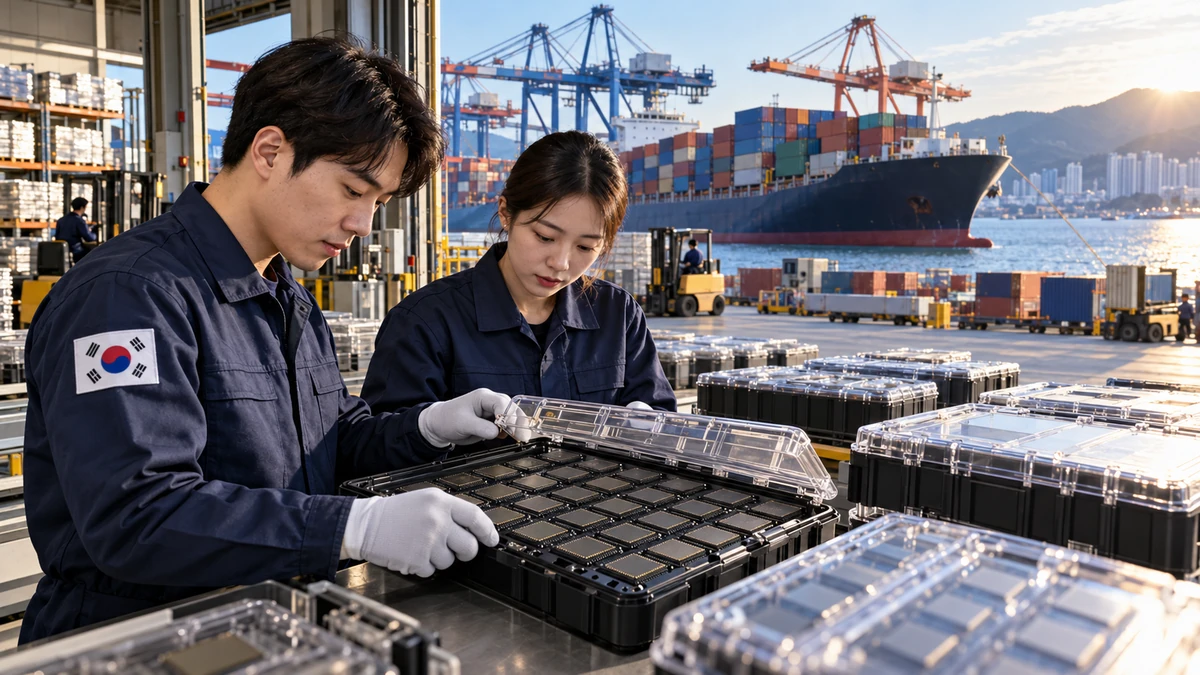
The expansion was powered by semiconductors, a cornerstone of South Korea’s export economy. Second-quarter chip exports jumped 181.6% from a year earlier to $113.89 billion. Third-quarter exports rose 218.7% to $148.02 billion.
Higher semiconductor prices increased export revenue even when shipment volumes remained unchanged. Citing strong chip exports, the Bank of Korea said the annual current account surplus could exceed its earlier $450 billion forecast and potentially approach $500 billion. Last year’s record surplus was $123.1 billion.
In its October World Economic Outlook, the IMF projected South Korea’s annual surplus at $421.95 billion, second only to China. The expected increase of $298.89 billion would be the largest among 190 countries and territories covered by the forecast. The surplus was projected to equal 18.8% of gross domestic product, well above South Korea’s previous high of 10.1% in 1998.
U.S. and China Market Risks
The outlook is closely tied to global spending on artificial intelligence, including demand from the United States, and to the semiconductor strategies of the world’s two largest economies. Analysts warned that weaker AI investment or increased memory-chip production by competitors could intensify price competition.
Another risk is that the United States and China could expand their domestic sourcing of memory chips, reducing South Korean producers’ market share and weakening exports to China.
Experts have called for South Korea to use the windfall to restructure struggling companies and strengthen industrial competitiveness before the chip cycle turns. The government is also seeking to expand domestic demand, encourage investment in emerging industries and improve service-sector competitiveness so growth is less dependent on semiconductor exports.
Comments
Post a Comment