Image to help understand the article
South Korea’s Leading Aircraft Manufacturer
Korea Aerospace Industries, commonly known as KAI, is South Korea’s primary developer and manufacturer of complete aircraft. The company developed the T-50 Golden Eagle advanced trainer and the Surion utility helicopter and, as of 2017, was the country’s largest defense contractor.
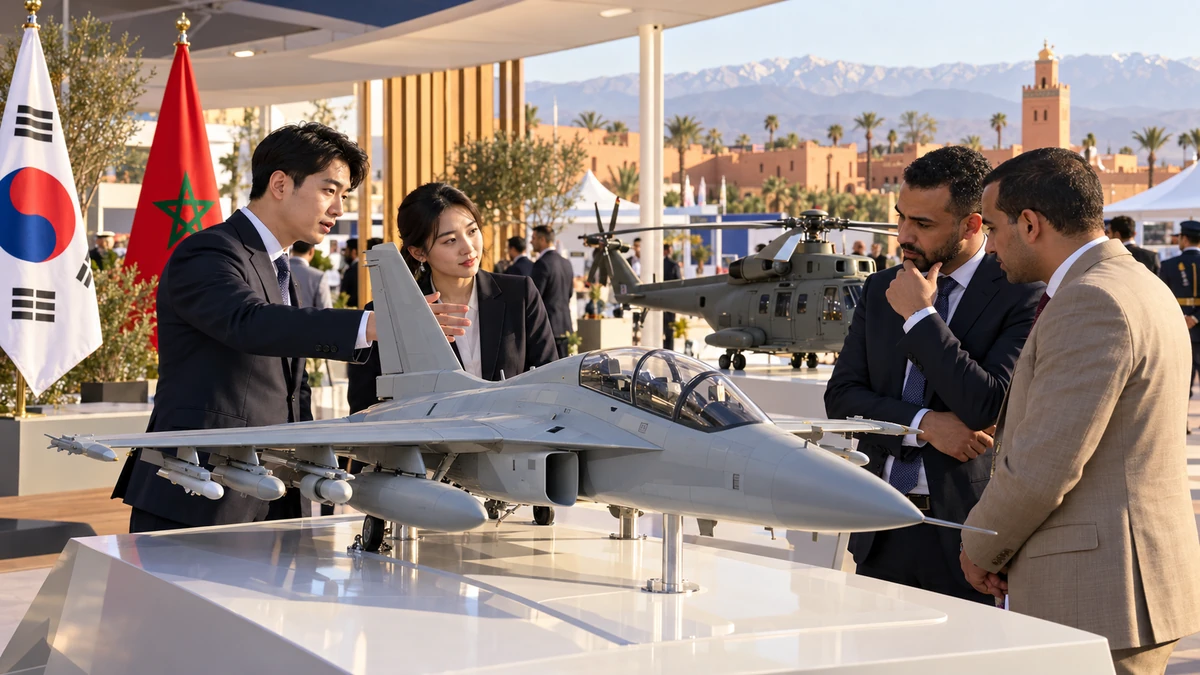
KAI drew attention on Google Trends on Oct. 9, 2026, although the reason for the surge in searches was not confirmed. News reports published that day included KAI’s first appearance at the Marrakech Air Show in Morocco and its effort to market the FA-50 light combat aircraft in Africa. Other reports covered a five-year, 114.5 billion won support contract for the South Korean Marine Corps’ amphibious maneuver helicopter, KAI’s participation in the IAC 2026 space event, the unveiling of a low-Earth-orbit satellite for 6G communications and efforts to diversify procurement channels for production of the KF-21 fighter.
Born From an Industry Restructuring
KAI was created in 1999 during corporate restructuring that followed South Korea’s financial crisis and International Monetary Fund bailout. The government of President Kim Dae-jung consolidated the struggling aerospace operations of Samsung Aerospace, Daewoo Heavy Industries and Hyundai Aerospace. Korean Air declined to join the combination.
The new company formally launched Oct. 1, South Korea’s Armed Forces Day. KAI moved its headquarters from Seoul to Sacheon, a city in South Gyeongsang province, in 2005. Its headquarters and airfield remain there, while the Sacheon office of the Defense Acquisition Program Administration oversees KAI products in the field.
KAI’s work extends beyond aircraft developed under its own name. It builds aircraft components, helicopters, missile-related systems, satellite launch vehicles and software. It also modifies, maintains and upgrades aircraft made by other manufacturers. The company has organized its operations around fixed-wing aircraft, helicopters, commercial aerospace work and long-term aircraft support.
Military and Commercial Programs
KAI’s military portfolio includes the KT-1 Woongbi basic trainer, the KA-1 tactical control and light attack aircraft, the T-50 Golden Eagle, the Surion helicopter and the Songgolmae corps-level reconnaissance drone. KAI has continued to support and upgrade the Songgolmae after its initial development and production.
The company has also worked on KF-16 Block 52+ fighters, wings and forward fuselage sections for the F-15K, fuselages for the AH-64D Apache helicopter and wings for the A-10C. Its modernization work includes upgrades for South Korea’s UH-60P helicopters and P-3C maritime patrol aircraft. KAI is also conducting research and development on optionally piloted stealth aircraft and stealth unmanned combat aircraft.
In the commercial sector, KAI has handled the KC-100 and KT-100 aircraft program and produced structures for Boeing and Airbus jets. Its work has included wings or wing structures for the Boeing 717, 747 and 787, parts of the Airbus A350 wing and fuselage sections for the A320 and A321. KAI participated in the Boeing 787 program as a joint development partner and has also manufactured structures for other Boeing commercial aircraft and a 25-seat Israeli passenger jet.
KAI’s space work includes participation in South Korea’s Arirang series of multipurpose satellites, including Arirang 1, 2, 3, 3A and 5.
The T-50 and Its American Partnership
The T-50 traces its origins to the KTX-2 program led by South Korea’s Agency for Defense Development. Concept studies and exploratory development ran from 1992 to 1997 before responsibility shifted to industry. Samsung Aerospace initially led the work, and KAI took over after the three-company merger.
South Korea’s Air Force provided 70% of the development funding, while U.S. defense company Lockheed Martin contributed 30% in the areas of flight controls and avionics. Full-scale development began in 1997 and concluded in January 2006.
Developed by KAI and Lockheed Martin under contract with the South Korean Air Force, the T-50 became the first supersonic aircraft developed in South Korea. Its successful flight made South Korea the 12th country to fly an independently designed supersonic aircraft.
The aircraft has a maximum speed of Mach 1.5 and comes in three principal versions: the T-50 advanced trainer, the TA-50 lead-in fighter trainer and the armed FA-50 light combat aircraft. The smaller aircraft weighs about 77% as much as an F-16, limiting some capabilities, but the FA-50 can perform combat missions as well as training duties.
KAI and Lockheed Martin have also teamed up to compete in the U.S. Navy’s program for a new advanced jet trainer, giving the Korean aircraft maker a direct connection to the American defense market. KAI’s manufacturing role on Boeing commercial programs provides another longstanding link between South Korea’s aerospace industry and major U.S. companies.
Next-Generation Aircraft
KAI’s major future programs include the Light Armed Helicopter and the KF-X fighter project, whose aircraft is now known as the KF-21. The fighter program was planned to replace South Korea’s aging F-4 and F-5 aircraft and is intended to provide a future mainstay for the country’s Air Force.
Additional details about KAI’s aircraft, space systems and support programs are available through the company’s official website.
Comments
Post a Comment