Image to help understand the article
Five Friends, Five Unequal Paths
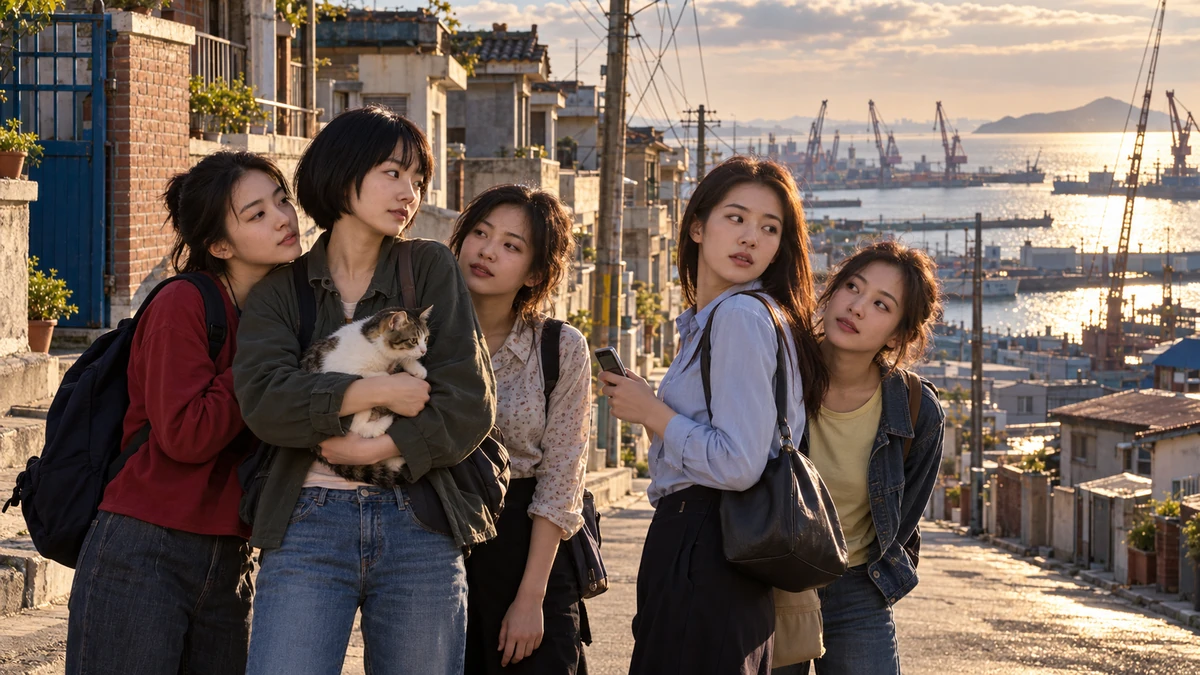
Jeong Jae-eun’s 2001 debut feature, “Take Care of My Cat,” follows five friends confronting the first sharp divisions of adulthood after graduating from a girls’ vocational business high school in Incheon, South Korea’s port city west of Seoul.
Released in South Korea on Oct. 12, 2001, the 112-minute drama centers on Tae-hee, Hye-joo, Ji-young and twin sisters Bi-ryu and Ohn-jo. Though the women attended the same school, differences in money, family circumstances and opportunity quickly pull them apart.
Hye-joo, played by Lee Yo-won, takes a job at a Seoul securities firm and dreams of professional success, only to find herself at the bottom of the office hierarchy. Ji-young, played by Ok Ji-young, has artistic talent but struggles to find work while living with her grandparents in a deteriorating home and imagining a future abroad.
Bae Doona plays Tae-hee, who works without pay at her family’s sauna and helps a poet with cerebral palsy by typing his work. Bi-ryu and Ohn-jo, played by Lee Eun-sil and Lee Eun-joo, are descendants of Chinese immigrants who live in Incheon’s Chinese community and sell handmade accessories on the street.
A Kitten Between Friends
A stray kitten named Titi becomes the thread connecting the women. Ji-young first takes in the cat, but responsibility for Titi shifts from friend to friend as their circumstances change, giving the film its title. Cellphone text messages and ringtones also recur as fragile links among friends who are gradually drifting apart.
Against Incheon’s industrial districts and harbor, the film traces how young women experience South Korea’s working world after graduation. Hye-joo faces rigid workplace rankings, Ji-young bears the pressure of poverty and unemployment, and Tae-hee feels isolated within a middle-class family. Tae-hee’s interest in a ferry terminal and foreign migrant workers further widens the film’s view beyond the five friends.
Festival Recognition and a Grassroots Rescue
“Take Care of My Cat” received the NETPAC Award and a special mention in the New Currents section at the 2001 Busan International Film Festival. It later earned special mentions from the international critics’ federation at the Hong Kong International Film Festival and from the Dutch film critics’ association at the International Film Festival Rotterdam. It won the Golden Moon of Valencia for best film at Spain’s Cinema Jove festival and screened in the Berlin International Film Festival’s Young Forum program.
The film also brought major domestic recognition to its cast and director. Lee Yo-won won best new actress at South Korea’s Blue Dragon Film Awards, while Jeong received honors including a special jury prize at the Chunsa Film Art Awards and new director of the year at the Director’s Cut Awards. Bae won best actress at the Baeksang Arts Awards, where Lee received the new actress prize.
Despite critical praise, the low-budget film struggled to secure broad distribution and faced an early end to its theatrical run. Film industry figures and Incheon residents joined efforts to keep it in theaters. Supporters also linked it with three other struggling Korean releases — “Waikiki Brothers,” “Raybang” and “Nabi” — in a campaign whose Korean name combined parts of the four titles.
From U.S. Theaters to Modern Classic
The film received theatrical releases in the United States as well as Japan, Hong Kong and Britain. Los Angeles Times critic Kevin Thomas praised it for addressing women’s concerns without becoming preachy. Although it was not a major commercial success, the movie developed a devoted following through strong reviews and audience advocacy.
Its reputation continued to grow. In 2020, The Guardian ranked “Take Care of My Cat” No. 19 on its list of classics of modern Korean cinema. A 4K restoration returned to South Korean theaters on Oct. 13, 2021, marking its 20th anniversary.
In 2025, director Lim Oh-jeong selected the movie as a work that deeply influenced her creative path, bringing it back to the Busan International Film Festival in a program examining Korean cinema’s history and future.
Comments
Post a Comment