Image to help understand the article
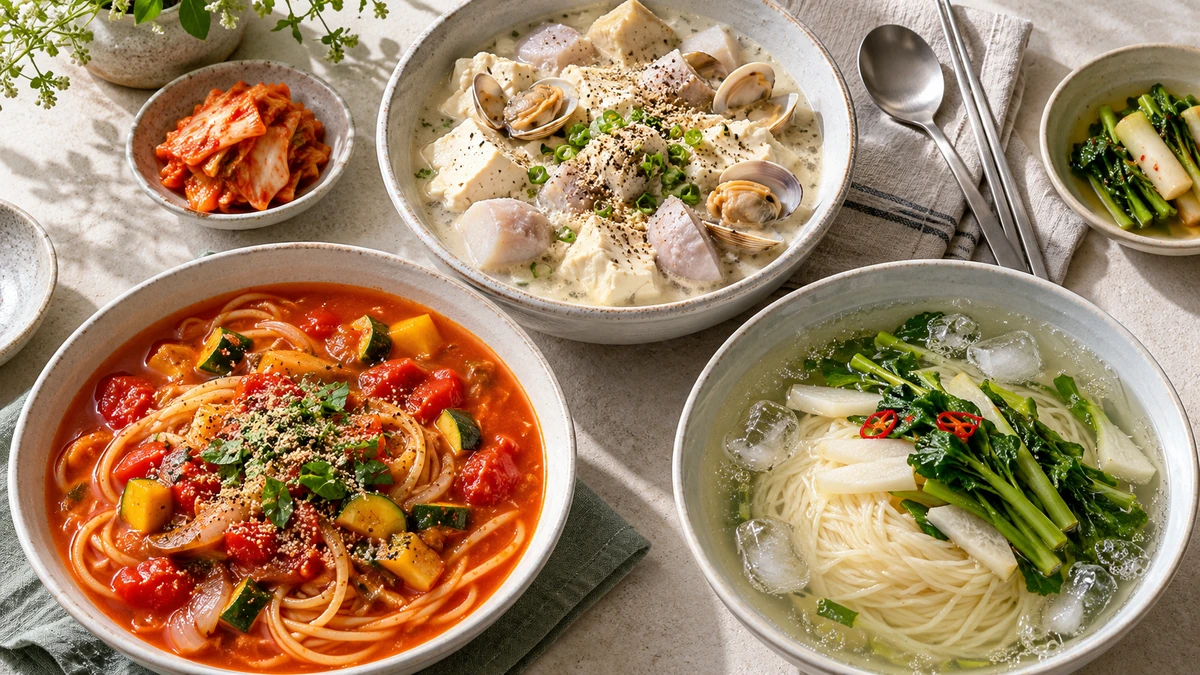
These three dishes from South Korea’s Ministry of Food and Drug Safety public recipe database offer different answers to the soup-or-main-course question. A taro and silken tofu stew draws depth from clams and ground perilla seeds, a tomato soup pasta leans on vegetables, and chilled konjac noodles pair young radish water kimchi with sparkling water. Each recipe uses strongly flavored ingredients to reduce reliance on salt.
Taro and Silken Tofu Stew
This Korean-style stew combines 40 grams of taro, 20 grams of shiitake mushrooms, 1 gram of red chile, 2 grams of Cheongyang chile, 150 grams of clams, 40 grams of ground perilla seeds and 150 grams of silken tofu. Cheongyang chiles are a small, notably hot variety commonly used in Korean cooking, while ground perilla seeds add a rich, nutty quality.
Cut the taro into 2-centimeter cubes, slice the mushrooms into strips and cut the chiles diagonally. Bring 500 milliliters of water to a boil, add the clams and cook until they open, creating the broth. Add the taro, ground perilla seeds and mushrooms. Once the broth begins to thicken, gently add the silken tofu and continue cooking. Finish with the sliced red and Cheongyang chiles.
The clams and perilla provide enough flavor to limit added salt. The database also highlights taro as an ingredient associated with sodium excretion. Listed nutrition per serving is 312.7 calories, 2.93 grams of carbohydrates, 3.48 grams of protein, 2.96 grams of fat and 409.2 milligrams of sodium.
Tomato Soup Pasta With Vegetables
This dish uses 200 grams of whole tomatoes, 100 grams of fresh tomato, 30 grams of minced onion, 20 grams of minced garlic, 25 grams of squid-ink pasta, 25 grams of cheese, 1 gram of dried parsley, 1 gram of glasswort salt and 30 grams of olive oil. The accompanying vegetables are 20 grams each of onion, eggplant, zucchini and bell peppers in two colors.
Chop the tomatoes. Sauté the garlic and minced onion in a pot, then blend them with the tomatoes to make a soup. Return the mixture to the heat and cook to mellow its acidity. Boil the squid-ink pasta, toss it with oil and sauté it. Cut the remaining vegetables into bite-size pieces and sauté them separately, then combine them with the pasta. Plate the mixture and top it with the tomato soup and finely chopped cheese.
The recipe uses tomatoes and an assortment of vegetables to supply flavor in place of additional salt. Listed nutrition is 282.6 calories, 37 grams of carbohydrates, 10.4 grams of protein, 10.4 grams of fat and 41.4 milligrams of sodium.
Chilled Konjac Noodles With Water Kimchi Broth
This light noodle dish calls for 200 grams of thin konjac noodles, 200 grams of young radish water kimchi broth, 25 grams of cucumber, one 60-gram egg, 20 grams of carrot, 50 grams of onion, 3 grams of sesame seeds, 15 grams of lemon juice, 50 milliliters of sparkling water and 5 grams of low-sodium fish sauce. Young radish water kimchi, known in Korea as yeolmu mul kimchi, is a cool, brothy form of kimchi rather than the thicker, chile-coated cabbage version more familiar to many Americans.
Julienne the onion, carrot and cucumber. Mix the kimchi broth with the sparkling water and fish sauce. Hard-boil the egg. Boil the konjac noodles with lemon juice to reduce their distinctive aroma, drain them and season them lightly with fish sauce. Place the noodles in a bowl, pour over the broth and garnish with the vegetables, egg and sesame seeds.
The sparkling water adds fizz to the refreshing kimchi broth, while the low-sodium fish sauce supplies savory flavor. Listed nutrition is 36.9 calories, 6.1 grams of carbohydrates, 0.1 gram of protein, 1.4 grams of fat and 490.7 milligrams of sodium.
Comments
Post a Comment