Image to help understand the article
A prince chooses monastic life
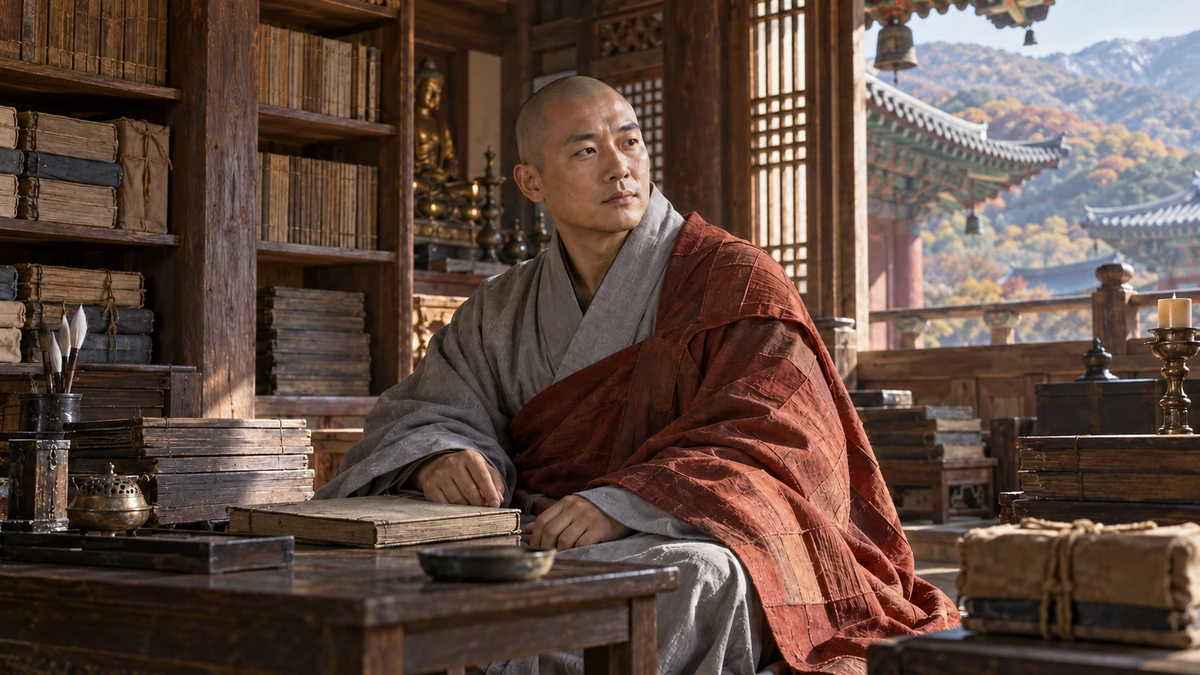
Uicheon, a Buddhist monk born into Korea’s royal family, became one of the most influential religious scholars of the Goryeo dynasty, which ruled the Korean Peninsula from 918 to 1392. Through scholarship, publishing and the establishment of the Korean Tiantai tradition, he sought to reconcile competing Buddhist schools and strengthen the kingdom.
Born Wang Hu in 1055 in Gaegyeong, the Goryeo capital in what is now North Korea, he was the fourth son of King Munjong and Queen Inye. He was also the younger brother of three future kings: Sunjong, Seonjong and Sukjong. When Munjong asked which of his sons would enter religious life, the young prince volunteered.
He became a monk in 1065 under his maternal uncle, the Buddhist leader Nanwon, and studied at Yeongtong Temple. Uicheon ranged beyond the traditional Buddhist canon of sutras, monastic rules and philosophical treatises, also studying Confucian classics, history and other schools of thought. After his teacher’s death, he continued Nanwon’s lectures. In 1067, Munjong gave him the title Use and appointed him seungtong, a senior position in the Buddhist establishment.
Studying across East Asia
Goryeo Buddhism was divided among several schools, with particularly sharp tension between Seon, the Korean form of Zen, and doctrinal traditions centered on scriptural study. Uicheon immersed himself in both approaches and became a leading authority on Buddhist thought.
After corresponding with the Song dynasty monk Jingyuan, Uicheon sailed for China in 1085 despite King Seonjong’s objections. The Goryeo court sent attendants after learning of his departure, while Song Emperor Zhezong assigned an official to guide the delegation.
During his travels, Uicheon met more than 50 prominent monks. In the Song capital of Bianjing, he studied Huayan thought and visited monks associated with the Yunmen school. He also met an Indian monk who told him about Indian society and learning. In Hangzhou, Uicheon and Jingyuan discussed major Buddhist scriptures and the Tiantai and Huayan traditions.
At Mount Tiantai, Uicheon paid homage at the memorial shrine of Zhiyi, the tradition’s foundational Chinese teacher, and vowed to revive Tiantai Buddhism in Goryeo. His reputation also reached the neighboring Liao dynasty. Emperor Daozong reportedly received Buddhist precepts from him and continued sending scriptures, tea, incense, gold and silk after Uicheon returned home.
Building a Buddhist library
Uicheon returned to Goryeo in 1086 with more than 3,000 volumes of Buddhist writings. Welcomed by the king and queen, he became head of Heungwang Temple, where he organized Tiantai teachings, trained disciples and maintained exchanges of books and letters with Song scholars. He sent Jingyuan 2,000 nyang of gold to support work on the Avatamsaka Sutra and construction of a scripture repository.
His signature undertaking was the Gyojang, a collection devoted to commentaries on Buddhist scripture. Uicheon established a government-supported publishing office at Heungwang Temple and assembled about 4,000 texts obtained from Goryeo, Song China, Liao China and Japan. The project produced roughly 4,740 volumes known as the Goryeo Supplementary Canon.
He also compiled the three-volume “New Comprehensive Catalog of the Doctrinal Canon.” Rather than listing the main Buddhist scriptures themselves, it cataloged commentaries on the traditional canon. It was the first such bibliography produced in Korea.
Founding the Korean Tiantai school
After serving at several major temples, Uicheon became the first head of the newly constructed Gukcheong Temple in 1097. There he formally established the Korean Tiantai school, known as Cheontae in Korean.
Uicheon used Tiantai teachings to bridge meditation and textual study, hoping to bring Seon and doctrinal Buddhism into closer alignment. His broader goal was to unify a fragmented religious establishment and reinforce the foundations of the state. The school held its first examination for monks in 1099, followed two years later by a state-administered advanced examination.
Uicheon trained more than 160 prominent monks, including Gyogung, Jing-eom and Sugye. King Sukjong’s son, also named Jing-eom, entered monastic life under Uicheon and continued his religious lineage. Uicheon also sustained correspondence with monks and Buddhist scholars in Song China.
Scholar, translator and policy adviser
Uicheon’s influence extended beyond religion. During Sukjong’s reign, he advocated minting coins, drawing on what he had observed in China. The king subsequently created a government minting office and issued coins including the Haedong Tongbo and Samhan Tongbo in an effort to promote currency circulation.
Uicheon produced numerous scholarly works, including a 22-volume collection of Buddhist writings and a 250-volume Buddhist encyclopedia. He also translated and lectured in the Korean language on more than 300 volumes, including 180 volumes of the Avatamsaka Sutra.
Most of his writings have been lost. Surviving materials include his three-volume catalog, incomplete copies of collections assembled after his death, portions of other works and the preface to one of his philosophical studies.
Remembered as Daegak Guksa
On Oct. 3, 1101, Sukjong appointed Uicheon the kingdom’s national preceptor, its highest-ranking Buddhist adviser. Gravely ill, Uicheon urged the king to protect Buddhism and said his ambition had been to restore the true path of the faith. He died later that year at Chongji Temple. He was recorded as 47 years old and had spent 36 years in monastic life.
Sukjong suspended court business, declared a temporary holiday and personally oversaw the cremation ceremony. Uicheon’s relics were placed in a stone chamber on a mountain east of Yeongtong Temple. Memorial inscriptions were later erected at Yeongtong and Seonbong temples.
Uicheon received the posthumous title Daegak Guksa, or National Preceptor of Great Enlightenment. He is remembered for organizing Buddhist scholarship, publishing the supplementary canon, bringing new learning from Song China and founding the Cheontae school as a means of religious reconciliation. The modern Cheontae Order of Korean Buddhism honors him as the reviver of its Korean tradition and one of its three principal patriarchs.
Comments
Post a Comment