Image to help understand the article
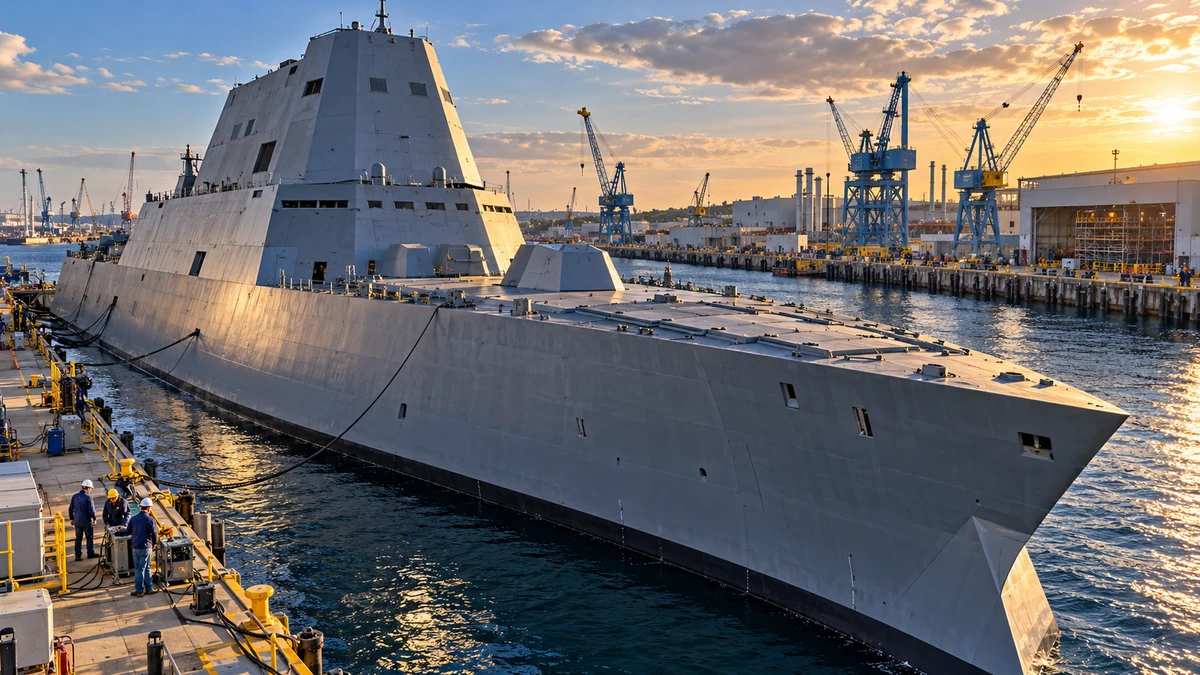
The U.S. Navy has begun preparing the USS Lyndon B. Johnson, the third and final Zumwalt-class destroyer, for sea trials, according to an announcement dated Oct. 19, 2026. Work to inspect the ship’s propulsion, steering and combat systems is expected to continue through October 2028.
The Navy awarded a $99 million contract modification to HII’s Ingalls Shipbuilding for the sea-trial preparations. The ship, designated DDG-1002, is scheduled to enter service in 2027.
Hypersonic Weapons Planned
The Lyndon B. Johnson is designed to carry as many as 12 Conventional Prompt Strike hypersonic missiles in four vertical launch tubes installed near its bow. The first shipboard launch test is planned for 2027.
Zumwalt-class ships are stealthy, multipurpose destroyers developed with an emphasis on attacks against targets on land. The Navy initially planned to build 32, but cost overruns reduced the class to three ships.
What Defines a Destroyer
Destroyers escort larger vessels in fleets, convoys and aircraft carrier strike groups while defending against multiple types of threats. Their name reflects their original mission of defeating torpedo boats that threatened larger warships.
Modern guided-missile destroyers have grown significantly in size and firepower. The U.S. Navy’s Sumner-class destroyers displaced about 2,200 tons, while Arleigh Burke-class ships displace about 9,600 tons. By the early 21st century, destroyers had become the global standard for major surface combatants. Only the United States and Russia officially operate the larger category of cruisers, while China’s Type 055 destroyer has been described as a cruiser in some U.S. Navy reports because of its size and armament.
Ship classifications are not always consistent among allied navies. Several NATO members, including Canada, France, Spain, the Netherlands, Denmark and Germany, use the term frigate for some ships that might be considered destroyers elsewhere.
South Korea’s Destroyer Fleet
South Korea operates three principal destroyer classes: the roughly 3,000-ton Gwanggaeto the Great class, first launched in 1997; the roughly 4,000-ton Chungmugong Yi Sun-sin class; and the roughly 10,000-ton Sejong the Great class.
The Gwanggaeto the Great class carries 48 Sea Sparrow missiles and uses rotating radar, while the Chungmugong Yi Sun-sin class carries 48 SM-2 missiles and also uses rotating radar. The Aegis-equipped Sejong the Great class carries 128 cruise missiles for air defense, anti-submarine warfare and land attack, along with 16 anti-ship missiles and four phased-array radar panels providing coverage in all directions.
Other prominent destroyer classes include the U.S. Arleigh Burke and Zumwalt classes, Russia’s Sovremenny and Udaloy classes, Britain’s Daring and Type 42 classes, and the French-Italian Horizon class.
Comments
Post a Comment