Image to help understand the article
Krill oil comes from a key Antarctic species
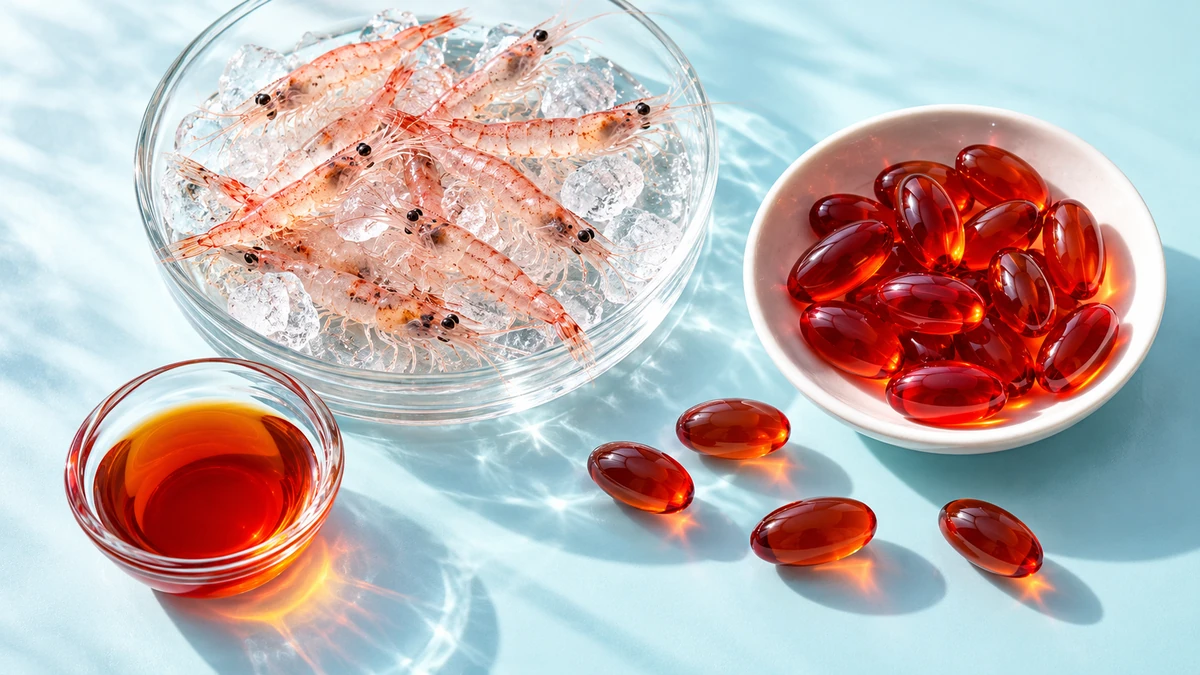
Krill oil is a lipid extract made from Antarctic krill, a small marine crustacean known scientifically as Euphausia superba. Krill resemble shrimp but are not closely related to them. They can grow to about 2 inches long and occupy a particularly important place in the Southern Ocean food chain.
The oil primarily contains phospholipids and the omega-3 fatty acids EPA and DHA. Phosphatidylcholine, a type of phospholipid, accounts for about 34 grams per 100 grams of oil. Krill oil’s red color comes from astaxanthin, a carotenoid pigment whose concentration can range from 0.1 to 1.5 milligrams per milliliter depending on processing. Commercial products are commonly sold in capsules.
According to a European Food Safety Authority assessment, Antarctic krill lipid extract is produced using acetone. Krill residue, including protein, is filtered out, while the acetone and remaining water are removed through evaporation. The resulting extract contains phospholipids, EPA and DHA omega-3 fatty acids, and astaxanthin.
South Korea recognizes specific ingredients, not every product
The Korea Consumer Agency says krill oil products sold domestically are classified as conventional foods rather than health functional foods, South Korea’s regulated category for products carrying officially recognized health claims. They may be marketed under categories such as fish oil or other processed seafood products.
Separately, South Korea’s Ministry of Food and Drug Safety has recognized three specific krill-based ingredients for limited health functions. FJH-KO krill oil is recognized as potentially supporting joint health and circulation by helping inhibit platelet aggregation. Superba Boost krill oil is recognized as potentially helping reduce body fat. FlexPro MD, a krill oil-based compound, is recognized as potentially supporting joint health.
The recognized daily intake also differs by ingredient: 1.5 grams for FJH-KO, 1 to 2 grams for Superba Boost and 462 milligrams for FlexPro MD. The recognition applies to the designated ingredients and their stated uses, not automatically to every krill oil product on store shelves.
Medication and health warnings vary
South Korean guidance says infants, children, pregnant or breastfeeding people, those prone to allergies and people with certain medical conditions should use caution with all three ingredients. Anyone who experiences an adverse reaction should stop taking the product and consult a health professional.
People with medical conditions or those taking medication should consult a professional before using FJH-KO or FlexPro MD. Consumers considering Superba Boost should seek advice if they take anticoagulant or antiplatelet drugs. Excessive consumption of FlexPro MD may temporarily turn the skin yellow and may interfere with beta-carotene absorption.
U.S. health agencies offer similar omega-3 precautions
MedlinePlus, a service of the U.S. National Library of Medicine, advises people with allergies to fish or shellfish and those taking prescription drugs, over-the-counter medicines, vitamins, dietary supplements or herbal products to tell a doctor or pharmacist before taking omega-3 supplements. It also recommends medical consultation for people who are pregnant, planning a pregnancy or breastfeeding, as well as those with diabetes, atrial fibrillation or flutter, or liver, thyroid or pancreatic conditions.
Common side effects listed by MedlinePlus include belching, heartburn, stomach pain or discomfort, joint pain, vomiting, constipation, diarrhea, nausea and changes in taste. The National Center for Complementary and Integrative Health, part of the National Institutes of Health, says omega-3 supplement side effects are generally mild but may include an unpleasant taste, bad breath, strong-smelling sweat, headache, heartburn, nausea and diarrhea.
Krill oil supplements are not medicines. Consumers with health conditions or those taking medications or other supplements should discuss their use with a qualified health professional.
Comments
Post a Comment