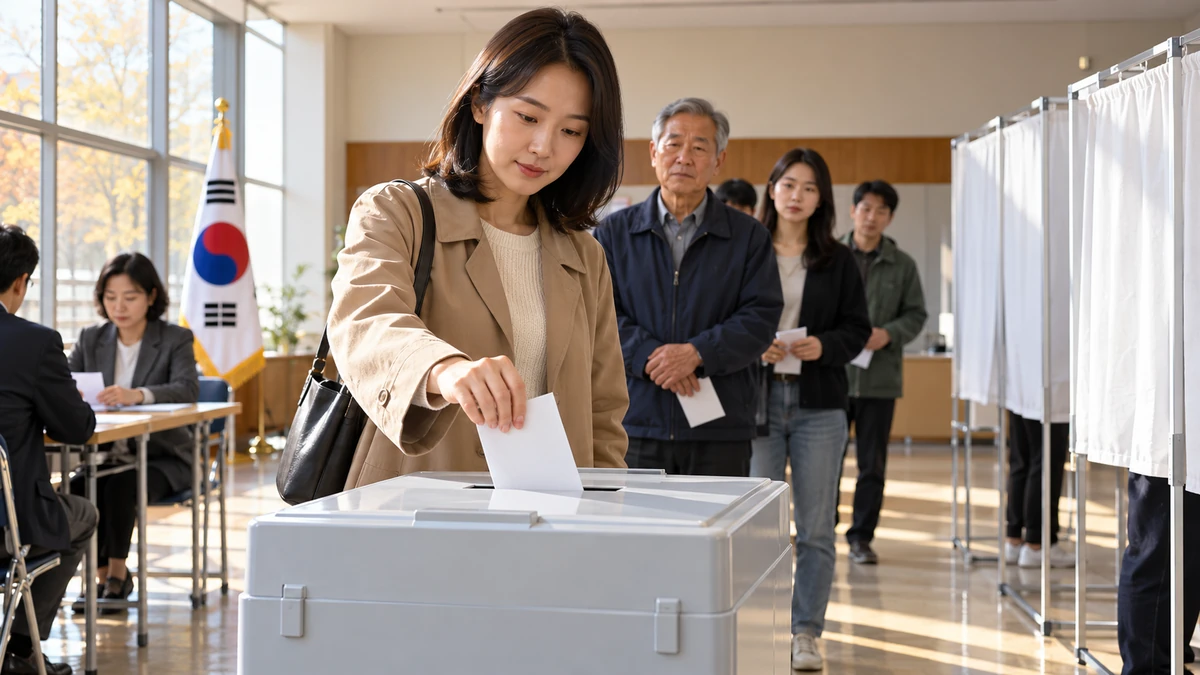
Image to help understand the article
Election-related searches surged on Google Trends in South Korea on Oct. 13, 2026, drawing attention to the basic rules governing how public officials and other representatives are chosen.
Elections are collective decision-making procedures usually conducted through voting. Although national contests for president and members of the National Assembly — South Korea’s legislature — carry the greatest political weight, elections are also common in labor unions, churches, companies and schools.
By selecting representatives, voters indirectly help determine the government and the country’s political direction. That process provides democratic legitimacy for the exercise of state power.
South Korea’s Four Election Principles
South Korea’s Constitution applies four central principles to presidential and National Assembly elections: universal, equal, direct and secret voting.
Universal suffrage gives voting rights to all residents who meet the age requirement. Equal voting means each person’s ballot carries the same value. In a direct election, voters choose candidates themselves, while a secret ballot prevents others from learning how an individual voted.
The entire group entitled to participate forms the electorate, and each voter expresses a choice through a ballot. Voting is generally conducted in writing, though other systems can include signed ballots or votes by a show of hands. A winning candidate gains the office after accepting the selection.
Election Days and District Boundaries
South Korean elections are generally held on Wednesdays. National Assembly elections take place in April, while local elections are held in June. Voters must present identification that confirms their identity at the polls.
When drawing electoral districts for provincial and metropolitan councils, authorities consider not only population but also regional representation and significant population differences between urban and rural areas. Population deviations of up to 60% are permitted among districts for lower-level local councils.
The National Assembly has broad discretion in drawing districts. However, boundaries that undermine equal voting power without a reasonable justification can be ruled arbitrary and unconstitutional.
Secret and Open Voting
Secret ballots, now used in most countries, keep each voter’s choice private. Open voting makes those choices visible to observers or other third parties, as in black-and-white ballot systems or voting by a show of hands. Such public methods are frequently associated with fraudulent elections.
The U.S. Electoral Connection
Search suggestions on South Korea’s Naver platform also pointed users toward U.S. midterm elections. The United States uses an Electoral College in presidential contests, meaning voters choose electors who formally select the president. The source grouped the United States with geographically large countries, including Russia and Brazil, in discussing indirect election systems and the complications created by distance and time zones.
Comments
Post a Comment