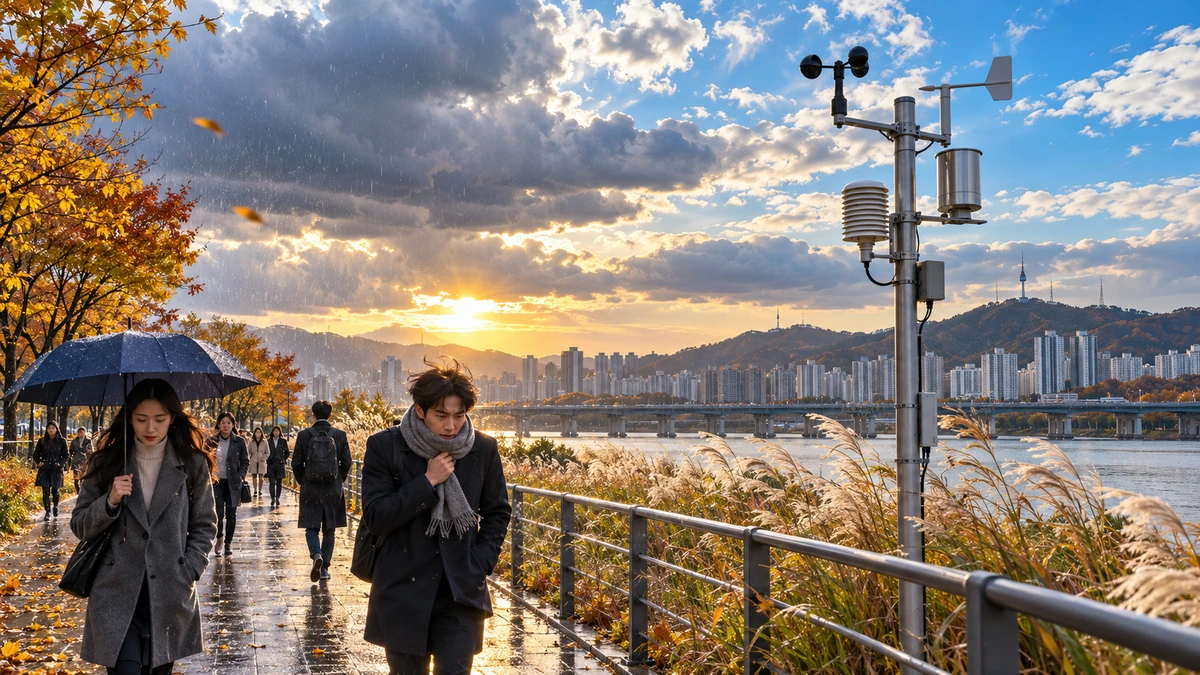
Image to help understand the article
The Korean term for meteorology rose among Google Trends’ fastest-growing searches on Oct. 15, 2026, as news reports focused on colder morning temperatures, early-winter conditions, cooperation between weather and electric-power technologies, and the National Institute of Meteorological Sciences’ greenhouse gas analysis capabilities.
Weather, Meteorology and Climate
In Korean, “gisang,” written with Chinese-derived characters meaning atmospheric phenomena, refers broadly to physical events in the atmosphere, including precipitation, wind and clouds. It is sometimes used interchangeably with words meaning “weather,” but the terms are not identical: Weather generally describes atmospheric conditions on a particular day, while meteorology can encompass larger phenomena such as typhoons and cloud systems.
Meteorological conditions usually describe changes over relatively short periods, from several hours to part of a day. Climate refers to average atmospheric conditions over a much longer period. Although Earth’s atmosphere extends more than 1,000 kilometers, or about 620 miles, most familiar weather — including clouds and precipitation — occurs in the troposphere, its lowest layer.
How Weather Phenomena Are Classified
The World Meteorological Organization groups meteorological phenomena into four broad categories. Water-related phenomena include rain, snow, hail, fog, mist, frost, ice needles and waterspouts. Dust-related phenomena involve solid particles with little or no water or ice, including yellow dust, haze and smoke. Optical phenomena created by reflection, refraction, diffraction or interference include halos, coronas, iridescent clouds, rainbows and mirages. Electrical phenomena include lightning, St. Elmo’s fire and auroras.
How Forecasts Are Made
Weather forecasting combines measurements of current atmospheric conditions with scientific understanding of atmospheric processes to estimate what will happen at a particular place and time. Observers measure factors such as temperature and air pressure while tracking precipitation, clouds and other visible conditions.
Because the atmosphere covers an enormous area and extends far above the surface, observations must come from many locations and elevations. Networks include ground, marine and mountain stations, as well as upper-air and very-high-altitude systems. Specialized observations also support agriculture, aviation and water management.
Ground-based equipment includes rain gauges, snow gauges and radar, while satellites and radiosondes — instrument packages carried through the atmosphere — collect data at higher altitudes.
Why Forecasts Can Vary Within Seoul
The spacing between observation stations affects the size of the weather systems forecasters can detect. Stations placed about 300 kilometers, or 186 miles, apart can identify systems at least that large, including weather fronts. Stations spaced about 50 kilometers apart can capture smaller systems and localized heavy rainfall. Denser networks can detect still smaller events.
That helps explain why a forecast calling for cloudy conditions across Seoul can coincide with sunshine or rain in particular neighborhoods. Small-scale events are scattered within larger weather systems and generally last for shorter periods. An individual cloud formation may persist for only minutes, while high- and low-pressure systems can remain for several days.
How Google Labels Conditions
Google Weather divides rain into categories such as drizzle, showers, heavy rain, wind-driven rain and cold rain. Snow labels include snow showers, temporary heavy snow, light snow and ice pellets. Sky conditions range from cloudy and mostly cloudy to partly cloudy, mostly sunny and clear. Other categories include sleet, wind, fog and hail.
Comments
Post a Comment