Image to help understand the article
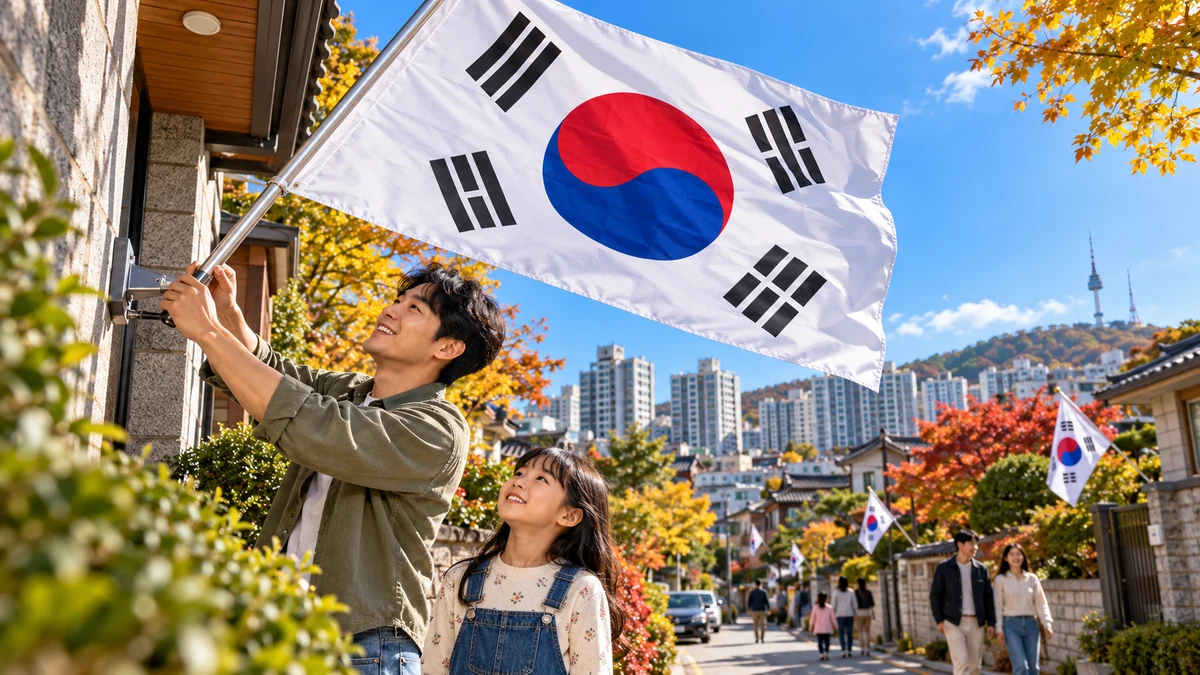
South Korea observes Gaecheonjeol, or National Foundation Day, each year on Oct. 3, commemorating the traditional founding of Gojoseon, Korea’s earliest kingdom, by the legendary ruler Dangun Wanggeom. The national flag, known as the Taegeukgi, is flown for the holiday.
The holiday drew heightened online interest as South Koreans searched for long-weekend weather and travel information, regional events and traffic restrictions on major roads in Seoul.
What Gaecheonjeol Means
Gaecheonjeol literally means “the day heaven opened.” One interpretation connects the phrase to Hwanung, a figure in Korea’s foundation mythology who descended from heaven to a sacred tree on Mount Taebaek. Another associates it with Dangun’s establishment of Gojoseon in 2333 B.C., according to traditional chronology.
Daejonggyo, a Korean faith centered on Dangun, traces the occasion further back. Its tradition places Hwanung’s descent on the third day of the 10th lunar month in 2457 B.C., when he began pursuing the ideals of benefiting humanity and creating a harmonious world.
Rituals honoring heaven are central to the holiday. Koreans historically called the 10th lunar month sangdal, meaning an exalted or sacred month, and held ceremonies of reflection tied to the ideals attributed to Dangun before the modern name Gaecheonjeol came into use.
How Oct. 3 Became the Official Date
The observance was originally held on the third day of the 10th lunar month. Its roots include a custom in areas such as Hamgyong province, now largely in North Korea, where residents marked what they regarded as Dangun’s birthday with a rite called Hyangsan-je.
After Daejonggyo was reorganized in 1909, followers made the date an annual celebration. The Korean Provisional Government, established in 1919 during Japan’s colonial rule, also designated it as a national foundation commemoration.
South Korea fixed the holiday on Oct. 3 under the 1949 law governing national holidays. Officials concluded that there was no precise way to convert the traditional lunar date to the solar calendar every year but decided to preserve the symbolic numbers 10 and 3. The holiday has remained on the solar-calendar date since then.
Rituals, Festivals and Song
Traditions of offering rites to heaven continued after Gojoseon disappeared. Ancient states held related celebrations under different names, including Dongmaeng in Goguryeo, Yeonggo in Buyeo and Mucheon in Dongye. Such observances continued in various forms through the Goryeo and Joseon dynasties. They were not only solemn ceremonies but also communal festivals featuring food, drink and entertainment.
The modern Gaecheonjeol song also grew out of Daejonggyo tradition. It was revised into its current form after the observance became a national holiday, with lyrics by Jeong In-bo and music by Kim Seong-tae. The song honors Dangun as a revered ancestor and pledges to carry forward and illuminate his ideals.
Comments
Post a Comment