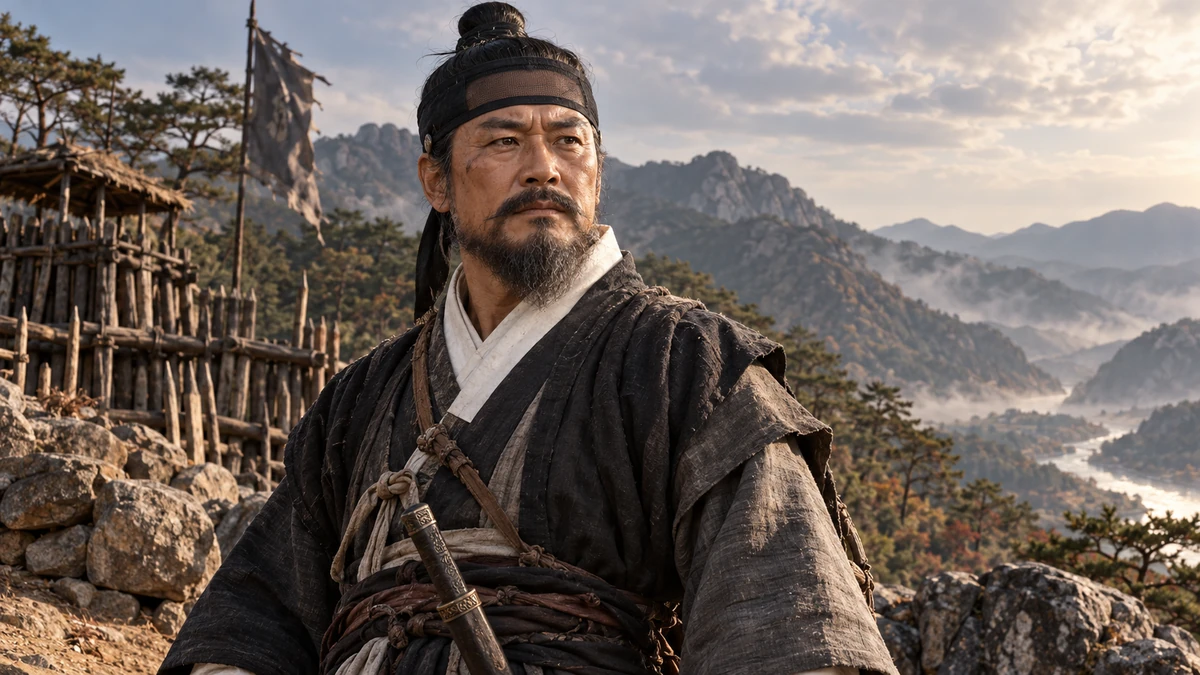
Image to help understand the article
From military officer to rebel commander
Yi Gang-nyeon, one of the leading commanders of Korea’s anti-Japanese “righteous armies,” organized armed resistance across central and eastern Korea before his capture and execution in 1908. The volunteer forces, known in Korean as uibyeong, fought Japanese troops and Korean officials viewed as collaborators during the final years of the Joseon dynasty and the Korean Empire.
Born in 1858 in Mungyeong, in what is now North Gyeongsang province, Yi was the only son of Yi Gi-tae and a descendant of Prince Hyoryeong, a son of King Taejong. He passed the military civil service examination in 1880 and served as an officer, but resigned after the failed Gapsin Coup of 1884 and returned home. During the 1894 Donghak Peasant Movement, he commanded local fighters against Japanese troops and corrupt officials.
Raising the righteous armies
After the 1895 assassination of Queen Min, later honored as Empress Myeongseong, and a government order requiring Korean men to cut their traditional topknots, Yi used his family’s wealth to prepare an uprising. He raised a volunteer army in Mungyeong on Jan. 11, 1896, and later joined the force led by Confucian scholar and resistance leader Yu In-seok.
Serving as a guerrilla commander, Yi operated around Mungyeong, Pyeongcheon and the strategic Joryeong mountain pass. After government troops defeated the force at Jecheon in April 1896, Yu moved into Liaodong, China. Yi disbanded his unit and followed him, spending three years there before returning to Korea and devoting himself to study in Danyang.
Yi took up arms again in 1907 after Emperor Gojong was forced to abdicate following Korea’s unsuccessful effort to seek international support at The Hague and the Korean military was dissolved under a treaty imposed by Japan. From Yeongchun, Yi joined forces with troops led by Min Geung-ho, a former Korean army officer, and attacked Chungju before fighting Japanese forces at Jecheon.
A campaign across three provinces
Yi’s fighters recorded successes at locations including Ssaritjae, Jungnyeong, Goripyeong and Baekjadong in late 1907. That December, volunteer armies from across Korea assembled in Yangju to create a 13-province coalition intended to advance on Seoul. Yi served as the coalition’s commander for the Hoseo region, an older name associated with the Chungcheong provinces, though the planned offensive did not succeed.
He resumed operations in early 1908, leading battles from Yongso-dong and Galgi-dong to Baekdamsa temple and Seobyeok in Andong. His forces also fought around Gapyeong, Inje, Gangneung and Yangyang. Drawn largely from Gangwon, Chungcheong and North Gyeongsang provinces, Yi’s soldiers benefited from their knowledge of the mountainous terrain. Their strict discipline and strong support among local residents made the unit one of the volunteer forces most feared by the Japanese military.
Capture, execution and legacy
Yi was shot in the ankle and captured during a battle with Japanese troops at Cheongpung and Jakseong on June 4, 1908. He was detained by the Japanese garrison in Suwon, transferred to the Japanese military police command in Seoul and sentenced to death on Sept. 22. He was hanged at Seodaemun Prison in Seoul later that year.
In accordance with his wishes, Yi’s body was released to two of his sons and fellow commander Kwon Yong-il. He was first buried near the tomb of Prince Hyoryeong in Gwacheon, then reburied in Jecheon and later in Sangju. His surviving writings were collected in the “Ungang Literary Collection,” while his students and former fighters compiled a chronicle of his resistance activities.
Yi’s family was forced to leave its hometown because of his anti-Japanese campaign. During their absence, Japanese settlers and a Korean who had served in the colonial police were said to have seized roughly 3,000 pyeong of his land in Mungyeong — about 2.5 acres — after threatening his son and forcing him to stamp documents portraying the transfer as a sale.
South Korea posthumously awarded Yi the Republic of Korea Medal of the Order of Merit for National Foundation in 1962, the country’s highest class of decoration for contributions to Korean independence.
Comments
Post a Comment