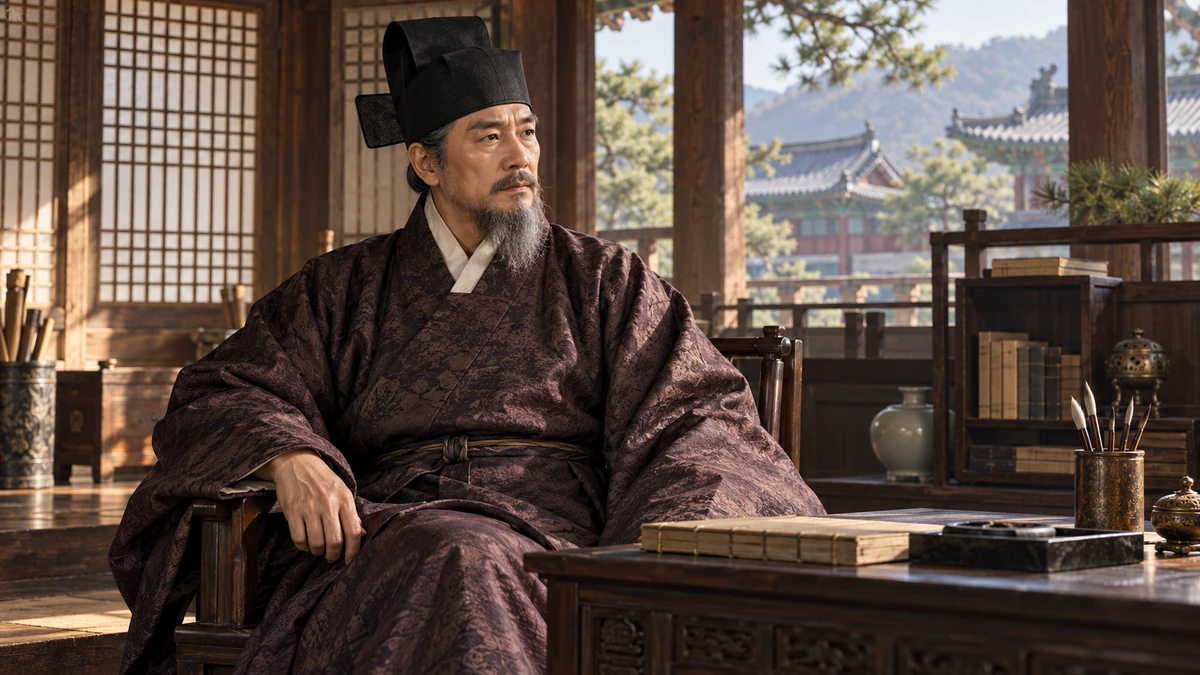
Image to help understand the article
Yi Saek was a scholar and senior official during the final decades of Korea’s Goryeo dynasty, which ruled from 918 to 1392. Through his leadership at the kingdom’s highest educational institution, he helped spread Neo-Confucian thought and trained scholars who would become leading figures on both sides of Korea’s dynastic transition.
Yet when Yi Seong-gye founded the Joseon dynasty after Goryeo’s collapse, Yi Saek refused repeated calls to serve the new government. His decision made him an enduring symbol of loyalty to a fallen kingdom.
A Scholar in Late Goryeo
Yi was born in 1328 in what is now Yeonghae, part of Yeongdeok County in southeastern South Korea. He is often known by his pen name, Mogeun. His father, Yi Gok, was a high-ranking official, and Yi Saek studied under Yi Je-hyeon, one of Goryeo’s prominent Confucian scholars.
Yi Saek is traditionally grouped with Jeong Mong-ju and Gil Jae as the “Three Euns,” three noted scholars of late Goryeo whose pen names each contained the Korean character “eun.”
He began studying classical texts as a child and learned the teachings associated with the Chinese thinkers Cheng Hao and Zhu Xi. In 1348, he traveled to the Yuan dynasty in China and entered its national academy, where he pursued Neo-Confucian studies. After returning to Goryeo following his father’s death in 1351, he lectured on the philosophy and ritual practices he had encountered there.
His students included Jeong Mong-ju, Jeong Do-jeon, Yi Sung-in, Gwon Geun and Ha Ryun. Some remained loyal to Goryeo, while others later helped establish and administer Joseon.
Scholarship and Government Reform
Yi’s career combined scholarship with public service. In 1352, he submitted reform proposals to King Gongmin addressing land administration, national defense, education and the political influence of Buddhism. He placed first in regional civil service examinations the following year and later distinguished himself in the Yuan dynasty’s examinations.
After holding posts connected to the Yuan imperial academy and official historical compilation, Yi returned to Goryeo and served in a succession of government positions. He proposed abolishing the Jeongbang, an office that wielded influence over personnel appointments, and promoted the Confucian practice of a three-year mourning period for parents.
When the Red Turban forces invaded Goryeo in 1361, Yi accompanied King Gongmin as the court moved south. He was later recognized for that service and continued to hold senior positions in the government.
Reviving the Royal Academy
Yi’s most lasting influence came through Seonggyungwan, Goryeo’s leading state academy and a predecessor of the institution that became central to elite education under Joseon. As the academy’s top official in 1367, he appointed scholars including Kim Gu-yong, Jeong Mong-ju and Yi Sung-in as instructors and led lectures at Myeongnyundang, the academy’s main teaching hall.
Those efforts revitalized Confucian education and expanded the reach of Neo-Confucianism, also known as the Cheng-Zhu school. The philosophy emphasized moral cultivation, social order and government led by educated scholar-officials. It would later become the governing ideology of the Joseon dynasty.
Yi supervised five rounds of state examinations and selected 132 successful candidates. His intellectual circle reflected the political divisions of the era: Jeong Mong-ju, Gil Jae and Yi Sung-in became known for their loyalty to Goryeo, while Jeong Do-jeon, Ha Ryun, Yun So-jong and Gwon Geun took part in building the new Joseon state.
Yi presented Neo-Confucianism as a basis for social reform. Although he viewed Buddhism as a historical tradition that could coexist with Confucianism, he criticized abuses within Buddhist institutions. He favored gradual measures, including a licensing system to limit the number of monks.
Loyalty During a Dynastic Crisis
Yi continued to rise through the government in the 1370s and served as a teacher to King U. During the 1388 dispute over the Cheollyeong territory, he argued for a peaceful resolution.
That year, Gen. Yi Seong-gye turned his army back from Wihwa Island rather than proceed with a campaign against Ming China. The move shifted political power and ultimately set the stage for Goryeo’s fall. After King U was removed, Yi Saek worked with Jo Min-su to place King Chang on the throne.
Yi traveled to Ming China and sought recognition for the young king while attempting to restrain Yi Seong-gye’s growing faction. Once that faction consolidated power, Yi Saek was exiled and later imprisoned after being implicated in another political case.
He also opposed plans to abolish privately controlled landholdings, a position the historical account describes as reflecting his own interests as a member of the landowning elite. His refusal to support a change of dynasty placed him in political conflict with former students, including Jeong Do-jeon, Jo Jun and Nam Eun.
Yi was released in 1391 but was banished again after the 1392 killing of Jeong Mong-ju, one of Goryeo’s most prominent loyalists. He spent time in exile before being freed.
After founding Joseon, Yi Seong-gye — now King Taejo — granted Yi Saek a title and urged him to return to public service in 1395. Yi declined, saying in effect that, as a scholar-official of a fallen dynasty, he would return home and be buried there. He died in 1396 while traveling to Yeogang.
A Legacy in Education and Literature
Yi left extensive collections of poetry and prose. The 55-volume “Mogeun Collection” contains more than 10,000 poems under 4,370 titles, along with prose writings under 244 titles. His work is valued as a record of the political climate and intellectual life of late Goryeo, and he was regarded as one of the leading writers of his era.
The “Annals of King Taejo,” compiled during early Joseon, described Yi as intelligent, broadly learned and generous. It also praised his dedication to teaching younger scholars and his ability to produce precise, compelling prose with remarkable speed.
Later generations honored Yi at Confucian academies and shrines in Jangdan, Cheongju, Hansan and Yeonghae. His students helped establish the major intellectual traditions of early Joseon, even though Yi himself would not serve the dynasty. His reputation rests on that tension: He helped prepare the philosophy and scholars who shaped a new political order while remaining personally loyal to the one it replaced.
Comments
Post a Comment