
A close call on a busy stretch of sea
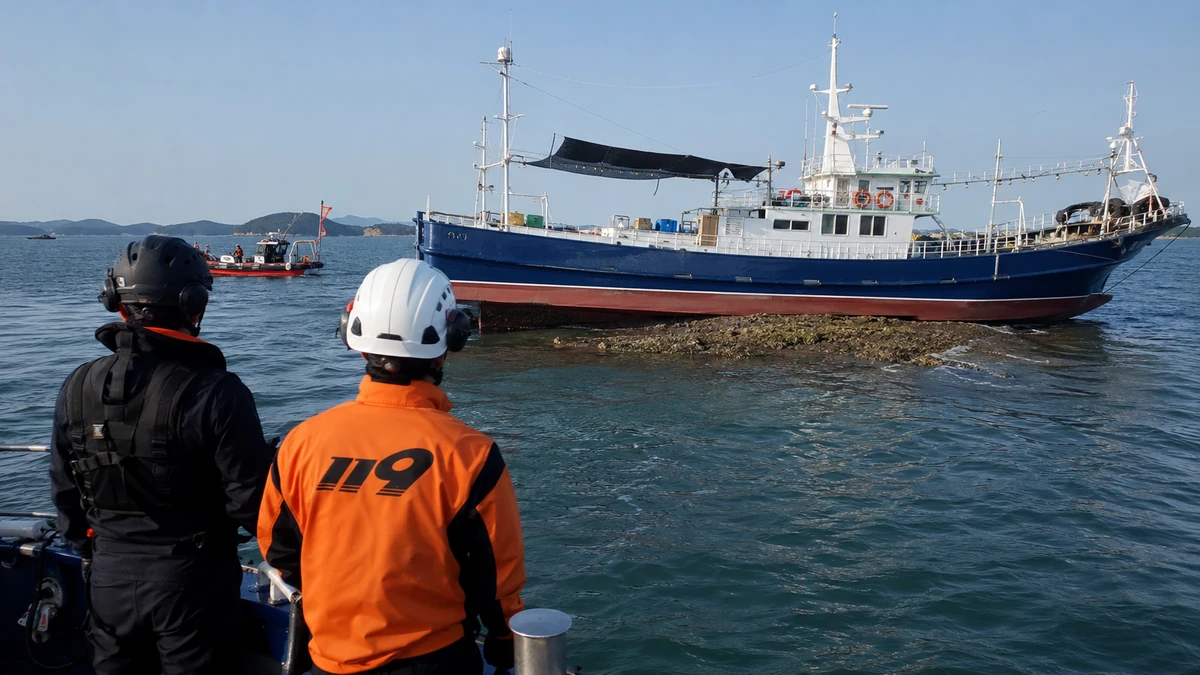
A fishing charter carrying 22 people ran aground Saturday evening near Wonsando, an island off the coast of Boryeong in South Korea, but all aboard were rescued in what authorities described as a successful multi-step response involving nearby civilian vessels, the Coast Guard and emergency medical crews.
The grounding happened at about 5:23 p.m. near Ocheon-myeon, a coastal area in South Chungcheong Province, according to the South Korean news agency Yonhap. The vessel, identified in local reports only as Ship A, was a 9.77-ton fishing boat operating in waters that are popular with recreational anglers and tourists along the country’s western shoreline.
Of the 22 people on board, 20 were first rescued by another nearby vessel or vessels in the area. The remaining two were pulled to safety by the Korea Coast Guard after a distress report was received, local reports said. Three of those rescued later complained of symptoms including chest pain and dizziness and were taken by 119 ambulance crews to a nearby hospital. Their injuries were not believed to be life-threatening.
In the most immediate sense, the story is one of relief. A marine accident that could have spiraled into panic and potentially mass casualties instead ended with every passenger and crew member alive. But the incident also offers a window into something larger: how South Korea’s coastal leisure economy works, why fishing charters are such a common part of ordinary life there, and how much depends on those first minutes when a boat gets into trouble.
For American readers, the easiest comparison may be to a charter fishing trip off the Jersey Shore, the Gulf Coast or Southern California — a day that starts as routine recreation and suddenly turns into an emergency at sea. What makes this case notable is not only that the accident occurred, but that multiple links in the rescue chain appear to have worked quickly enough to keep a frightening situation from becoming a tragedy.
Why this area matters in South Korea
Boryeong may be best known internationally for its annual mud festival, one of South Korea’s most recognizable tourism events, but the waters off its coast are also part of a larger maritime recreation zone that draws anglers, families and weekend travelers. Wonsando, the island near where the grounding took place, sits in a part of the Yellow Sea — known in Korea as the West Sea — where fishing, island travel and coastal sightseeing are deeply woven into the local economy.
That matters because this was not an accident involving a remote cargo lane or a commercial shipping route far from public life. It happened in a place tied to leisure, tourism and small-scale regional business. In South Korea, so-called fishing boats often serve a dual role: they are working maritime vessels, but they are also a way for paying customers to take part in sea fishing as a hobby. In that sense, they occupy a space somewhere between a charter boat and a community tourism business.
For Americans unfamiliar with the scale of coastal recreation in South Korea, it helps to picture a country where major population centers are never very far from the sea, where domestic tourism is dense, and where day trips and weekend outings can quickly funnel large numbers of people into beaches, harbors and island-adjacent waters. A fishing charter accident in such an environment is not treated as a niche story affecting only a specialized workforce. It lands as a broader public-safety story because the people on board are often ordinary residents or visitors seeking a day outdoors.
That is part of why the incident drew attention beyond the immediate region. When 22 people become rescue targets at once, the story is no longer simply about one vessel. It becomes a test of confidence in the wider marine safety system — not just whether one captain made the right call, but whether nearby crews, emergency dispatchers, rescue authorities and medical responders can function together under pressure.
The timing amplified that concern. The accident came as South Korea headed into a stretch of clear, warm weekend weather that encourages outdoor activity. Pleasant conditions often bring more people onto the water, just as sunshine in the United States sends crowds toward lakes, beaches and trailheads. Good weather can create a false sense of security. It may make travel easier, but it also increases exposure by placing more people in environments where a small mistake or mechanical problem can turn serious quickly.
How the rescue unfolded
The sequence of the rescue is, in some ways, the central fact of the story. According to local reports, 20 of the 22 people aboard were rescued first by another vessel near the scene. The remaining two were rescued later by the Coast Guard after authorities received a distress report.
That division is important because it underscores a reality common in marine emergencies around the world: the first effective responder is often not the government but whoever happens to be closest. On the open water, even a fast official response can take time. Boats must receive the call, pinpoint the location, travel to the scene and approach safely. In those first moments, nearby vessels can be the difference between an orderly transfer and a much more dangerous scramble.
In the United States, the Coast Guard often emphasizes a similar principle in boating safety: boaters help boaters, and a rescue system is strongest when private mariners, local authorities and federal responders work in tandem. The South Korean case appears to have followed that pattern. Civilian intervention did not replace the official response; it bought time and stabilized the situation until public authorities could complete the rescue and medical follow-up.
Groundings can be especially unnerving because they create multiple risks at once. A vessel that runs aground may become immobilized, begin taking on water, list unpredictably with the tide or face secondary damage if waves continue to push it against rocks or a shoal. Even if passengers never enter the water, the situation can deteriorate fast. Fear, confusion and a rush to move people off the boat can create their own hazards.
That all 22 were rescued does not erase the seriousness of what likely unfolded in those minutes. It simply means the system worked well enough to prevent the worst outcome. And in disaster reporting, that distinction matters. “Everyone survived” can sound reassuring in a headline, but it should not obscure the fact that a relatively large group of people had to be evacuated from a grounded vessel in active coastal waters.
One reason this case may resonate with readers in other countries is that it illustrates how emergency competence is often measured not by the absence of accidents but by what happens immediately after one begins. There is no coastal nation — whether South Korea, the United States or Japan — that can eliminate boating accidents entirely. What separates a close call from a catastrophe is often the speed and coordination of the response.
The role of the Coast Guard and 119
For Americans, one useful piece of cultural context is how South Korea structures emergency response. The Korea Coast Guard handles maritime law enforcement and sea rescue, much like the U.S. Coast Guard. Meanwhile, “119” is South Korea’s nationwide emergency number for fire and medical response — essentially the equivalent of calling 911 for an ambulance or fire crew in the United States.
That means the handoff described in local reporting — Coast Guard rescue followed by 119 ambulance transport — reflects a familiar but important division of labor. The immediate mission at sea is to get people out of danger. The next mission is to determine whether anyone needs urgent medical care, even if injuries are not obvious at first glance.
Three of the rescued passengers were taken to a nearby hospital after reporting chest pain or dizziness. Those symptoms may sound minor compared with the drama of a grounding, but emergency specialists treat them seriously for good reason. Marine accidents can trigger delayed physical effects from shock, abrupt movement, stress, temperature change and dehydration. A person does not need to have fallen overboard or suffered visible trauma to need medical evaluation.
In that respect, the South Korean response appears to have moved beyond the simple counting of survivors. Too often, disaster coverage can end at the phrase “all rescued,” as if survival alone closes the story. But the aftermath matters too. A successful rescue includes not only getting people off a damaged vessel but also recognizing that some may require hospital care even if they are conscious, walking and outwardly stable.
That broader view of emergency management has particular significance in South Korea, a country whose public institutions have faced intense scrutiny over disaster response in past national tragedies. Without overstating the comparison, any incident involving multiple people in danger naturally draws attention to whether public systems are functioning with speed, clarity and coordination. In this case, at least based on the facts currently reported, the chain from distress report to rescue to hospital transport appears to have held together.
There is also a civic lesson embedded in that sequence. Safety on the water is not just a matter of regulations, technology or one skilled captain. It depends on layered readiness: someone nearby willing or able to help, a clear reporting mechanism, trained responders who can reach the site, and medical teams prepared to take over once survivors are back on land. Remove one of those links, and the outcome can look very different.
What the numbers tell us — and what they do not
The known facts in this case are relatively spare, but they are revealing. The accident occurred at 5:23 p.m. The vessel was 9.77 tons. There were 22 people on board. Twenty were rescued first by nearby vessels, and two by the Coast Guard. Three were taken to a hospital. On paper, that is a small set of numbers. In practice, it sketches the shape of a high-stakes emergency.
Start with the passenger count. A group of 22 on a recreational fishing vessel is large enough that an accident can become chaotic quickly, especially if the evacuation route is narrow, the deck is unstable or some passengers are inexperienced at sea. A grounding involving one or two people is one kind of incident. A grounding involving 22 people requires much more rapid organization and much more room for error.
The division of the rescue — 20 by nearby boat, two by the Coast Guard — also hints at the confusion that can accompany such events without inviting speculation beyond the reported facts. It suggests there may have been a staggered evacuation rather than a single, clean transfer. That does not mean the response was disorganized. It means real-life rescues are often uneven, shaped by positioning, timing and the practical challenge of moving people safely from one vessel to another.
Then there is the number three: the passengers who later sought medical attention. That figure is a reminder that “all rescued” and “completely unharmed” are not the same thing. Disaster coverage can flatten that distinction, but it matters to survivors, families and emergency planners alike. Even in successful rescues, the human body absorbs stress, and the psychological aftermath can linger long after a hospital discharge.
At the same time, there are limits to what these numbers can tell us. Local summaries did not establish the cause of the grounding, and responsible reporting should stop short of filling in gaps with assumption. Weather, tide, navigation error, mechanical issues or seabed conditions can all play roles in such incidents. Without official investigative findings, the more careful conclusion is simply that the boat ran aground and a rescue followed.
That restraint is especially important in a digital media environment where maritime accidents can instantly become vehicles for blame before facts are established. The more useful public lesson at this stage is not premature finger-pointing, but recognition of how fragile a routine outing can become and how decisive those first rescue actions can be.
A reminder for a country that lives close to the water
South Korea is, in many ways, a maritime society. It is a peninsula nation with dense coastal development, busy ports, inter-island traffic and a robust culture of seaside recreation. Fishing is not just an industry; it is also a pastime, a local business model and a weekend ritual. That means marine safety is not an abstract policy issue. It intersects directly with how people travel, relax and spend money.
The grounding near Wonsando is a reminder of that everyday reality. The sea in this context is not an exotic or distant frontier. It is a leisure space — one that feels familiar precisely because it is so accessible. And that familiarity can obscure risk. A sunny weekend fishing trip, much like a summer boat excursion on Cape Cod or in the Florida Keys, can feel ordinary right up until the moment it does not.
There is a temptation after successful rescues to frame such incidents entirely as feel-good stories of competence and relief. Certainly there is relief here, and it is warranted. Twenty-two people were saved. Three were hospitalized, but none were reported in life-threatening condition. Families who might have faced devastating phone calls instead got word that loved ones were coming home.
Still, the underlying message is not that the sea is now safe because this rescue worked. It is that safety depends on preparation, proximity and coordination. The nearest vessel mattered. The distress report mattered. The Coast Guard mattered. The ambulance crews mattered. The story is best understood not as a triumph over unusual danger, but as proof that in a heavily used marine environment, rescue systems must be ready for ordinary recreation to turn extraordinary with almost no warning.
That lesson travels well beyond South Korea. Any country with charter fishing, holiday boating and coastal tourism faces the same basic challenge: how to keep a manageable accident from cascading into something worse. Technology helps. Regulation helps. Training helps. But in the end, outcomes often hinge on whether the right people respond in the right order within a very small window of time.
By that standard, the South Korean response near Boryeong appears to have done what the public most needs from such a system. It turned minutes of danger into an outcome measured not in fatalities, but in survival, treatment and return. That may not erase the fear experienced aboard the vessel, but it is exactly the kind of result communities hope for when a distress call goes out over the water.
Why this story resonates beyond one accident
For international readers, especially in the United States, it can be tempting to view incidents like this as local news from far away — important to the people involved, but culturally distant. In reality, the themes are immediately recognizable. A recreational boat. A crowded outing. A sudden mechanical or navigational crisis. Bystanders who become first responders. Public rescue authorities who race to the scene. A small number of people sent to the hospital, and a much larger number of families counting themselves lucky by nightfall.
That sequence could just as easily describe a story out of Maryland’s Chesapeake Bay, the Gulf waters off Louisiana or a harbor near Seattle. What makes the South Korean version especially instructive is the clarity with which it shows the architecture of rescue. No single institution carried the entire burden. The response worked because it was shared.
That may be the most durable takeaway from the grounding off Wonsando. The accident itself lasted minutes. Its broader meaning lies in how communities prepare for those minutes before they ever arrive. In a society where coastal tourism and sea-based leisure are a normal part of life, the public’s trust rests not on the belief that nothing will go wrong, but on the confidence that when something does, help will connect quickly enough to matter.
On Saturday off South Korea’s west coast, that connection appears to have held. And because it did, 22 people who began the evening aboard a grounded fishing charter ended it alive.


0 Comments