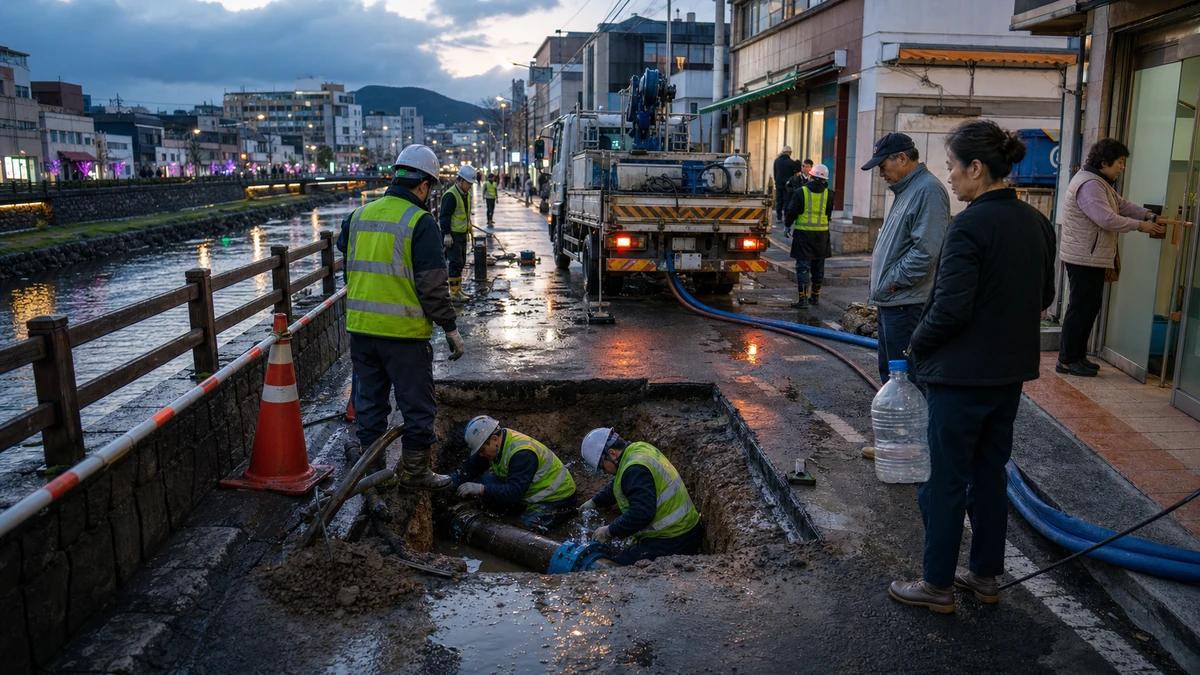
A short disruption in a city built for both residents and travelers
On an island better known to many international visitors for volcanic landscapes, seaside hotels and honeymoon getaways, a broken water pipe briefly became the most important story of the evening.
Parts of central Jeju City lost water service for about 1 hour and 25 minutes on June 22, after a damaged water pipe near Sanjicheon, a stream that runs through the old downtown area, interrupted supply to sections of Samdo 2-dong, Ildo 1-dong and Geonip-dong, according to local authorities and South Korean media reports. The outage began around 5:50 p.m. and was restored by 7:15 p.m., officials said.
Measured against the kinds of infrastructure disasters that can leave neighborhoods dry for a day or more, this was a relatively small event. There were no reports in the available information of widespread evacuations, hospital emergencies or prolonged business closures. But that misses the point of why the incident matters. In a dense urban district during the dinner hour, even a short interruption in water service can unsettle daily life almost immediately.
Water outages are among the least dramatic infrastructure failures to describe and among the most disruptive to live through. There is no fireball, no toppled skyline, no visual spectacle that travels quickly on social media. Instead, the disruption arrives in tiny domestic frustrations all at once: a restaurant sink that stops running before the dinner rush, a family unable to start cooking, a hotel staff member forced to rethink cleaning schedules, a bathroom faucet that suddenly produces nothing.
For readers in the United States, the dynamic is familiar even if the setting is not. Think of the way a brief power outage on a humid summer evening can make a whole neighborhood feel off balance, or how a water main break in a mixed residential-commercial district can quickly ripple from homes to coffee shops to small inns. The Jeju outage appears to have been brief and contained. Still, it offered a reminder that the most basic systems of modern city life matter most when they stop working.
That is especially true in Jeju, a place often marketed abroad as a scenic escape but lived in every day as a functioning city and island community. The outage did not last long. Its significance lies in what it revealed.
Why Jeju matters far beyond its tourism image
To many Americans who know South Korea primarily through Seoul, K-pop and Korean dramas, Jeju may register as a picturesque side note: an island province with lava tubes, black volcanic rock, coastal roads and a reputation as one of the country’s top vacation destinations. That image is not wrong, but it is incomplete.
Jeju is often described as South Korea’s answer to Hawaii, a shorthand that helps foreign readers place it quickly. Like Hawaii, it is an island destination associated with natural beauty, domestic tourism and a distinct local identity. But comparisons only go so far. Jeju is also a year-round home to hundreds of thousands of residents, with neighborhoods, schools, government offices, service workers, delivery routes and urban infrastructure that must function regardless of tourist season.
The areas affected in this outage are not abstract dots on a map. Samdo 2-dong, Ildo 1-dong and Geonip-dong are part of Jeju City’s old urban core, where local routines and visitor traffic overlap. In South Korea, the term “dong” refers to an urban neighborhood-level administrative district, somewhat like a named neighborhood within a city. These areas sit close to the everyday commercial and residential heart of Jeju City rather than the postcard version of the island many tourists imagine.
That distinction matters. In places where residents and visitors share the same streets, utilities and services, even a minor breakdown can carry dual consequences. It can inconvenience people trying to make dinner at home and people checking into a guesthouse. It can affect neighborhood restaurants that serve office workers and travelers in the same evening. It can interrupt a local’s routine while also shaping a visitor’s impression of whether the city feels smooth, reliable and easy to navigate.
Jeju’s popularity as a travel destination can obscure that reality. Tourism tends to spotlight the visible parts of a place: beaches, markets, cliffs, museums, restaurants. Infrastructure is the invisible opposite. Most people notice it only when it fails. Yet in a city like Jeju, the island’s reputation depends not only on scenery and hospitality but also on the quieter systems underneath them, including roads, drainage, electricity and potable water.
The June 22 outage was not a referendum on Jeju’s overall infrastructure. It was a contained incident tied, based on the available reporting, to a broken water supply pipe near a downtown road by Sanjicheon. But it does serve as a useful window into how dependent daily island life is on systems few travelers ever think about.
The timing made the outage feel larger than the clock suggests
One reason the interruption likely felt more disruptive than its length alone would suggest is simple: timing. It hit in the early evening, beginning just before 6 p.m. and ending after 7 p.m. In many households, that is when dinner preparation begins in earnest. In commercial districts, it is also when cafes, casual eateries and small businesses may be handling an important slice of daily revenue.
A water outage at 3 a.m. and a water outage at 6 p.m. may last the same number of minutes, but they do not register the same way in lived experience. Utility interruptions are deeply shaped by routine. During the dinner hour, water is not an abstract public service. It is active in nearly every room of a home and nearly every task in a food business.
In practical terms, even a brief loss of running water can complicate hand washing, dish cleaning, cooking, restroom use and basic sanitation. For lodging businesses, it can affect room turnover and guest comfort. For neighborhood stores or offices, it can create uncertainty about whether normal operations can continue. None of this necessarily adds up to chaos, and there is no verified reporting in the material provided that businesses suffered serious losses. But inconvenience in these cases is immediate, not theoretical.
That helps explain why relatively short outages can loom large in public memory. Infrastructure failure is often experienced not through duration but through interruption of expectation. Modern urban life depends on hundreds of background systems that people rarely pause to consider because they work almost all the time. Running water is perhaps the clearest example. Turning on a tap is one of the most ordinary actions in a city. When it suddenly does not work, the effect is jarring precisely because it violates such a basic assumption.
In the United States, residents of older cities know this pattern well. A single water main break can force street closures, pressure drops, boil-water advisories or temporary business interruptions even when the physical damage appears limited to a small stretch of road. The Jeju case, as reported, did not escalate to that level. But the underlying lesson is similar: infrastructure does not have to fail on a massive scale to be socially significant.
The available timeline suggests local authorities restored service relatively quickly. That speed is important. The shorter the disruption, the less likely it is to cascade into broader problems. A fast repair can keep a manageable inconvenience from becoming a prolonged public headache.
Sanjicheon and the hidden relationship between landscape and infrastructure
The damaged pipe was identified near Sanjicheon, according to the summary of the reporting. For those unfamiliar with Jeju City, Sanjicheon is a stream corridor in the downtown area, a place people may associate more readily with the city’s visible landscape than with underground utility networks. That contrast is part of what makes the episode instructive.
Cities are often experienced in two layers. There is the surface layer people see and remember: bridges, sidewalks, storefronts, waterways, trees, traffic and public space. Then there is the buried layer that makes the visible one livable: water pipes, sewers, power lines, telecommunications conduits and drainage systems. The two are inseparable, even when they are easy to mentally divide.
Jeju’s tourism economy, like that of many destination cities, depends heavily on its visible environment. Visitors notice a clean promenade, a charming urban stream, a walkable district, a well-kept road. They do not notice the distribution network below the pavement unless something breaks. Yet every attractive urban setting relies on those unseen systems functioning day after day.
That is particularly true on islands, where geography can sharpen the stakes of logistics and public works. Islands often carry a double image in the public imagination: idyllic and fragile. Jeju contains both elements. It is celebrated for beauty, but island communities also tend to be acutely aware of weather, transport links and utility resilience. Services can feel less interchangeable when there is less room for failure.
The reporting does not suggest the stream itself caused the outage, nor does it establish any connection between the water pipe failure and other environmental factors. The known cause, based on the available information, was damage to a water pipe along a nearby road. Still, the location underscores a broader truth about urban life: the postcard view of a city and the engineering beneath it are part of the same reality.
That relationship often becomes clearer in places tourists think they already understand. Jeju is frequently reduced abroad to scenery. But cities and towns on the island run on the same fundamental systems as anywhere else. Faucets, toilets, kitchens, drainage and public sanitation are not glamorous subjects. They are what make daily life and tourism possible at the same time.
Fast restoration is the story, but so is public trust
By the standards of utility repair, the response appears to have been swift. Authorities said the outage started around 5:50 p.m., the damaged pipe was identified, and restoration was completed by 7:15 p.m. That sequence matters because in infrastructure incidents, speed is not just an operational measure. It is also a form of public reassurance.
People tend to judge local government and public utilities less by whether breakdowns ever happen than by how clearly and quickly those breakdowns are addressed. Pipes age. Roads shift. Equipment fails. In any city, occasional service interruptions are almost inevitable. What residents remember is whether officials located the problem, communicated the basics and restored service before inconvenience hardened into distrust.
Based on the facts available here, the Jeju water authorities appear to have done the most important immediate things: identify the damaged section and restore supply the same evening. There is not enough verified information in the source material to say whether officials announced additional inspections, broader maintenance plans or longer-term policy changes. It would be speculative to go beyond the reported timeline. But even within those limits, the quick restoration suggests a level of routine response capacity that cities depend on every day.
That does not mean a short outage is insignificant. On the contrary, the smallness of the incident is part of why it is revealing. Urban resilience is not tested only by disasters. It is tested by ordinary failures handled competently. A city earns confidence through repetition: the light turns on, the bus arrives, the street drains after rain, the water runs, and when a system stumbles, it is fixed before the disruption spreads.
For American readers, there is a familiar civic lesson here. Public confidence in infrastructure is often built less by grand ribbon-cutting projects than by the boring, difficult work of maintenance. Politicians love announcing new attractions. Residents care deeply about whether the pipes under the road still work. Jeju’s brief outage is a small-scale example of that universal truth.
It also hints at the delicate balancing act for a place whose public image is tied to comfort and ease. A tourist destination has to function not only as a brand but as a home. That means basic services are not secondary to the visitor economy. They are its precondition.
An island dealing with both weather and infrastructure on the same day
The same day as the water outage, South Korea’s weather agency issued rough sea advisories for waters around Jeju later that night. The weather notice and the pipe failure were not presented as directly related events, and there is no basis in the available reporting to connect them causally. Still, taken together, they offer a broader snapshot of life on Jeju that outsiders sometimes miss.
Island living is shaped by overlapping systems of dependence. Some are built by people, such as water networks, roads and drainage. Others are environmental, such as wind, waves and marine weather. On Jeju, those systems coexist more visibly than they might in a large inland metropolis. Residents do not just live in a tourist destination; they live in an island environment where weather, transportation and utilities can all affect the rhythm of an ordinary day.
That context matters because global audiences often consume places like Jeju as lifestyle imagery. Travel marketing naturally emphasizes the island’s dramatic coastlines, tangerine farms, hiking trails and lava-formed terrain. Korean popular culture has also helped cement Jeju as a recognizable symbol of escape, romance and healing. But actual communities are more complicated. Their daily stability depends on mundane competence: utilities that function, roads that remain passable, ports and seas that can be navigated safely, and public agencies that can respond when something goes wrong.
The rough sea advisories issued that evening reinforce the idea that Jeju is not just a leisure backdrop. It is a working island tied to weather in ways mainland readers may underestimate. While the water outage itself was urban and localized, the wider day’s events point to an enduring reality: island life can be highly sensitive to both natural conditions and the hidden infrastructure of everyday living.
For readers outside Korea, that may be the most valuable takeaway. Jeju is often introduced through its beauty, but understanding the island means recognizing the ordinary civic systems that support that beauty. In that sense, a minor outage may tell a more honest story than a tourism brochure ever could.
What a 1-hour-25-minute outage says about modern urban life
It would be easy to dismiss this as too small to matter. No long-term regional shutdown. No evidence, based on the material provided, of severe damage or extended public health consequences. Service came back the same evening. In pure event terms, the story is modest.
But local reporting on modest disruptions often serves a deeper purpose. It records the texture of how a society functions. Who lost service? When? For how long? What caused it? How quickly was it fixed? Those questions help explain the real quality of urban life more clearly than promotional narratives or broad national stereotypes ever can.
In that sense, the Jeju outage is less a story about malfunction than about dependence and recovery. It shows how thoroughly urban life rests on systems people barely notice. It shows how a service interruption can feel consequential even when it is brief, especially in neighborhoods where homes, shops and visitor accommodations are packed close together. And it shows the importance of restoration speed in a city where residents and travelers alike assume that basic utilities will simply be there.
South Korea is often recognized internationally for high-speed internet, efficient transit and dense urban convenience. Those reputations are rooted in real achievements, but they can also create the illusion that infrastructure is automatic. It is not. It is maintained, repaired and constantly tested by wear, age and accident. Jeju’s brief outage is a reminder that even in well-developed systems, basic services remain vulnerable to very ordinary failures.
At the same time, the story offers a more positive message: resilience does not always look dramatic. Sometimes it looks like a repair crew finding the break, a public utility restoring pressure, and a city resuming dinner service after an inconvenience rather than enduring a crisis. In a world where infrastructure news often means catastrophe, there is value in paying attention to competent recovery too.
For Americans and other English-speaking readers, the episode may not transform their understanding of Jeju overnight. But it should complicate it in a useful way. Beyond the beaches and basalt cliffs is a lived-in island city, dependent on the same fragile, essential systems that shape life anywhere. For 1 hour and 25 minutes on a June evening, one of those systems paused. The quick repair prevented a larger problem. The interruption itself, however brief, made visible everything that usually stays hidden.
Comments
Post a Comment