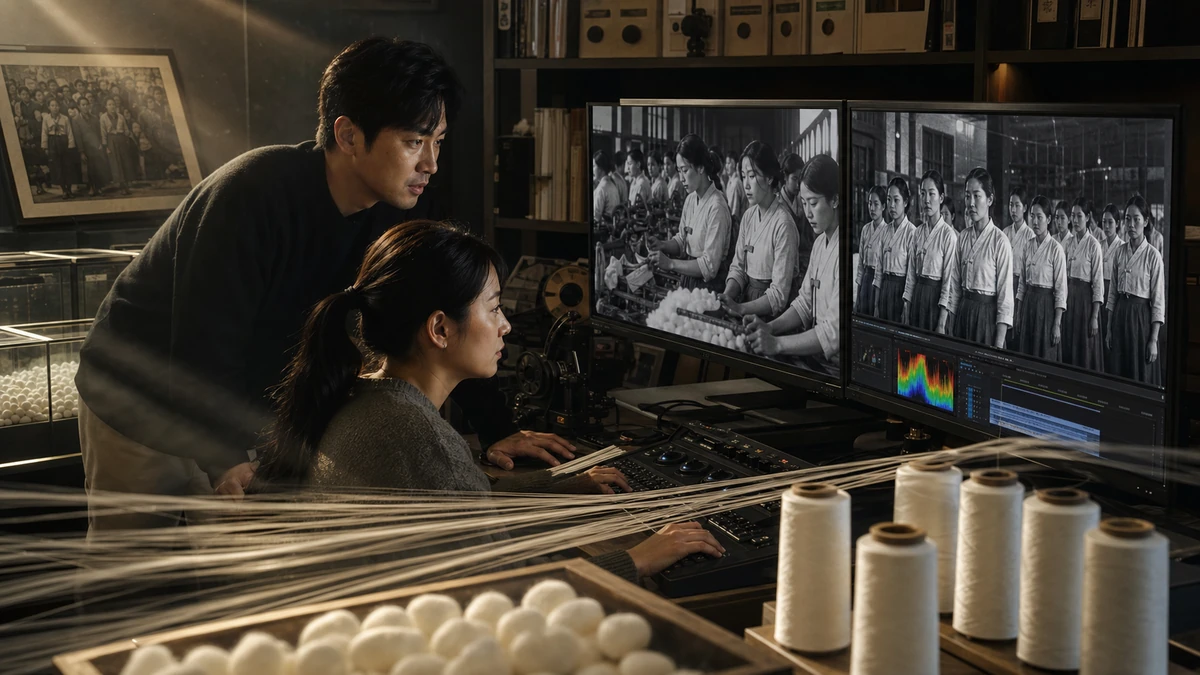
A local Korean story heads to national television
At a time when much of the world associates South Korean media with K-pop, Netflix thrillers and glossy historical dramas, a public broadcaster in South Korea is betting that a quieter kind of story can still command national attention. On June 21, KBS 1TV, the main terrestrial channel of South Korea’s public broadcasting system, is set to air “Silkworm Cocoon Girls,” a documentary produced by KBS Daejeon that revisits a largely forgotten labor struggle involving young female factory workers during Japan’s colonial rule of Korea.
For American viewers, the closest comparison may be a locally produced PBS documentary that suddenly breaks into the national conversation because it uncovers a neglected chapter of labor history. The difference is that in Korea, the historical wounds involved remain especially raw. The documentary centers on teenage girls who worked in a silk-reeling factory in Daejeon, a city in central South Korea, during the 1930s, when the Korean Peninsula was under Japanese colonial rule from 1910 to 1945. According to the filmmakers, those workers took part in an anti-colonial labor dispute that they describe as the first strike victory by Korean workers under colonial rule.
That framing matters. In South Korea, stories of resistance to Japanese colonial rule have often emphasized student activists, independence fighters, guerrilla movements and political martyrs. “Silkworm Cocoon Girls” appears to widen that lens. It suggests that resistance also happened in the workplace, among young women whose names did not make it into textbooks and whose acts of defiance were tied not to battlefields or manifestos, but to wages, dignity and survival.
The documentary’s national broadcast also arrives during what South Korea calls “Patriots and Veterans Month,” observed each June. In the United States, Americans may think of Memorial Day and Veterans Day as moments to reflect on military sacrifice. Korea’s June remembrance culture overlaps with that instinct, but it also includes broader reflection on national survival, war and independence. By programming this film during that period, KBS appears to be making a pointed argument: defending a nation’s dignity is not only the story of soldiers and armed resistance. It can also include exploited girls in a factory who decided they would no longer accept the terms imposed on them.
That is part of what gives this broadcast significance beyond the documentary itself. It is not simply another regional history special. It is a national act of remembrance, framed through television, about who gets recognized as a historical actor and what kinds of sacrifice count in a country still negotiating the legacy of colonialism, modernization and gendered labor.
Why these girls matter in Korean history
The title “Silkworm Cocoon Girls” is both literal and symbolic. It refers to the silk industry in which these workers labored, drawing thread from cocoons in a factory setting that was likely hot, repetitive and tightly controlled. But the image also evokes youth, fragility and confinement. These were not adult union leaders or celebrated revolutionaries. They were girls, many of them likely from economically vulnerable backgrounds, working in an industrial system that relied on their labor while rendering them almost invisible in official history.
To understand the power of that story, American readers may think of the 1911 Triangle Shirtwaist Factory fire in New York, or the long fights led by mill workers, garment workers and child labor reformers in early industrial America. Those episodes endure in U.S. memory because they exposed how modern economies were built on the labor of people who often had the least protection and the fewest choices. Korea’s colonial-era factory girls occupied a similarly precarious place, except they were working under the added pressure of foreign imperial rule.
That colonial context is essential. Japan’s rule over Korea transformed the peninsula’s political, cultural and economic life. Korean language and identity were often suppressed, resources were extracted, and industrial labor systems were shaped to serve imperial needs. So a labor action in that environment was rarely just about shop-floor conditions. Even when workers were demanding immediate improvements, their resistance could carry anti-colonial meaning because the structures exploiting them were inseparable from colonial authority.
The documentary reportedly identifies the girls’ action as an anti-Japanese labor struggle and as the first successful strike by Koreans under colonial rule. Historians may continue to debate exact definitions and precedents, as they often do in labor history. But the broader point is clear: the film is restoring agency to workers who have long existed, if at all, in the margins of the record.
That restoration also reflects a larger trend in historical storytelling, in Korea and elsewhere. More filmmakers, scholars and museums are asking whose stories were omitted from national narratives built around statesmen, generals and elite male figures. Women’s labor history has become a particularly important field because industrialization in many societies depended on women and girls whose contributions were treated as ordinary at the time and unremarkable in hindsight. By turning its camera toward those workers, the documentary joins a global conversation about recovering the people who made history without ever being credited for it.
In South Korea, that recovery has special resonance because the country’s modern success story, often celebrated abroad as a miracle of development, was also built on difficult labor, authoritarian periods and sacrifices that were unequally distributed. Looking back to colonial-era girl workers does not diminish South Korea’s later achievements. If anything, it complicates them in a necessary way, reminding viewers that national progress and national memory are never as tidy as official anniversaries suggest.
More than a war story: Expanding what patriotism looks like
One of the most interesting aspects of this broadcast is the way it reframes patriotism. In South Korea, June commemoration often centers on the Korean War, national defense and the sacrifices of service members and independence activists. Those themes remain deeply important. But “Silkworm Cocoon Girls” appears to argue that patriotism can also be found in labor resistance, especially when the workplace itself is shaped by political domination.
For American audiences, that may sound familiar in a broader sense. U.S. public memory has gradually expanded to include stories once treated as peripheral to national identity: civil rights activism, women’s suffrage, farmworker organizing and labor struggles in coal mines, packing plants and textile mills. Those were not always framed as patriotic in their own time. In many cases, participants were branded as troublemakers. Only later did the country come to see that their fight for dignity was part of the democratic project.
The Korean documentary seems to make a comparable move. It suggests that asking for humane treatment in a factory under colonial rule was not separate from defending the nation’s dignity. It was one expression of it. That is an important intervention because public remembrance can easily become too narrow, too militarized or too polished. When nations remember only formal heroes, they risk flattening the lived experiences of the people who endured history without monuments or medals.
There is also a gender dimension here that should not be overlooked. Women’s contributions to anti-colonial and national struggles are often celebrated rhetorically but documented unevenly. Young female workers, in particular, tend to disappear from narratives that prefer either charismatic leaders or dramatic battlefield resistance. By focusing on “girl workers,” the film restores a category of people who were doubly marginalized: by age and by gender.
That makes the documentary not only a work of historical recovery but a subtle challenge to the hierarchy of memory itself. Who gets remembered as brave? Who counts as a political actor? And what kinds of courage are easier for institutions to celebrate? In many countries, including the United States, those questions remain unsettled. South Korea’s public broadcaster is now putting its own version of them before a national audience.
How the documentary uses archives and artificial intelligence
The production itself also reflects a changing media landscape. According to the summary released around the broadcast, the filmmakers combined painstaking archival research into 1930s materials with generative artificial intelligence video technology to recreate the silk factory and its conditions. In a media world often obsessed with what AI might disrupt or distort, this is a notable use case: not replacing history, but trying to visualize it where the visual record is incomplete.
That approach comes with promise and risk. Historical documentaries have always faced a basic challenge: the farther back a story goes, the thinner the surviving footage tends to be, especially for local labor history and for people who were not wealthy, powerful or famous. American viewers know this from Ken Burns-style documentaries or local public television specials that rely on photographs, letters, maps, newspaper clippings and carefully staged visual devices to animate the past. In Korea, where many stories from the colonial period were poorly documented from the perspective of Korean workers themselves, the problem can be even more pronounced.
Using AI-generated imagery to reconstruct those spaces may help audiences picture industrial life that otherwise exists only in text and memory. It may make younger viewers more likely to connect emotionally with an era that can feel abstract or remote. But it also raises familiar ethical questions. How should broadcasters distinguish between documented images and visual interpretation? At what point does reconstruction begin to over-direct the viewer’s emotional response? And how can producers ensure that compelling visuals do not accidentally create false certainty about details the archive cannot prove?
From the description available, the filmmakers seem aware of that tension. Their emphasis on extensive source excavation suggests that the AI imagery is being presented as a supplement grounded in evidence, not as invention for its own sake. That distinction is crucial. In the best documentaries, technology serves the archive. In the worst, it outruns it.
This is not just a technical issue. It goes to the heart of public trust, especially for a broadcaster like KBS. Public broadcasters in democratic societies are increasingly under pressure from streaming platforms, shrinking attention spans and political polarization. If they turn to new visual tools, they have to do so in ways that reinforce credibility rather than weaken it. A documentary about forgotten workers demands exactly that kind of care, because it is trying to rebuild memory where memory has already been damaged by neglect.
In that sense, the production method is part of the story. “Silkworm Cocoon Girls” is not simply about rediscovering the past. It is about how a public institution in 2026 uses new tools to make an old history legible again without surrendering to sensationalism. That balancing act may determine whether such documentaries can keep a meaningful place in national media ecosystems increasingly dominated by short-form content and algorithmic entertainment.
Why a regional broadcaster’s project matters nationally
Another reason this documentary has drawn attention is its path from local production to national airing. KBS Daejeon is a regional arm of the Korean public broadcaster, and Daejeon itself is not typically the first Korean city that comes to mind for foreign audiences. Seoul dominates cultural exports. Busan is known for film and port commerce. Jeju carries tourism appeal. Daejeon, located in the country’s center, is often associated domestically with research institutes, transportation links and administrative convenience rather than cinematic mythology.
That is precisely why this story matters. It shows how regional history can reshape a national narrative when given a larger platform. The girls who worked in Daejeon’s silk factory were rooted in one city and one industrial site, but their experience touches national themes: labor, colonialism, women’s history, economic survival and the politics of remembrance. A regional story becomes a national one not because it is scaled up artificially, but because the specifics turn out to reveal something broader.
American readers can see parallels in how local stories have reframed U.S. history. A strike in one West Virginia county can illuminate the national labor movement. A school district in Arkansas can become shorthand for desegregation. A factory town in Massachusetts can tell the story of industrial capitalism. Locality is not a limitation when the underlying tensions are widely shared.
For South Korea’s public media system, that local-to-national move may be especially important now. Like broadcasters elsewhere, Korean television faces intense competition from streaming platforms and social media. Commercial logic tends to reward celebrity-driven, fast-moving or globally exportable content. A documentary about teenage silk workers from colonial-era Daejeon does not fit that model. Its value lies elsewhere: in civic memory, historical literacy and the idea that a nation should know the stories that were built below the threshold of fame.
That also helps explain why this documentary belongs in a broader conversation about Korean content, even if it sits outside the “K-wave” most familiar to international audiences. The global rise of Korean entertainment has often been told through pop music, prestige television and genre filmmaking. But a mature media culture is not defined only by its exports. It is also defined by the seriousness with which it tells its own past to itself. By giving national airtime to this film, KBS is making a claim about what public broadcasting is for.
It is possible, of course, that the documentary will draw a modest audience compared with blockbuster dramas or streaming hits. But ratings are only one measure of impact. Some programs matter because they become reference points for teachers, historians, local communities and families who recognize themselves in stories once omitted. Public broadcasters often justify their existence on that ground: they preserve a space for material that markets alone might not prioritize.
A Korean story with global relevance
Although “Silkworm Cocoon Girls” is rooted in Korean history, its themes travel easily across borders. The story speaks to anyone interested in labor rights, women’s history, empire, industrialization and the politics of memory. It asks universal questions in a distinctly Korean setting: What happens when the people most essential to an economy are treated as disposable? How do nations remember workers whose names were never recorded carefully in the first place? And how should public institutions tell hard histories in an age when audiences are flooded with distractions?
For English-speaking readers with limited familiarity with Korea’s past, the documentary may also serve as an entry point into the colonial period, which remains central to modern Korean identity but is often underexplored in mainstream American media. U.S. coverage of Korea tends to focus on North Korea, technology giants, pop culture and the security alliance with Washington. Those subjects matter, but they can leave little room for the deeper historical experiences that continue to shape Korean politics and public emotion.
The colonial era is one of those experiences. Debates over Japan’s wartime conduct, forced labor, cultural erasure and historical memory still surface regularly in Korean civic life and diplomacy. A documentary about teenage girl workers in a silk factory will not resolve those disputes. But it can humanize them. Instead of beginning with treaties and official statements, it begins with bodies at work, with adolescence interrupted, with economic necessity pressed into imperial service.
That human scale is often what allows history to cross national boundaries. Viewers do not need to know every detail of Korean historiography to understand what it means for young workers to resist an unjust system. They do not need deep prior knowledge of Daejeon to grasp why it matters when local memory is lifted onto a national stage. And they do not need to speak Korean to recognize the broader truth the documentary appears to be asserting: societies are built not only by celebrated leaders, but by ordinary people who acted under pressure and were forgotten too quickly.
In that sense, the documentary fits into a larger global trend in nonfiction storytelling. Audiences are increasingly drawn to works that recover hidden histories, especially those involving women, workers and colonized peoples. These stories challenge triumphalist national narratives without abandoning the possibility of collective pride. They make patriotism harder, more honest and more democratic.
That may be the deepest significance of “Silkworm Cocoon Girls.” It does not seem designed to flatter viewers with a simple heroic myth. Instead, it invites them to widen their understanding of who belongs in the nation’s memory. In Korea, that means recognizing teenage factory workers as historical agents. For foreign audiences, it offers a reminder that Korean storytelling is not only about the future-facing sheen of global entertainment. It is also about the unfinished work of remembering the people who never got center stage the first time around.
As KBS prepares to broadcast the documentary nationwide, the immediate question will be how viewers respond. The longer-term question is whether this kind of programming can influence how Koreans, and perhaps international audiences, understand the relationship between labor, gender and anti-colonial history. Even before the program airs, one point is already clear: a regional documentary about forgotten girls in a silk factory has become a national cultural event because it touches a nerve far larger than its setting. It asks what it means to return the nameless to “their rightful place in history,” and whether television can still serve that public purpose in a fractured media age.
Comments
Post a Comment