A defeat that still said something
On the scoreboard, South Korea’s 1-0 loss to Mexico looked simple enough: a host nation protected its home turf, a contender came up short, and the group-stage pressure at the 2026 World Cup only intensified. But soccer games — especially World Cup games — rarely live only in the final score. For South Korea, the match may be remembered less for the result than for a late attacking sequence that revealed how far the program has come and why its players still believe this tournament can become something larger.
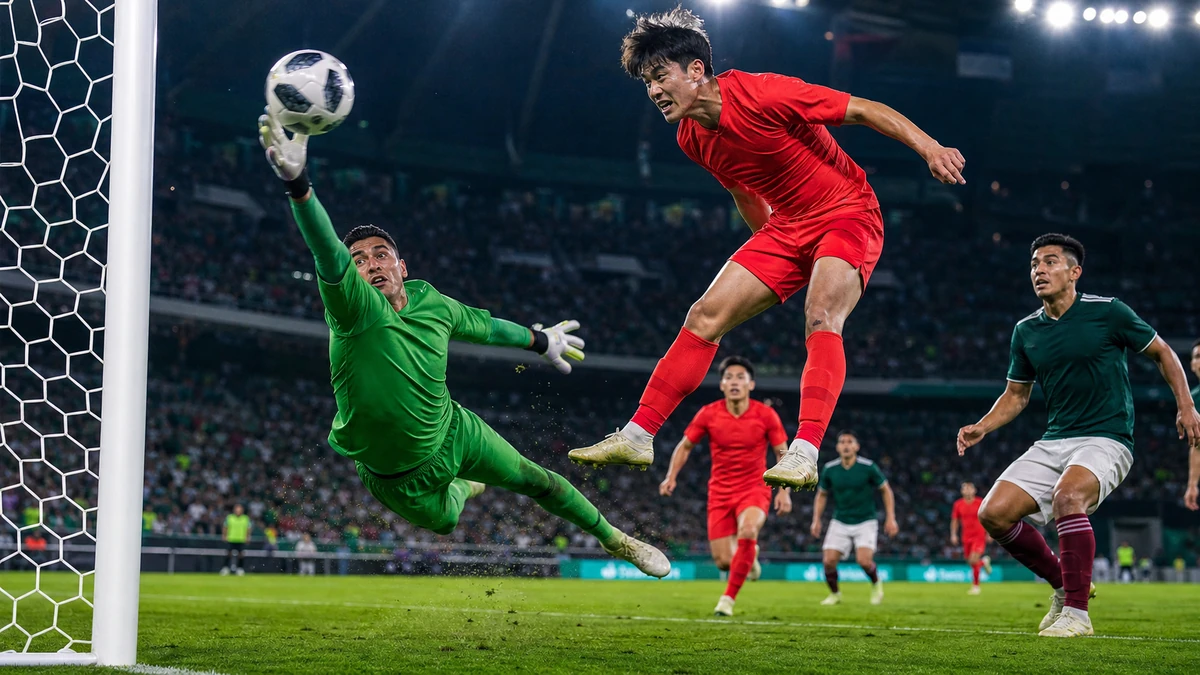
That moment arrived in the 87th minute, when winger Um Ji-sung drove a dangerous cross into the penalty area and striker Cho Gue-sung rose to meet it with a header. The connection was clean, the timing was right, and for a split second South Korea appeared to have found the equalizer it had chased all night. Instead, Mexico goalkeeper Raul Rangel reacted sharply and kept the ball out, preserving the hosts’ lead and, ultimately, the victory.
It was the kind of play that can vanish in a box score but linger in the minds of players and fans. For Korean supporters, it was not merely a missed chance. It was proof that their team could manufacture a high-level opportunity against a World Cup host, late in a pressure match, on one of the sport’s biggest stages. For American readers more familiar with the way people remember a near-touchdown in the final minute of an NFL playoff game or a ninth-inning drive that falls just short in October baseball, the feeling is recognizable: disappointment, yes, but also the stubborn sense that something important was revealed.
Speaking to reporters during recovery training the following day near Guadalajara, Um described the play in a way that stood out. When he later watched the video, he said, the cross looked powerful. But when he struck it in the moment, it felt as if the ball were floating through the air in slow motion. That description captured something athletes often struggle to explain — how the biggest moments can alter perception itself. Under extreme pressure, time can seem to stretch. A fraction of a second can feel cinematic. The World Cup has a way of doing that.
South Korea lost. That part is not in dispute. But it also left the field with a sequence that coaches can revisit, attackers can build on and supporters can hold onto as evidence that the team’s ambitions are not fantasy. In a tournament where margins are thin and confidence matters almost as much as tactics, that counts for something.
Why one late sequence resonated
The play mattered because it was not random. It was the product of two players reading each other correctly at speed, under pressure, in a match that could easily have slipped into desperation. Um’s delivery bent into the dangerous space between defenders and goalkeeper — the kind of cross that forces everyone to make a decision and usually punishes hesitation. Cho timed his run well and rose with conviction. If not for Rangel’s save, South Korea would have had the equalizer and perhaps a very different emotional ending.
Those details are worth emphasizing because elite international soccer is often decided not by constant domination but by a handful of moments when structure, instinct and nerve line up at once. South Korea did not need to control the match for 90 minutes to prove it belonged. It needed only to create a few real chances against an opponent playing in front of a heavily supportive crowd. The Um-Cho sequence was the clearest example.
For Americans still adjusting to the rhythms of a sport where a single goal can define an entire evening, this is part of the drama. In basketball, a team can survive a missed layup in the closing minutes. In baseball, another inning may still be available. In soccer, one missed header can become the night’s defining image. That is why supporters often talk about “moments” as much as “results.” The emotional memory of a game is not always located in what happened most often. It is usually attached to what almost changed everything.
That sequence also resonated because South Korea had to earn it against Mexico, one of the tournament hosts and a nation with a deep soccer culture. Playing a host country at the World Cup means more than facing 11 players. It means contending with crowd energy, familiarity with conditions and the momentum that often comes from a nation expecting a result. South Korea did not fold under that pressure. It found a way to threaten late.
In a broader sense, the play served as a snapshot of modern Korean soccer. These were not players simply trying to survive on the world stage. They were players executing an attacking idea with composure and sophistication. The finish did not come. The quality of the move did.
Um Ji-sung and Cho Gue-sung as symbols of a changing team
There is a larger story inside the missed chance, and it has to do with where South Korea’s leading players now develop their games. Um, identified in Korean media as a Swansea City player, and Cho, who plays for Danish club Midtjylland, represent a generation of Korean internationals shaped not only by the domestic K League but also by European competition, training intensity and tactical expectations. That matters because international soccer increasingly rewards players who can adapt quickly to different speeds, styles and spaces.
South Korea has long produced technically capable players and fiercely committed national teams. American audiences may already know names such as Son Heung-min, the Tottenham star who has become one of Asia’s most recognizable athletes. But beneath the global star system is a broader evolution: more Korean players are moving abroad earlier, testing themselves in tougher leagues and returning to the national team with experience that can translate in tournament settings.
The Um-to-Cho chance illustrated that evolution in miniature. The movement looked rehearsed but not rigid, instinctive but not chaotic. It suggested a familiarity with the kind of narrow-window attacking actions that are common in high-level European soccer. One player recognized the lane. The other anticipated the service. They trusted the play enough to commit fully.
That is why the sequence drew attention even in defeat. It said something about the floor and the ceiling of this team. The floor is that South Korea can remain organized and competitive against strong opposition. The ceiling is that, if its attacking combinations click at the right time, it can trouble almost anyone. In tournament play, that matters. Teams do not need to be perfect for seven straight matches. They need to peak in the right stretches and capitalize when chances come.
Cho, in particular, remains a fascinating figure in South Korea’s World Cup narrative. Many fans outside Korea first learned his name at the 2022 World Cup in Qatar, where his goals and physical presence made him one of the breakout faces of the tournament. He carries the expectations that come with that visibility. Every header, every run, every near miss now exists inside a larger public memory of what he has already done on this stage. When he rose against Mexico, Korean fans were not just seeing an isolated play. They were seeing a striker with a World Cup history trying to write another chapter.
Um’s comments after the game suggested that he, too, understood the emotional weight of the moment. He reportedly recalled memories of Korea’s 2022 World Cup group-stage match against Ghana, another reminder that players do not arrive at these games as blank slates. They carry the archive of past tournaments with them — old goals, old disappointments, old lessons about how quickly matches can turn. That accumulated memory is part of what makes a national team feel seasoned rather than merely talented.
The weight of the World Cup for South Korea
To understand why a losing effort could still generate optimism, it helps to understand what the World Cup means in South Korea. Few sporting events command such concentrated national attention there. The national team is often referred to as the “Taeguk Warriors,” a nickname rooted in the taegeuk symbol on the South Korean flag. It is a patriotic shorthand, but it also reflects how the team is viewed: not just as a sports side, but as a group carrying national representation in one of the most visible arenas in global culture.
For American readers, the closest comparison may be the emotional intensity of the Olympics combined with the civic pride of a major national team event. But even that can undersell it. In South Korea, World Cup moments live for years. Fans remember not only results but individual scenes — a sprint down the wing, a fingertip save, a celebration, a collapse. The country’s modern soccer identity was transformed by its run to the 2002 World Cup semifinals on home soil, still one of the most significant achievements in Asian soccer history. Since then, each tournament has been measured against the desire to prove that Korea belongs as more than a respectable participant.
This helps explain why the late chance against Mexico landed with such force. It was not simply a nice play in a losing cause. It fed into a long-running national conversation about whether Korean soccer can consistently create, and convert, decisive moments against elite competition. The answer in this case was incomplete. South Korea created the moment but did not finish it. Even so, creation itself matters. You cannot score chances you never generate.
There is another layer here as well. South Korea entered this tournament under coach Hong Myung-bo, one of the most iconic figures in Korean soccer history. Hong captained the 2002 team and remains associated with discipline, organization and national pride. Any team he leads carries extra symbolic weight because fans inevitably connect the present to Korea’s most celebrated soccer past. The pressure that comes with that is enormous. So is the opportunity.
Against Mexico, that opportunity did not produce a point. But the performance offered enough evidence to suggest the team’s ambitions — including a deep run away from home — are not empty slogans. It showed a squad capable of surviving difficult stretches and, just as importantly, capable of threatening when the game demanded courage.
More than tactics: recovery, family and tournament psychology
One of the more revealing details from the aftermath of the Mexico match had nothing to do with formations or shot maps. The day after the loss, South Korea held a light recovery session, and team officials indicated players would also be given free time, including opportunities to spend time with family. That may sound minor to casual observers. In reality, it reflects one of the central truths of modern tournament soccer: emotional management is part of performance.
National team players at a World Cup live in a compressed environment of travel, training, scouting, media obligations and constant scrutiny. The physical load is obvious. The mental load is often harder to see. A one-goal loss can replay in a player’s mind overnight. A missed chance can linger longer than sore legs. Coaches and federations increasingly understand that recovery is not just about ice baths and stretching. It is also about protecting players from emotional burnout.
The Korea Football Association has, since the 2022 World Cup, supported a family invitation program meant to help with motivation and psychological stability during long tournaments. All 26 players in the final squad reportedly received that benefit for this World Cup. In practical terms, that means a player can step away, at least briefly, from the tunnel vision of competition and reconnect with the people who knew him before he became a public figure carrying national expectations.
For an American audience, this may sound similar to the way NFL or NBA teams now openly discuss mental wellness, sleep science and family support as performance issues rather than private matters. The old model of simply demanding toughness has given way to something more nuanced. Elite athletes still need toughness, of course. But they also need systems that help them reset.
That is particularly important for a team like South Korea, which has been together for an extended camp and now faces the grind of a major tournament in North America. Players are not robots. They are young men living inside an emotionally amplified event, trying to recover from disappointment quickly enough to be sharp for the next tactical assignment. A missed chance against Mexico can either become a source of doubt or a source of belief. The days after the game help determine which one it becomes.
If South Korea does make a push deeper into the tournament, these behind-the-scenes decisions may be remembered as part of the foundation. World Cups are not won by talent alone. They are navigated through energy, mood, resilience and the ability to metabolize both success and failure in real time.
What South Korea can take into its next match
The most important question after a narrow loss is never whether disappointment exists. Of course it does. The real question is what can be carried forward. For South Korea, the answer begins with evidence. Against Mexico, it proved it could create a dangerous late opportunity against a host nation. That may not comfort anyone fully in the standings, but it is the sort of detail players and coaches can point to when reinforcing belief.
There are tactical lessons as well. The late sequence showed that South Korea can find success by attacking the spaces between defenders and goalkeeper, especially when wide players are decisive and the center forward attacks the delivery with conviction. That may sound basic, but clarity matters in tournament soccer. Teams often improve not by reinventing themselves between matches but by identifying one or two patterns that can reliably produce stress for opponents.
There is also a psychological lesson: South Korea stayed engaged long enough to threaten late. It did not drift into passive acceptance. That trait matters in group play, where one moment in one match can reshape an entire campaign. Teams that remain emotionally available to the game deep into the second half often give themselves a chance to steal points, even when they are not at their best.
None of this should be mistaken for romanticizing defeat. South Korea still lost, and in a World Cup group stage, losses tighten margins dramatically. The team will need goals, not just encouraging patterns, if it is to advance and chase the kind of run that Korean fans have been dreaming about for years. Yet sports are full of examples in which a team announces its potential before the results fully catch up. A hard-fought loss can expose flaws, but it can also reveal a route forward.
That is why the Um-to-Cho connection remains worth discussing. It condensed so many elements of South Korea’s current soccer identity into one play: the technical growth of its players, the increasing influence of European experience, the emotional memory of past World Cups and the belief that this program can still produce drama against major opposition. The save by Rangel denied the finish. It did not erase the message.
A moment that may outlast the result
World Cups are remembered through images. Sometimes they are goals. Sometimes they are collapses. Sometimes they are near misses that tell the truth about a team before the standings do. South Korea’s loss to Mexico may ultimately fade into tournament bookkeeping, but the late cross from Um Ji-sung and header from Cho Gue-sung could endure as one of those revealing images.
It showed a team that still had conviction in the closing minutes. It showed players whose internal experience of the stage — the strange sense of slow motion Um described — matched the magnitude of the event. And it showed why fans often leave a loss both frustrated and strangely encouraged. They saw enough to imagine what might happen the next time that ball comes in, the next time the run is timed, the next time the goalkeeper is a fraction slower.
That may be the real value of the moment for South Korea. Not that it excuses defeat, but that it sharpens possibility. In a sport where belief can be fragile and momentum can change with one clean connection, that is no small thing. The World Cup can be merciless. It can also be clarifying. For South Korea, a single missed header against Mexico did both.
And so the story moving forward is not only about a 1-0 loss. It is about whether South Korea can turn that one fleeting sequence into the next breakthrough — the next cross, the next finish, the next result that shifts the mood from admiration to eruption. For now, the team leaves the Mexico match with no points from that moment. But it leaves with something else, too: a reminder that even in defeat, it can still create the kind of scene that makes a tournament feel alive.
Comments
Post a Comment