A New Korean Medical Drama Turns a Webtoon Into Prime-Time TV, and Signals How Far the Format Has Come
A webtoon-to-drama success story opens with a strong debut
South Korea’s latest webtoon adaptation is off to a notable start. ENA’s new Monday-Tuesday drama “Doctor Seomboy” premiered July 1 with a 4.0% nationwide rating, according to Nielsen Korea, a figure reported by Yonhap News as the strongest first-episode performance for an ENA drama in that time slot. In the crowded and highly competitive world of Korean television, that kind of opening does not guarantee a hit. But it does signal something important: viewers showed up early, and they were willing to give a new regional medical drama a chance.
That matters because “Doctor Seomboy” is not built around the most familiar K-drama formula. It is not a luxury melodrama set in a corporate empire, not a legal thriller centered on a star prosecutor, and not a glossy hospital series unfolding in a major Seoul medical center. Instead, the story follows a young public health doctor assigned to a remote island that others would rather avoid. The premise is smaller, more local and more character-driven. Yet those same qualities may be exactly why the adaptation is drawing attention.
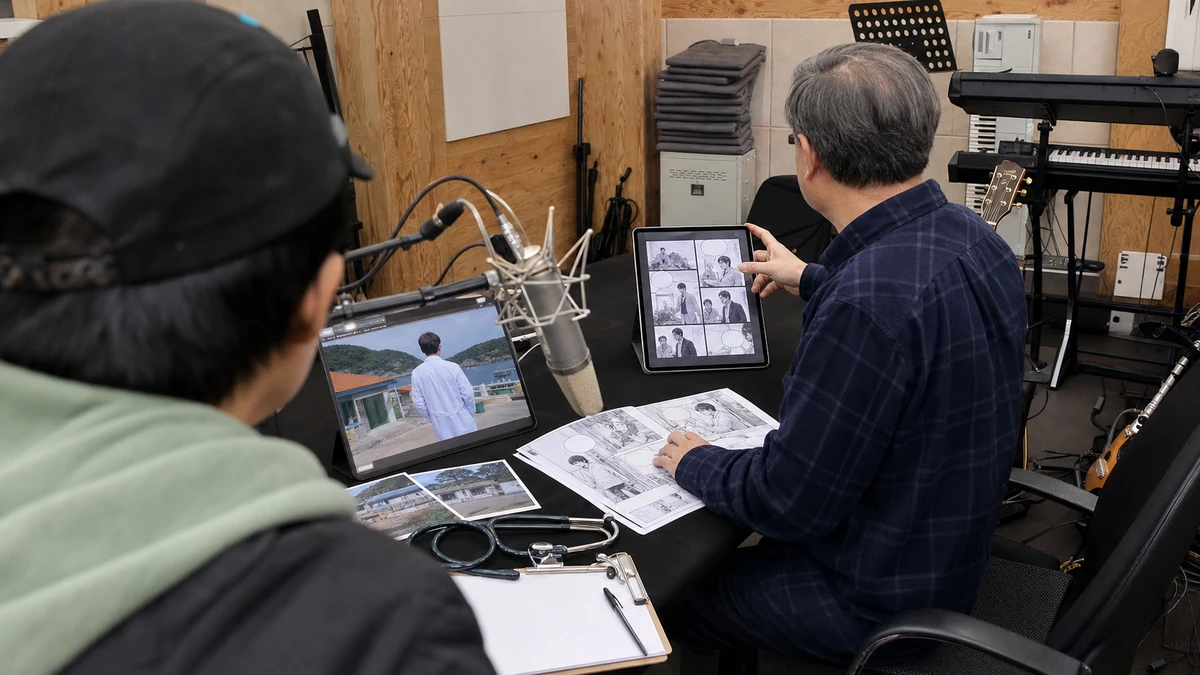
The drama is based on writer Kim Taepung’s webtoon “Jonbeo Doctor,” which first appeared in 2019 through Naver Webtoon’s challenge comics section, a kind of proving ground where emerging creators can test stories and build an audience before landing an official serialization. The series later moved into formal publication on Kakao Webtoon and KakaoPage in 2022, a path that reflects one of the most important features of South Korea’s digital comics business: stories are often developed in public, refined through reader response and then expanded into larger media formats if they prove durable enough.
For American readers, the closest comparison may be the way a self-published comic, indie graphic novel or breakout online fiction property can slowly build enough momentum to interest streamers, studios or television producers. But Korea’s webtoon ecosystem is more centralized, more industrialized and more tightly connected to the entertainment pipeline than anything most U.S. audiences are used to. A webtoon there is not just a digital comic. It can be a testing ground for intellectual property, a fandom engine and a launchpad for television all at once.
“Doctor Seomboy” arrives at a moment when that pipeline is no longer a niche Korean phenomenon but an increasingly global one. Even viewers who have never used Korean platforms like Naver or Kakao may already have watched stories shaped by that world. For that reason, the drama’s early ratings are about more than one premiere night. They suggest that the webtoon-to-screen model still has room to evolve, especially when it moves beyond obvious fantasy spectacles or romance hits and into more grounded social storytelling.
From “Jonbeo Doctor” to “Doctor Seomboy,” a title shift with a broader appeal
One of the most revealing details about the adaptation is the change in title. The original webtoon, “Jonbeo Doctor,” uses a Korean slang expression that can be difficult to translate neatly into English. “Jonbeo” loosely conveys the idea of hanging in there, enduring, gutting it out or surviving through hardship by sheer persistence. It is a term associated with resilience, but often a weary, hard-earned kind rather than triumphal grit. In that sense, the original title emphasizes the doctor’s endurance.
The TV version, “Doctor Seomboy,” shifts the emphasis. “Seom” means island in Korean, and the new title makes the show’s setting and identity more immediately legible. Even without knowing Korean, viewers can grasp the basic setup: this is a doctor story, but one defined by island life, isolation and a fish-out-of-water dynamic. It is a smart example of how adaptations do not simply transfer a story from one format to another. They often reframe it, packaging the same core material in a way that better fits a broader audience.
That reframing is especially important when a story moves from a digital comics readership into broadcast television. Webtoon readers may already be comfortable with platform-specific humor, internet-age slang and serialized character beats that build over long stretches. Television needs a clearer first impression. A title that quickly communicates profession, place and tone can help lower the barrier for casual viewers who are scanning a programming slate rather than actively following a niche comic.
The title change also hints at a broader thematic expansion. If “Jonbeo Doctor” spotlights the emotional grind of a protagonist who must simply endure, “Doctor Seomboy” suggests a larger stage: an island community, a set of relationships, a social environment and a public-health context. That makes sense for television, which depends heavily on ensemble interplay and visual world-building. The island is not just a backdrop. It is the engine of the story.
In practical terms, that means the show can explore a familiar universal narrative through specifically Korean circumstances. Audiences everywhere understand stories about outsiders adjusting to difficult communities, young professionals learning humility or idealists confronting real-world constraints. But by placing that narrative inside South Korea’s own regional medical system, the drama gains a texture that is local rather than generic. For overseas audiences, that local specificity is often part of the appeal.
The Korean context: what a public health doctor means here
At the center of the drama is Do Ji-ui, a public health doctor assigned to Pyeondongdo, a remote island described as a place people generally do not want to go. That premise carries a layer of Korean social context that may not be obvious to many American viewers at first glance. In South Korea, the term “public health doctor” refers to physicians who serve in medically underserved areas or other public-need placements. The role is not just a generic rural doctor posting. It comes with a specific institutional and social meaning.
For U.S. readers, one rough point of comparison might be a blend of rural service medicine, government placement and the idea of working in a medically underserved region where staffing shortages shape daily life. But even that comparison only goes so far. Korea’s medical geography, transportation patterns and national health structure create pressures that are distinct from those in the United States. On an island or in a remote region, the doctor is not just treating patients. He may also function as one of the few readily available links between a community and the broader health system.
That setup gives “Doctor Seomboy” a built-in dramatic tension. In a big-city hospital drama, conflict often comes from institutional politics, surgical prestige or life-and-death emergencies within a highly resourced system. In an island setting, scarcity itself becomes a narrative tool. Limited staff, limited facilities, close-knit residents and the social complications of being an outsider can all create conflict that is less flashy but often more intimate. The doctor is not hidden inside a huge bureaucracy. He is exposed to the community at every turn.
The island setting matters in another way, too. South Korean popular culture is often exported through urban imagery: neon cityscapes, elite schools, sleek offices and luxury apartments. Those settings are real, but they can narrow outsiders’ perception of the country. A drama like “Doctor Seomboy” points viewers toward a different Korea — one shaped by regional identity, uneven infrastructure and local community dynamics. That does not make the show a documentary, of course. It is still entertainment. But it broadens the cultural frame.
And it may broaden the K-drama frame as well. For years, global fans have associated Korean drama with romance, revenge thrillers and high-concept genre hybrids. Those remain central parts of the industry. Yet some of the most interesting recent Korean storytelling has come from works that explore public systems, social obligations and the friction between urban modernity and local life. A medical drama set on an unwanted island assignment can tap directly into that tension.
Why the webtoon pipeline matters in Korea’s entertainment economy
To understand why “Doctor Seomboy” is attracting attention, it helps to understand how webtoons function in South Korea’s content economy. Webtoons are vertically scrolling digital comics optimized for smartphones, and in Korea they are woven deeply into everyday media consumption. They are not a niche hobby in the way comic-book reading is often perceived in the United States. They are mainstream, accessible and structurally suited to weekly audience engagement.
The origin of “Jonbeo Doctor” in Naver Webtoon’s challenge section is especially significant. That section serves as an entry point for creators who have not yet become formally serialized professionals. It is where readers help determine, through attention and response, which stories show promise. In Hollywood terms, imagine if a studio system had a massive built-in public audition platform, where new creators could pitch serialized work directly to millions of users and successful concepts could move step by step into paid publication and eventually visual adaptation.
That appears to be what happened here. According to the reported timeline, Kim’s story began as a challenge comic in 2019 and advanced to official serialization on Kakao Webtoon and KakaoPage beginning in 2022. Only after that accumulation of audience reaction, platform validation and sustained narrative development did it become a television drama. In other words, “Doctor Seomboy” is not the result of a sudden rights grab. It is the product of a layered development process.
That process helps explain why Korean webtoon adaptations can feel unusually confident in their worlds. By the time a story reaches television, characters may already have been tested over years of reader engagement. Writers and producers are not adapting an unproven outline. They are adapting a property that has already demonstrated staying power, emotional attachment and enough narrative scaffolding to support expansion.
Of course, that does not mean every adaptation succeeds. Fans of the original often worry that a drama will flatten characters, soften edge or miss the rhythm that made a webtoon work in the first place. But when the transition works, it can create a rare kind of multiplatform life. Characters first imagined in still frames gain actors’ voices, physical gestures and new chemistry. A local digital comic becomes a broadcast event. That transformation is part of what Kim described in deeply personal terms.
The creator’s response: more than a licensing deal
Speaking at a meeting in Seoul’s Mapo district on July 12, Kim compared watching his work become a drama to a parent’s feelings toward a child, according to Yonhap. It is an emotional metaphor, but a telling one. Creators often speak cautiously about adaptations, especially when they have limited control over casting, scripting or production choices. Kim’s comments suggest that he views the drama not as a detached corporate reuse of his intellectual property, but as a continuation of the characters’ life in another form.
That idea matters because the relationship between original creators and adaptations has become a recurring issue across global entertainment. American readers are familiar with the debates: whether a comic-book adaptation respects the source, whether a bestselling novel is diluted by prestige-TV packaging, whether fan service overwhelms storytelling. In Korea’s webtoon market, those questions are similarly alive, and sometimes even sharper because readers often feel close to works they followed serially on their phones week after week.
Kim’s remarks suggest a level of satisfaction with the adaptation’s interpretation, particularly in the area fans usually scrutinize first: casting. He reportedly said he was especially pleased with the casting of actress Shin Ye-eun as the mysterious nurse Yuk Hari, saying the choice felt so fitting that he wondered whether anyone else could have expressed the role better. For readers of the original, that kind of endorsement can function as an informal seal of trust.
It does not eliminate debate. Fans will still make up their own minds about whether the performances match the versions they imagined. But a creator’s public approval can help narrow the gap between longtime readers and first-time viewers. That is crucial for webtoon adaptations, which need to satisfy two audiences at once: those who arrive with expectations and those who arrive with none.
Kim also said he had been moved by audience reactions, particularly the way viewers affectionately use the characters’ names. That response points to something ratings alone cannot fully capture. A show succeeds not only when people sample it, but when they adopt its characters into the language of fandom and everyday conversation. In a serialized medium, affection can be as important as curiosity.
Star power, early ratings and what 4.0% really means
The drama stars Lee Jae-wook as Do Ji-ui and Shin Ye-eun as Yuk Hari, giving the series a recognizable pair of young actors to anchor its adaptation. In the Korean TV market, casting is often part of a complex balancing act: big enough names to draw attention, but not so overpowering that the stars eclipse the world of the story. In a project adapted from a known webtoon, that balance becomes even more delicate because fans want both fidelity and charisma.
The 4.0% premiere rating has been highlighted because it marks the highest first-episode rating for an ENA Monday-Tuesday drama. That is a meaningful benchmark, though American readers should resist reading it through the wrong lens. Korean ratings percentages are often discussed with great intensity because they remain a highly visible shorthand for public interest, even in an era when streaming, delayed viewing and online clips have complicated old-fashioned broadcast metrics everywhere.
In other words, 4.0% is not the same thing as a U.S. network rating headline from the height of traditional American television. It is best understood comparatively, within its own channel and time-slot context. Here, the significance lies less in the raw number than in the record it set for that slot on that network and what it implies about initial curiosity. The premiere appears to have convinced a substantial first-night audience to tune in, which is no small feat for a new show on a cable channel.
It is also worth noting what a strong opening can and cannot tell us. A premiere number reflects marketing, cast appeal, platform identity and the power of the premise. It does not guarantee long-term momentum, critical acclaim or international breakout status. But it can show that a drama has successfully crossed the first threshold that matters in adaptation: persuading both fans of the original and viewers unfamiliar with it to at least begin the journey.
That dual appeal may be one reason the show’s launch has resonated. Fans of the webtoon have reason to watch because they want to see how beloved characters are reimagined. New viewers can enter through the accessible structure of the story itself: a young doctor sent somewhere isolated, forced to navigate difficult patients, unfamiliar neighbors and his own growth. That setup is specific enough to feel fresh and universal enough to travel.
What “Doctor Seomboy” says about the next phase of K-drama globalization
For years, the global conversation around Korean entertainment has centered on scale: bigger fandoms, bigger streaming deals, bigger crossover success. But sometimes the more revealing stories are the smaller ones — the projects that show how Korea’s entertainment system continues to generate adaptable stories from the ground up. “Doctor Seomboy” is one of those cases.
The facts currently confirmed are straightforward. Kim Taepung’s webtoon “Jonbeo Doctor” has been adapted into ENA’s “Doctor Seomboy.” Lee Jae-wook and Shin Ye-eun play key roles. The show premiered with a 4.0% nationwide rating, the best opening for an ENA Monday-Tuesday drama. Kim has publicly spoken of his pride in watching the story evolve, likening the experience to seeing others cherish one’s child. Those details alone make for a notable industry story.
But the broader significance lies in what the adaptation represents. It shows that Korean television’s source material pipeline remains fertile beyond blockbuster fantasy or school romance. It demonstrates that stories rooted in Korean institutions and regional realities can still be packaged for broad entertainment appeal. And it suggests that international audiences increasingly have the appetite to meet Korean culture not only through glamorous exports, but through stories shaped by public service, local communities and places off the usual map.
That may be one of the most durable lessons of the Korean Wave’s current phase. Global success does not always require flattening cultural specificity into something generic. Often, the opposite is true. The more firmly a series understands its own social texture — in this case, a remote island, a public health assignment and the awkward growth of a young doctor — the more strongly it can stand out in an international marketplace crowded with interchangeable concepts.
Whether “Doctor Seomboy” becomes a major long-term hit remains to be seen. But its opening has already confirmed a few things: that the webtoon pipeline continues to shape Korean television in powerful ways, that creators can see adaptation as an expansion rather than a loss, and that a story born in a digital challenge-comics space can eventually command prime-time attention. For American viewers trying to understand what keeps South Korea’s entertainment industry so dynamic, that journey may be every bit as interesting as the drama itself.
Comments
Post a Comment