A Returned Korean Buddhist Statue Goes on View in Japan, Reopening Old Questions About Art, Ownership and History
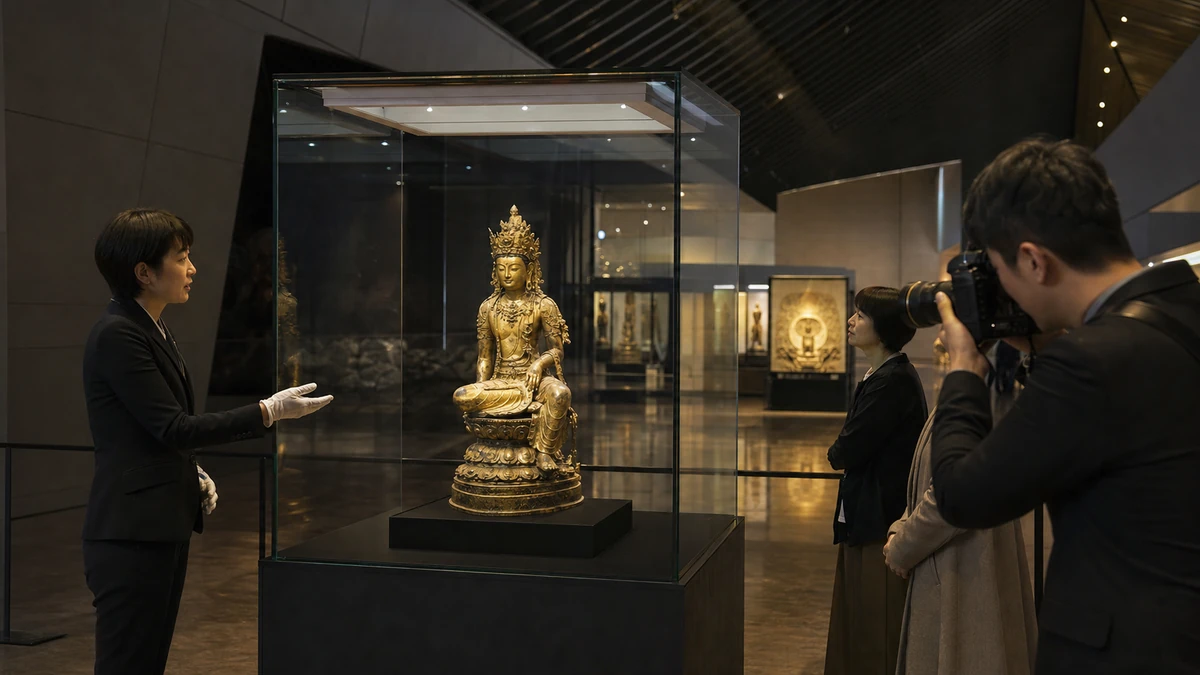
A medieval Buddhist statue at the center of a modern dispute
A 14th-century Buddhist statue made on the Korean Peninsula and fought over for more than a decade is about to enter a new chapter — this time under museum lights in Japan.
The Kyushu National Museum said it will begin showing the gilt-bronze seated Bodhisattva, a Korean Buddhist sculpture linked to the early 1300s, in a special exhibition starting Aug. 7. The statue was returned last year to Tsushima, a Japanese island between South Korea and Japan, after a 13-year ownership battle that drew in courts, monks, historians and government officials on both sides of the Korea Strait.
To many readers in the United States, the case may sound at first like another repatriation dispute — the sort of conflict Americans have seen involving Native American sacred objects, Nazi-looted art or antiquities removed from former colonies. But this case is more layered than a straightforward fight over possession. The object in question is at once a work of art, a religious image, a vessel of memory and a symbol of the long, often uneasy cultural relationship between Korea and Japan.
The museum describes the statue as a seated Avalokitesvara Bodhisattva — known in Korean as Gwaneum and in Japanese as Kannon — made on the Korean Peninsula during the Goryeo period around 1330, and associated with Kannonji temple in Tsushima. It also notes that the statue “returned” in 2025, language that underscores how much historical meaning can be packed into a museum label. In a few words, the institution identifies where the sculpture was made, where it has long been kept and how it is being framed after its return.
That framing matters. Museum exhibitions do not simply display objects; they also present a public version of history. In this case, the story is not just about a beautiful medieval Buddhist figure but about how East Asia remembers movement across the sea, how courts decide ownership after centuries of upheaval, and how religious art can belong to more than one narrative at the same time.
Why this statue matters beyond Korea and Japan
The sculpture is not a household name internationally in the way the Elgin Marbles or the Benin Bronzes are. Yet it touches on many of the same issues that have become central in global debates over cultural property: Who has the strongest claim to a work of art? Is legal possession the same as moral ownership? How should museums explain objects that were made in one place, venerated in another and disputed in yet another?
For American readers, it may help to think of the statue not as a museum piece alone but as something closer to a church icon that also has major art-historical value. In Buddhist tradition, Avalokitesvara is the bodhisattva of compassion, a figure associated with mercy and protection. A bodhisattva, unlike a Buddha, is an enlightened being who remains engaged with the suffering of the world. That means the statue has never been merely decorative. For believers, it is an object of devotion. For scholars, it is a rare example of Goryeo Buddhist art. For local communities, it is part of inherited religious life.
That mix of meanings helps explain why the statue has provoked strong emotions. In the U.S., many people understand how a treasured church relic, tribal ceremonial item or synagogue artifact can carry significance that goes far beyond its market value. The same is true here. The fight over this sculpture was never only about where it should sit in a storage room or display case. It was also about where history itself should be anchored.
The dispute also arrives at a time when Korean culture is often discussed internationally through the lens of K-pop, streaming dramas and Oscar-winning films. Those modern cultural exports have made South Korea newly familiar to many English-speaking audiences. But this story is a reminder that Korean cultural influence did not begin with BTS or “Parasite.” Centuries before the modern Korean Wave, religious art, technology and ideas moved across Northeast Asia by sea, shaping the region in ways that are still visible today.
The long route from medieval Korea to a Japanese temple — and back into dispute
The statue is believed to date to the late Goryeo period, a dynasty that ruled Korea from 918 to 1392 and is widely known for sophisticated Buddhist art, celadon ceramics and refined metalwork. Goryeo Buddhism produced some of East Asia’s most admired religious images, and gilt-bronze sculptures from the period are especially prized for their technical skill and spiritual presence.
At some point in history, the statue came to be housed at Kannonji, a temple in Tsushima. Tsushima is not just any Japanese island. Geographically, it sits between the Korean Peninsula and the Japanese main islands, making it a natural waypoint for trade, diplomacy, migration and sometimes conflict. If there is a place that embodies the shared and contested currents of Korean-Japanese history, Tsushima is near the top of the list.
That geography is one reason the upcoming exhibition is titled “Kyushu Torai-butsu,” or roughly “Buddhist statues that came across to Kyushu.” The Japanese term points to religious images that crossed the sea from places including the Korean Peninsula to Japan. In other words, the exhibition is not presenting the statue as an isolated treasure but as part of a broader maritime history of cultural exchange.
That point is especially important because the modern dispute began with an illicit movement in the opposite direction. The statue was smuggled into South Korea, setting off years of legal and political arguments over who had the rightful claim. South Korean temple Buseoksa argued that the statue had originally been taken from Korea centuries ago during a period of turmoil and therefore should not simply be restored to Japan without reckoning with that deeper history. Japanese stakeholders, including the temple in Tsushima, maintained that the object belonged to Kannonji and should be returned.
What followed was not a brief diplomatic spat but a long-running struggle that lasted 13 years. The case moved through the courts and became a proxy for larger unresolved tensions between South Korea and Japan — two U.S. allies whose relationship is essential to regional security but frequently strained by disputes over history, colonial rule and cultural heritage. Even when the immediate subject is a single statue, those larger memories are never far away.
A court case, a religious ritual and the limits of legal closure
The legal fight eventually ended with the statue being returned to Japan last year. But “ended” is a relative term. Courts can settle possession, yet they do not necessarily settle memory.
Before the statue was sent back to Tsushima, Buseoksa held a 100-day Buddhist ritual. That detail may sound unusual to readers accustomed to thinking of repatriation in purely bureaucratic terms — shipping manifests, customs documents, court orders and insurance policies. But the ceremony is crucial to understanding how this case was experienced in Korea.
In Buddhism, ritual observances are not symbolic add-ons. They are part of religious life and communal meaning. Holding a 100-day rite before the statue’s departure signaled that, for the temple and its supporters, this was not simply an asset changing hands. It was a spiritually charged farewell to an object that many believed had deep ties to Korean Buddhist history.
This is one reason cultural property disputes involving sacred objects are often more difficult than those involving paintings or decorative antiquities. A Renaissance canvas may be cherished, but a devotional statue can also be prayed to. It occupies the overlapping worlds of aesthetics, faith and identity. That overlap complicates the notion of a clean legal solution.
For American audiences, there is a useful parallel in debates over Native American funerary and ceremonial objects under the Native American Graves Protection and Repatriation Act. Those cases often reveal a gap between museum categories and community meaning. An institution may classify an item as an artifact, while the community that made or used it sees it as an ancestor, a sacred being or part of living tradition. Something similar is at play here. The Goryeo statue can be cataloged, dated and insured — but it also carries devotional and historical life that resists administrative language.
The statue’s return therefore answered one question and sharpened several others. Where should such an object reside? Does the strongest claim lie with the place where it was made, the place where it was worshipped for centuries, or the community that can trace the original circumstances of its removal? Can historical injustice be repaired through present-day law when the original events took place so long ago that records are fragmentary? Those questions did not disappear when the statue crossed the sea again.
What the museum is really exhibiting: not just art, but an argument about history
When the statue goes on view at the Kyushu National Museum, visitors will encounter more than a medieval religious image. They will also encounter a carefully constructed narrative.
The museum’s description reportedly identifies the work both as something made on the Korean Peninsula during the Goryeo era and as the seated Kannon bodhisattva of Kannonji in Tsushima. That dual labeling is telling. It acknowledges a Korean origin while affirming a Japanese temple association and present custodial identity. Rather than erasing either side of the object’s biography, the wording holds them together in a single line.
That may sound like neutral cataloging, but in the world of contested heritage, labels are rarely neutral. The order of facts, the vocabulary of “return” or “recovery,” and the emphasis placed on origin versus custody all shape how the public understands ownership and legitimacy. American museums have faced similar scrutiny when updating labels for Indigenous art, colonial-era objects and works acquired under questionable circumstances. The shift from “discovered” to “taken,” or from “owner” to “custodian,” can fundamentally change the moral frame.
In this case, the museum’s choices matter not just to scholars but to ordinary visitors. A person viewing the statue may be struck first by its artistry — the calm expression, the seated posture, the elegance of its form. But once they read the label and the exhibition context, they are also being asked, whether explicitly or not, to think about how religion and culture travel across borders.
The exhibition title reinforces that message. By grouping the statue within a category of images that “came across” the sea, the museum situates it in a long history of movement between Korea and Japan. That framing may encourage visitors to think less in terms of modern national boundaries and more in terms of medieval maritime networks. At the same time, it could also be read as normalizing an object’s long presence in Japan after a modern dispute over ownership. Both readings are possible, which is why the exhibition is likely to draw close attention beyond the museum world.
Why Tsushima and Kyushu matter to the story
For many Americans, the names Tsushima and Kyushu may not immediately carry resonance. But they should be understood as places where the sea has long connected, not just separated, Korea and Japan.
Tsushima lies in the Korea Strait, much closer to the Korean Peninsula than to Tokyo. For centuries it served as a contact zone — sometimes peaceful, sometimes tense — where merchants, envoys, monks and ideas moved between the two societies. Kyushu, Japan’s southwestern main island, has similarly been one of Japan’s historic gateways to the Asian mainland. To stage this exhibition in Kyushu is therefore not incidental. It places the statue in a region defined by cross-border exchange.
That regional context matters because cultural identity in East Asia has often been shaped not only by capitals and empires but also by coastal routes, islands and trading corridors. Americans are familiar with the idea that border regions tell a different story than national myths from the center. The U.S.-Mexico border, New Orleans as a port city, or the Great Lakes as a shared zone with Canada all show how local geography can complicate tidy national narratives. Tsushima and Kyushu play a somewhat analogous role in this story.
The statue, then, is not simply a Korean object in Japan or a Japanese temple object with Korean origins. It is also evidence of an older world in which religious culture crossed the water more fluidly than today’s passport regimes might suggest. That does not erase questions of ownership. But it does help explain why a single work can be sincerely claimed, interpreted and mourned in more than one place.
A heritage dispute that reflects larger Korean-Japanese tensions
Any story involving Korea and Japan inevitably unfolds against the backdrop of a relationship shaped by deep cultural exchange and deep historical grievance. Japan’s colonial rule over Korea from 1910 to 1945 remains the central wound, with continuing disputes over forced labor, wartime sexual slavery, textbooks and official apologies. Cultural property controversies often become flashpoints because they concentrate larger questions of dignity, memory and recognition into a tangible object.
That does not mean every artifact dispute is merely symbolic theater for modern nationalism. The facts of each case matter. But it does mean public reactions are rarely limited to the object itself. When South Korean audiences hear about a Goryeo-era statue associated with a Japanese temple, some will think not only of medieval religious exchange but of centuries of loss, looting and asymmetry. When Japanese audiences hear about the statue’s return, some will view it as the resolution of a theft case and the homecoming of a local religious treasure.
Both responses can coexist, even if they clash. That is part of what makes this story internationally significant. It shows how cultural heritage can act like a pressure point, exposing unresolved historical debates without the drama of a summit meeting or trade fight.
It also suggests why this exhibition will be watched beyond Japan. Scholars, museum professionals and officials concerned with international cultural property will likely look closely at how the object is interpreted, what historical timeline is emphasized and whether the presentation acknowledges the full complexity of the dispute. In an era when museums worldwide are reexamining the origins of their collections, even a regional exhibition in Japan can resonate far beyond its immediate audience.
The bigger lesson: art does not stop moving when a court case ends
The upcoming unveiling on Aug. 7 marks an important public moment, but it is not the final word on the statue. If anything, it begins the next phase of its afterlife: the phase in which a returned object is seen, interpreted and debated by museumgoers rather than judges.
That transition is significant. Once an artifact reenters public display, it stops being only a matter of paperwork and becomes a matter of storytelling. Visitors will not just see where the statue is now; they will absorb the explanation attached to it. In that sense, the exhibit is about historical authorship as much as physical custody.
For global audiences, this is the deeper takeaway. Cultural heritage disputes are often framed as binary contests: one country wins, another loses; one side keeps an object, another side gives it up. But the reality is messier. Objects accumulate meanings as they move through time. A statue can be made in one culture, protected in another, stolen in one era, reclaimed in another and then reinterpreted for a global public still later.
That layered reality is what makes the Goryeo bodhisattva so compelling. It is a relic of medieval Korean craftsmanship, a long-venerated object in a Japanese temple, the subject of a modern legal battle and now a museum exhibit that will invite fresh scrutiny. Few objects illustrate so clearly how art can live simultaneously in the realms of devotion, diplomacy and public history.
For American readers who know South Korea primarily through pop culture and Japan through tourism or consumer brands, this story offers a different entry point into East Asia: one shaped by religion, historical memory and the politics of cultural inheritance. It is a reminder that the most revealing international stories are not always about elections, tariffs or military maneuvers. Sometimes they begin with a single object in a glass case, and the centuries of human conflict and connection that object carries with it.
When the statue goes on display next month, visitors will see a serene bodhisattva seated in composure. What they will not see so easily, unless the exhibition tells the story well, is the turbulence that has surrounded it: the sea routes that carried it, the arguments that claimed it, the prayers said over it and the competing histories it still embodies. That invisible history may be the most important part of the exhibition of all.
Comments
Post a Comment