A South Korean Activist’s Passport Fight Tests How Far a Democracy Can Go to Stop Citizens From Entering War Zones
A courtroom fight over a passport — and something bigger
In South Korea, a country where the passport is both a practical travel document and a symbol of global mobility, a legal fight unfolding in Seoul is raising a question that resonates far beyond one activist’s case: How much power should a democratic government have to stop its own citizens from traveling to places it considers too dangerous?
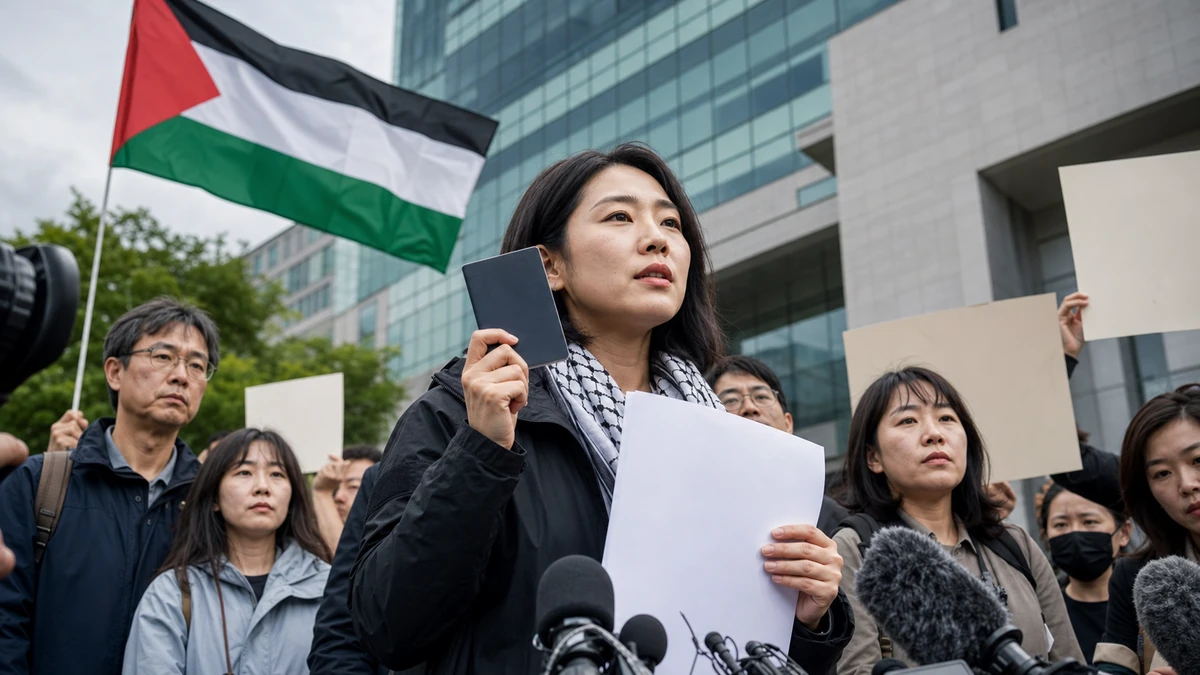
That question came into sharp focus this week as South Korean activist Kim Ah-hyun, who also uses the name Haecho, appeared at the Seoul Administrative Court for the first hearing in a lawsuit seeking to cancel a government order requiring her to surrender her passport. According to South Korean media reports, Kim’s passport was invalidated after she attempted to enter the Gaza Strip, which South Korea designates as a prohibited travel zone.
Outside the courthouse in Seoul’s Seocho district, Kim argued that the country’s passport law is being used not simply to protect citizens, but to restrict their freedom of movement. In remarks to reporters, she framed the dispute as larger than her own circumstances, warning that if the state can revoke or invalidate a passport in this kind of case, similar restrictions could later be used against other citizens.
For American readers, the closest comparison may be debates over whether the U.S. government can restrict travel to conflict zones or sanction Americans who provide material support in dangerous overseas situations. But South Korea’s system has its own history and legal structure, and the current case is emerging from a society where overseas travel carries special weight. For decades, South Koreans lived under tighter controls on international movement; today, the country is deeply globalized, and international travel is commonplace for work, study, family connections and activism. That helps explain why this lawsuit, though technical on its face, is drawing attention as a test of civil liberties.
At its core, the case pits two familiar democratic principles against each other: the government’s duty to protect life and maintain public welfare, and the individual’s claim to act according to conscience — even in ways the state believes are reckless. Kim’s challenge is not yet a definitive ruling on those principles. It is, at this stage, the opening round of a legal battle over whether the foreign ministry acted lawfully when it ordered her to return a passport that had been rendered invalid.
Still, even at this early stage, the dispute has become a proxy for a broader argument about the reach of state authority, the language of public safety and the boundaries of international solidarity in an era of highly visible war and humanitarian crisis.
Why Gaza, and why this case matters in South Korea
The immediate facts are relatively straightforward. Kim attempted to enter Gaza, a territory South Korea classifies as off-limits because of the severe risks tied to armed conflict. As in many countries, the South Korean government uses travel advisories and, in some cases, outright travel bans for areas considered especially dangerous. Officials argue that such measures are necessary to protect citizens from kidnapping, injury or death, and to avoid situations in which the government would face pressure to mount costly or diplomatically fraught rescue efforts.
In Kim’s case, that logic collided with activism. She is associated with a group identified in Korean reports as the Korean branch of a solidarity organization focused on Palestinian liberation. The group held the news conference outside court, signaling that supporters view the matter not as a narrow bureaucratic dispute but as part of a wider campaign related to Gaza and to political support for Palestinians.
That context matters. To many government officials, entering an active war zone looks like an obvious safety hazard. To Kim and her allies, the attempt to reach Gaza appears to have carried a political and humanitarian meaning that goes beyond tourism or personal adventure. In public remarks, Kim suggested that access to a conflict zone can be part of bearing witness, expressing solidarity or taking moral action in response to suffering abroad.
For audiences in the United States and other English-speaking countries, the language may sound familiar. Over the past several years, activists across the political spectrum have increasingly argued that citizenship does not end at the border — that moral responsibility can extend to distant conflicts, whether in Ukraine, Gaza, Sudan or elsewhere. Governments, however, tend to respond with the language of risk management, national responsibility and public order.
South Korea has its own reasons for treating these questions seriously. The country remains technically at war with North Korea, even if active combat ended more than 70 years ago with an armistice rather than a peace treaty. National security is not an abstract concern in South Korean political culture. At the same time, South Korea is also a vibrant democracy with a strong history of protest politics. Its public sphere includes activists who are deeply engaged with international issues, from labor rights to climate change to anti-war movements. Kim’s case lands at the intersection of those two traditions: security-minded governance and robust civic activism.
That is one reason the lawsuit may carry meaning beyond its immediate legal outcome. It asks not only whether Gaza is dangerous — a point few would dispute — but whether danger alone settles the question of what a citizen may choose to do, especially when that choice is presented as a matter of conscience.
The legal issue: protection, procedure and “public welfare”
Legally, the dispute centers on an administrative action by South Korea’s foreign ministry. The court is not being asked in this hearing to decide the morality of Kim’s activism or the politics of the Israel-Hamas war. Instead, it is examining whether the ministry’s order requiring Kim to return her passport was lawful under the relevant passport rules and administrative procedures.
According to Kim’s account of the government’s position, the foreign ministry argues that there were no procedural defects in its action and that the move was justified because of the significant danger to her life and physical safety, as well as the need to protect the public welfare. In many democracies, “public welfare” is a broad term that can do a lot of legal work. It can encompass public safety, the efficient use of state resources, diplomatic burdens and the government’s general responsibility to protect its nationals abroad.
But that same breadth is what makes the phrase controversial. Kim has publicly pushed back on the idea, asking in effect who gets to define the public welfare and by what standard. Her challenge goes to a familiar tension in constitutional democracies: when the state invokes a general public interest, does that reflect a legitimate balancing of competing needs, or can it become a catchall phrase that masks overreach?
American readers may recognize the shape of that debate even if the legal system is different. In the United States, arguments over public safety and individual liberty appear everywhere from protest restrictions to public health emergencies to immigration enforcement. South Korea’s administrative courts operate in a different legal tradition, but the underlying dispute is comparable. The state says it is acting to prevent grave harm; the individual says the state is using protection as a justification for undue control.
There is also a practical dimension. A passport is not just identification. It is the document that allows a person to cross borders, board international flights and, in many cases, participate in political or humanitarian activity abroad. Once a passport is invalidated or its return is ordered, the effect is immediate and concrete. It does not merely discourage travel; it can stop it outright.
That is why passport cases can take on an importance that exceeds paperwork. They sit at the border — literally and symbolically — between a citizen’s autonomy and the state’s gatekeeping power. Kim’s lawsuit asks the court to scrutinize whether that power was exercised within lawful bounds.
The cultural subtext: movement, obedience and dissent
Kim’s public comments suggest she wants the public to hear this case as more than a personal grievance. One of her sharpest remarks, as reported in Korean coverage, was aimed at a familiar social reaction: the idea that if the government says “don’t go,” a citizen should simply obey. Her objection was not limited to the specifics of Gaza. It was directed at what she portrayed as a more unsettling attitude — the assumption that a state order, once issued, should substitute for an individual’s ethical judgment.
That message carries particular force in South Korea, where questions of obedience, authority and dissent have a distinct historical resonance. Modern South Korea is a democracy, but it was shaped by periods of authoritarian rule during the Cold War, when the state often justified restrictions in the name of security and order. Democratic movements pushed back against that logic, arguing that citizens are not merely subjects to be managed but moral and political actors in their own right.
None of that means Kim’s position will prevail in court or in public opinion. Many South Koreans may view the government’s actions as common sense. After all, Gaza is not simply a politically charged location; it is a war zone. To critics, Kim’s rhetoric about freedom of movement may sound detached from the government’s real responsibility to prevent foreseeable harm.
But the fact that such a case can be argued openly, before a court and in front of cameras, speaks to South Korea’s democratic maturity. The issue is not whether the state may ever restrict travel. Most people accept that it can. The harder question is whether the state’s power is limited by a citizen’s right to take risks for political, moral or humanitarian reasons.
There is another layer for American readers worth understanding. In South Korea, foreign policy and security issues can feel close to home in ways that differ from the U.S. experience. The country’s geography, alliance structure and history of division make state warnings about danger carry special institutional weight. Yet precisely because South Koreans live with security language so often, there is also a strong tradition of challenging how that language is used. Kim’s case taps into that long-running debate.
In that sense, the lawsuit is as much about civic culture as it is about passport law. It asks whether the citizen’s role is to accept the government’s risk calculus or to retain the right to reject it — even at personal cost.
International solidarity meets the limits of the nation-state
The Gaza connection gives the case an emotional and geopolitical charge that a routine passport dispute would never have. Kim’s comments, including her question about why people can do so little for Palestinians facing catastrophe, frame travel not as leisure but as action. Whether one agrees with that framing or not, it reflects a broader trend in global activism: people increasingly see physical presence, humanitarian accompaniment and transnational solidarity as forms of political participation.
That can put activists on a collision course with the modern nation-state, which still controls the documents, borders and permissions that make international movement possible. A passport is issued by a government, not by a private conscience. That basic fact means that even a highly globalized citizen remains dependent on the state to move through the world.
What Kim appears to be contesting is not only the decision in her own case but the principle that a government may shut down a political journey by invalidating the document on which all foreign travel depends. From her perspective, the restriction reaches beyond personal safety and into political agency. If a citizen cannot travel to witness, protest or assist in a conflict zone because the state forbids it, then the state is doing more than offering protection; it is shaping the outer limits of moral action.
Governments, of course, see the matter differently. Officials do not need to deny the sincerity of activism to argue that some places are too dangerous for any responsible state to permit. In an age of instant global media, a dead or detained citizen abroad can quickly become a national crisis. The government may be condemned if it fails to rescue that person and criticized if it appears to have allowed the risk in the first place. From that viewpoint, travel bans and passport restrictions are not ideological tools but administrative guardrails.
This is one reason cases like Kim’s rarely stay narrow. They expose a structural contradiction. Democracies celebrate engaged citizenship, moral courage and global awareness. But they also reserve the power to say: not there, not now, not under these conditions.
That contradiction is not uniquely Korean. Yet South Korea provides a vivid example because it is both intensely connected to the world and highly attentive to security. The result is a legal and political environment in which international solidarity can flourish rhetorically while still meeting hard limits at the border.
What the court can decide — and what it cannot
As the case proceeds, the Seoul Administrative Court will be dealing with specific legal questions, not all the philosophical ones the case has stirred up. Judges will likely focus on the statutory authority behind the passport action, whether proper procedures were followed and whether the foreign ministry’s reasoning meets the standards required under South Korean administrative law.
That means the eventual ruling may be narrower than the public conversation surrounding it. A court could, for example, decide that the ministry acted lawfully without endorsing every aspect of the broader political rationale. Or it could find a procedural flaw without embracing Kim’s expansive claims about freedom of movement. Administrative litigation often works that way: the practical result can be significant even when the formal legal grounds are technical.
Even so, the symbolic stakes are considerable. If the government prevails cleanly, officials may feel reinforced in their ability to use passport law as a tool to prevent travel to prohibited zones. If Kim wins, even on a limited ground, activists and civil liberties advocates may treat the outcome as a sign that the state’s discretion has meaningful limits.
There is also the question of public opinion. South Korean society, like many others, is polarized on how to weigh safety against rights, and on how to interpret the war in Gaza. Some will likely see Kim as principled and brave; others will see her as irresponsible, or as trying to convert a self-created risk into a rights cause. That split mirrors debates in the United States over everything from foreign volunteer fighters to campus activism to the line between protest and endangerment.
For now, what is firmly established is limited. A first hearing has been held in a lawsuit challenging the order to return a passport after an attempt to enter Gaza. Kim has publicly criticized the passport law as an unjust restriction on movement. The foreign ministry, according to her account of its position, maintains that the action was lawful and justified by serious danger and public welfare concerns. Much more about the case — including the ministry’s full legal argument and the court’s eventual reasoning — remains to be seen.
A local case with global meaning
It would be easy to treat this as a niche legal story from abroad: one activist, one passport, one hearing in a Seoul court. But that would miss why the case is attracting notice. It speaks to a larger democratic dilemma that Americans and others are also wrestling with: When the government says it is protecting you, how much room is left for you to decide otherwise?
That question is especially sharp in wartime, when the language of danger is both credible and expansive. Gaza is unquestionably perilous. Yet the more dangerous a place becomes, the more governments can claim authority to decide who may approach it and for what purpose. For activists, journalists and humanitarian-minded citizens, that creates a troubling possibility: that the places where moral witness feels most urgent are precisely the places the state can most easily place beyond reach.
Kim’s case does not resolve that tension. It dramatizes it. It shows how a passport — something most travelers toss into a bag without much thought — can become the frontline document in a struggle over rights, conscience and state power. It also shows how domestic law can shape international solidarity, determining not just where citizens may go, but what kinds of action remain practically possible in response to distant suffering.
For South Korea, the lawsuit is a measure of how a democratic state manages risk without collapsing dissent into disobedience. For American readers, it offers a reminder that the tension between liberty and protection does not stop at the water’s edge. Whether the issue is a protest permit, a surveillance rule or a passport restriction, the underlying argument is familiar: Who gets to define the public good, and how much freedom can be curtailed in its name?
The Seoul court cannot answer all of that. But in hearing Kim Ah-hyun’s challenge, it is confronting one of the oldest democratic questions in a very modern form. In a global age, when citizens want not only to speak about injustice but sometimes to go where it is happening, governments still hold the power to stamp “no” on the document that makes movement possible. The legal question is whether that power was properly used. The political question — in South Korea, in the United States and beyond — is whether citizens are willing to accept how far that power can reach.
Comments
Post a Comment