A regional startup contest in South Korea points to a bigger technology shift
In South Korea, where global audiences often focus on Samsung smartphones, Hyundai cars and K-pop exports, a quieter but increasingly important story is unfolding in the startup world. This week, that story took shape in Gyeonggi Province, the populous region that surrounds Seoul and serves as one of the country’s main industrial and technology corridors.
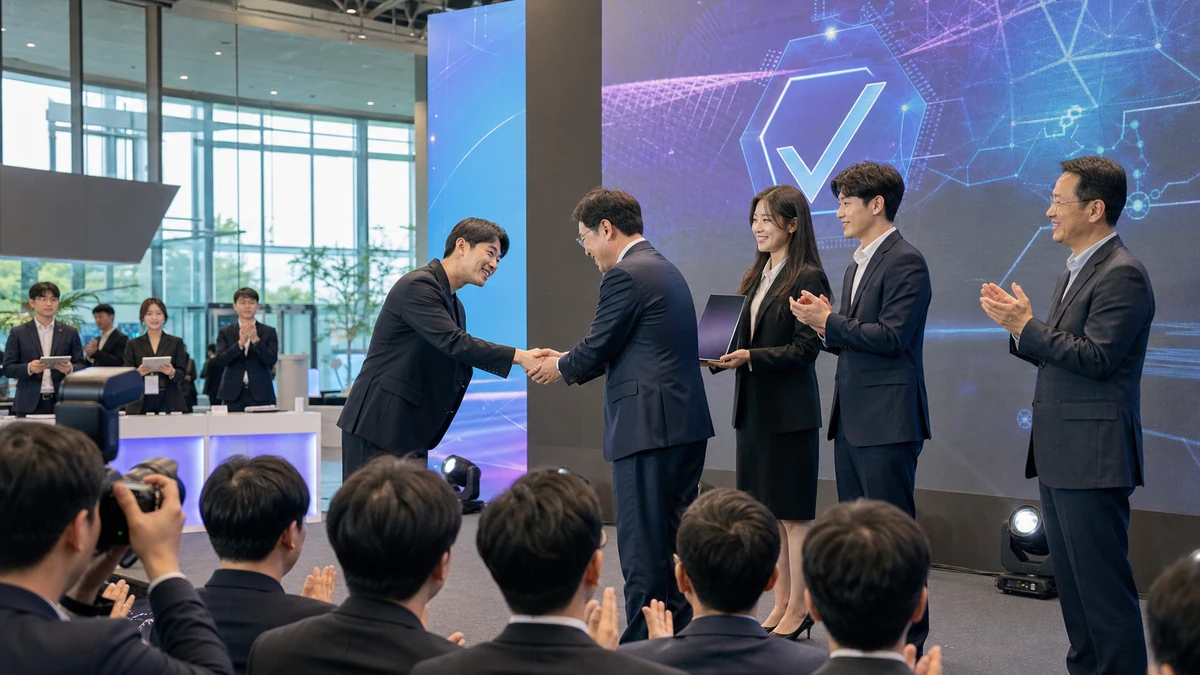
Officials in Gyeonggi said Testify, an early-stage startup developing an automated quality verification platform powered by generative artificial intelligence, won the grand prize in the finals of the “2026 Gyeonggi Startup Competition Preliminary-Early League.” The contest is aimed at would-be founders and startups less than three years old that are based in the province. The event was hosted by the provincial government and the Gyeonggi Business and Science Accelerator, a public agency that supports companies and science-based industries in the region.
On its face, the announcement may sound like the kind of local economic development story that rarely travels far beyond regional business pages. But for readers trying to understand where South Korea’s innovation economy is headed, the result offers a revealing snapshot. The winning idea was not another consumer-facing chatbot, entertainment app or delivery platform. It was a business tool focused on one of the least glamorous, but most essential, functions inside a company: making sure products and services meet required standards.
That matters because it suggests how the AI boom is maturing. In the United States, much of the public conversation around generative AI has centered on tools like ChatGPT, image generators and office productivity software. In South Korea, those discussions exist too. But the Gyeonggi competition signals that some of the most closely watched startup bets are now moving deeper into the machinery of business operations — into factory floors, testing workflows, energy systems and industrial communications.
It also underscores another feature of the Korean startup landscape that may be less familiar to American readers: local governments and quasi-public agencies play an outsized role in identifying, funding and promoting young companies. In the U.S., startup mythology often revolves around Silicon Valley venture capital, garage founders and private accelerators. In South Korea, public institutions frequently act as early gatekeepers and boosters, especially outside the country’s biggest conglomerates.
What Testify won — and what it says about AI’s next use case
According to provincial officials, Testify’s platform uses generative AI to automate quality verification, a broad category that can include checking whether a product, service or process meets expected specifications. In plain English, it is the kind of work that companies must do constantly but rarely celebrate: reviewing outputs, catching errors, comparing results against standards and documenting whether something passes inspection.
That may not sound as flashy as an AI-generated song or a digital avatar. But in business terms, quality verification sits at the heart of productivity, reliability and trust. Whether a company manufactures electronics, runs a software service, manages customer interactions or builds industrial systems, someone ultimately has to confirm that what is being delivered is actually good enough. Those checks are often repetitive, detail-heavy and expensive in labor terms — exactly the kinds of tasks that make executives and investors wonder whether AI can reduce costs or speed up operations.
The competition materials released publicly do not provide a deep technical breakdown of Testify’s product. There is no public detail in the summary about major clients, revenue, launch timing, overseas expansion or how the platform performs against established competitors. That distinction is important. Winning this prize does not mean the company has already transformed the market. It means judges believed the startup had a compelling technical direction and commercial promise at a very early stage.
Still, even at that level, the award is revealing. In the current AI cycle, investors and governments alike are trying to separate novelty from practical value. A startup that frames generative AI as a tool for quality assurance — rather than simply as a creative assistant — is speaking directly to a question many businesses are asking: Can AI help with the unglamorous but indispensable work that determines whether operations run smoothly?
That question has resonance well beyond South Korea. In the U.S., manufacturers, hospitals, logistics companies and software firms are all experimenting with automated review systems, AI copilots and machine-driven compliance tools. The Gyeonggi result suggests Korean startup judges are rewarding similar instincts: not just AI that impresses in demos, but AI that plugs into workflows where mistakes cost money and time.
Testify received 10 million won in prize money, or roughly several thousand U.S. dollars, along with an award from the head of the Gyeonggi Business and Science Accelerator. The cash itself is not transformative by startup funding standards. The symbolic value may matter more. In Korea’s tightly networked business and public support ecosystem, official recognition can help an early-stage company gain meetings, attract mentors and sharpen its pitch to future investors or customers.
Why Gyeonggi Province matters in South Korea’s startup economy
To understand why this competition draws attention, it helps to understand Gyeonggi’s place in South Korea. The province wraps around Seoul, the capital, and includes a dense cluster of satellite cities, research centers, industrial parks and residential communities. If Seoul is often compared to New York or Washington as a center of national power, Gyeonggi functions more like a sprawling mix of suburban innovation belt, manufacturing base and logistics backbone — though any American analogy is imperfect.
It is home to a large share of the country’s population and much of its economic infrastructure. Many of South Korea’s tech suppliers, factories, labs and startup support institutions are based there. That makes the province a particularly useful barometer for broader trends in Korean industry. When a regional contest in Gyeonggi highlights AI, solar technology and industrial networking, it is not just showcasing niche projects. It is reflecting the kinds of technologies policymakers believe can strengthen future competitiveness.
The contest itself is designed for founders who are either preparing to launch a company or have been in business for less than three years. That stage matters. These are not mature companies being judged on quarterly earnings or international market share. They are being judged largely on whether their technology addresses a real need and whether the team appears capable of building a business around it.
For American readers, one useful comparison might be to a state-backed entrepreneurship challenge tied to economic development goals — something that sits somewhere between a startup pitch contest, a public incubator and a workforce strategy initiative. In South Korea, that kind of public-sector involvement is common and often intentional. The government, at both national and local levels, has long viewed startup cultivation as one way to diversify an economy historically dominated by giant family-controlled conglomerates known as chaebol.
The term chaebol may be unfamiliar outside Korea, but it refers to the powerful business groups — like Samsung, SK, Hyundai and LG — that have shaped much of the country’s postwar economic rise. They remain central to Korean growth and exports. At the same time, policymakers have spent years trying to make more room for smaller, independent innovators. Competitions like this one are part of that strategy.
More than AI: Solar power and industrial networks also made the finals
Another striking feature of the Gyeonggi finals is that AI was not the only technology area recognized. The top prizes also went to startups focused on energy and industrial connectivity, suggesting a broader vision of innovation than the consumer internet-first model that once defined many startup ecosystems.
The excellence award went to Hexa Energy, which was recognized for a next-generation building-integrated photovoltaic system solution. Building-integrated photovoltaics, often shortened to BIPV, refers to solar technology embedded into parts of a building itself — such as facades, roofs or windows — rather than bolted on as separate panels after construction. For U.S. readers, think of it as the difference between adding a rooftop solar array to a house and designing the structure so that its outer skin also helps generate electricity.
The concept has drawn attention globally because it sits at the intersection of clean energy, architecture and urban planning. South Korea, like many countries, faces pressure to improve energy efficiency and reduce carbon emissions while still supporting dense urban development. A startup working on next-generation BIPV is therefore speaking to both climate policy and the real estate-construction economy.
The merit award went to MilliLink, recognized for an industrial wireless network solution based on intelligent reflective panels. While the public summary does not go into technical detail, the phrase points to efforts to improve connectivity in difficult industrial environments, where steel structures, signal interference and complex layouts can make wireless communication less reliable. In factories, warehouses and industrial facilities, even small improvements in communication performance can affect automation, safety monitoring and operational efficiency.
Taken together, the three winning teams tell a broader story. This was not a contest narrowly rewarding app-based convenience or online content businesses. It elevated technologies tied to automation, energy transition and industrial infrastructure — sectors that align closely with the needs of manufacturing-heavy economies. That is notable in South Korea, where advanced industry remains a core national strength and where startup policy is often shaped less by consumer trend-chasing than by the search for technologies that can reinforce larger economic systems.
In that sense, the competition’s outcome reflects a Korean version of a global shift already visible in the U.S. and Europe. After years in which software platforms often attracted the most excitement, the pendulum has moved back toward what some investors call “hard tech” or “deep tech”: technologies grounded in energy, industrial systems, enterprise efficiency and infrastructure. The Gyeonggi winners fit squarely in that category.
The public support model behind Korea’s early-stage companies
One reason this story matters internationally is that it highlights how South Korea supports startups in practice. In many Western narratives, startups rise or fall mainly through private capital markets. Founders pitch angels, venture firms and accelerators, and the state usually appears later through tax incentives or research grants. South Korea’s system can look different, especially in early stages.
Here, local governments and public agencies often act as active organizers of the startup pipeline. They host competitions, distribute seed support, offer training programs, provide showcase opportunities and connect companies to broader business networks. The Gyeonggi contest is a textbook example. Officials said that beyond the winners, the 10 finalist teams will receive professional capacity-building programs, promotional support and booth benefits at the Gyeonggi Startup Summit scheduled for October.
That post-competition support may sound procedural, but it can be significant for a young company. Early-stage founders often need more than prize money. They need help refining a pitch, understanding procurement, meeting potential partners, adjusting products to customer feedback and learning how to explain a technical idea in market language. In other words, the award ceremony is the beginning of a process, not the end of one.
The summit booth and publicity support matter for the same reason. For startups that have not yet built brand recognition, visibility can be almost as valuable as funding. A well-placed demo in front of investors, corporate buyers, government officials or industry peers can create openings that a cold email never will. South Korean public institutions have increasingly tried to play matchmaker in that way, helping startups move from local recognition to commercial conversations.
That does not guarantee success. Public support can raise a startup’s profile, but it cannot create product-market fit on its own. Testify and the other finalists will still need to prove that customers want what they are building, that the technology works at scale and that their business model makes sense in competitive markets. But the Korean model is built on the idea that early-stage ventures should not be left entirely on their own to clear those hurdles.
For foreign readers, this is one of the more instructive parts of the story. South Korea’s startup ecosystem is often discussed in terms of unicorn valuations or government slogans about innovation. What stories like this show is the less glamorous institutional architecture underneath — the contests, public agencies, mentorship tracks and regional showcases that help define what kinds of companies get early momentum.
What this says about South Korea’s economic priorities
This award announcement is not the sort of market-moving event that sends stocks surging or dominates international headlines. There are no blockbuster investment figures attached, and no evidence yet that the winning companies are on the verge of global expansion. But as an economic signal, it is still meaningful.
What gets rewarded in a startup competition can reveal what a region believes it will need in the future. In this case, the signals point in several directions at once. First, generative AI is being judged not only as a consumer novelty but as an internal business tool with potential to automate mission-critical work. Second, energy technology remains high on the agenda, especially solutions that can be integrated into the built environment. Third, industrial connectivity — the invisible plumbing behind smart factories and automated facilities — is being treated as fertile ground for innovation.
Those priorities make sense in South Korea’s broader economic context. The country remains deeply tied to advanced manufacturing, export competitiveness and technology-intensive production. Its policymakers are keenly aware of the pressures facing that model: rising competition from China, uncertainty in global supply chains, the energy transition and the rapid spread of AI across industries. Startups that can improve efficiency, resilience or technological sophistication in those areas are likely to receive close attention.
There is also a labor dimension lurking in the background. South Korea has an aging population, one of the world’s lowest birth rates and ongoing concerns about long-term workforce constraints. Technologies that automate repetitive inspection, improve industrial productivity or enhance energy performance fit naturally into a national conversation about doing more with fewer workers. In the United States, similar anxieties animate debates about automation in logistics, manufacturing and service industries.
That does not mean every AI-enabled quality verification system will become indispensable, or that every startup recognized by a regional government will mature into a durable company. Most will face brutal odds, as startups do everywhere. But the direction of travel matters. When judges in one of South Korea’s most important provinces choose to elevate a company focused on quality assurance automation, they are saying something about where value may be created next.
Why global readers should pay attention
For English-speaking audiences, especially in the United States, there is a tendency to read South Korea through a few familiar lenses: pop culture, North Korea tensions, semiconductor exports and the headline-grabbing power of its conglomerates. All of those frames matter. But they can obscure the quieter ecosystem where future industrial tools and business technologies are being tested.
The Gyeonggi startup competition offers a window into that ecosystem. It shows a public-sector-backed talent pipeline trying to identify promising technologies before they become obvious. It shows AI moving from novelty to workflow integration. It shows energy and industrial infrastructure competing for startup prestige alongside software. And it shows local governments acting not just as regulators, but as early-stage market shapers.
There is a caution here as well. Because the public information is limited, it would be premature to overstate the business readiness of Testify, Hexa Energy or MilliLink. The available summary does not establish how close they are to large-scale commercial adoption. The correct interpretation is more modest and, in some ways, more interesting: these are the kinds of ideas now receiving institutional validation in South Korea’s early startup scene.
That alone is worth watching. In technology reporting, it is easy to focus only on giants once they have already won. But regional competitions and early-stage awards often function as a first draft of industrial priorities. Today, in one important corner of South Korea, that draft includes generative AI for quality control, solar systems embedded in buildings and smarter wireless networks for industrial settings.
If South Korea’s next chapter of innovation is going to be written not just by household-name conglomerates but also by smaller companies attacking everyday business problems, this week’s result in Gyeonggi may be one small preview. The grand prize went to an AI startup built around verification rather than spectacle. That may be the most telling detail of all.
Comments
Post a Comment