
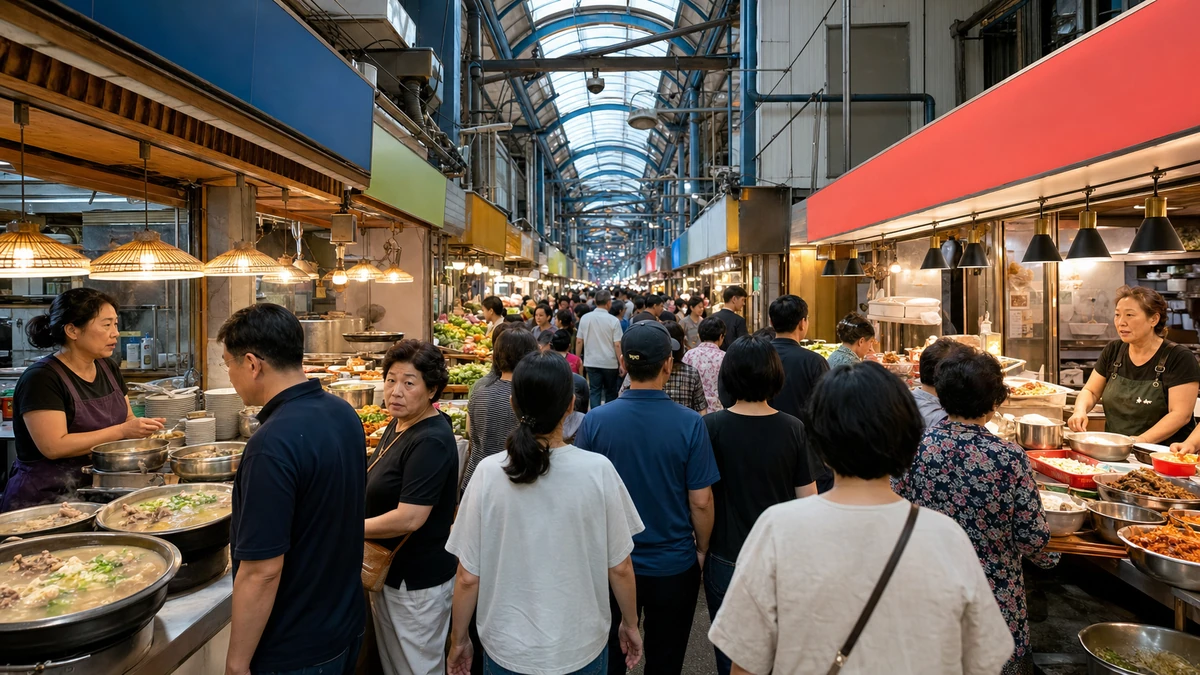
A final summer in a market at the center of a cultural shift
DAEGU, South Korea — In one corner of Daegu, a sprawling city in South Korea’s southeast better known to many Americans for textiles, baseball and blistering summer heat than for international controversy, merchants at Chilseong Market are navigating what may be their last full summer selling one of the country’s most debated traditional foods: dog meat soup.
The scene this month is less dramatic than outsiders might expect. There are no loud protests in the alleys and no sudden shutdowns. Instead, the transition is unfolding in a quieter, more intimate way — through restaurant menus, worried conversations between vendors and the sight of customers still ordering dishes they have known for decades even as the law moves decisively in another direction.
South Korea is in the middle of phasing out the dog meat trade under legislation that sets a deadline of June 16, 2027, after a grace period for businesses to close or convert. As that deadline approaches, the vendors at Chilseong Market, one of the country’s most recognizable traditional markets associated with the dog meat trade, are confronting the practical consequences of a social change that has been years in the making.
Some merchants say they are considering replacements such as samgyetang, a ginseng chicken soup, and wang galbitang, or beef short rib soup — both hearty, restorative dishes deeply familiar to Korean diners. Others wonder whether longtime customers who once came specifically for bosintang, the dog meat soup long tied to older ideas about stamina and summer health, will follow them into a new line of business.
For American readers, the story may be tempting to flatten into a simple morality tale about a country “ending” a controversial practice. But on the ground, it looks more like the slow rewiring of habit, livelihood and local identity. Chilseong Market is not just a place where a disputed food was sold. It is now a live case study in how a modern society retires an old custom while trying not to destroy the small-business ecosystem built around it.
That is why this final summer selling season matters. It captures a moment when law, generational change, animal welfare concerns and economics are all colliding in one very specific place: a traditional market where the future is being negotiated stall by stall.
What the market represents in South Korea today
Traditional markets in South Korea are more than shopping districts. They are neighborhood institutions, places where local residents buy produce, eat inexpensive meals and sustain family-run businesses that can stretch back decades. For visitors used to American farmers markets or old urban public markets — think Reading Terminal Market in Philadelphia or Pike Place in Seattle, though with a denser maze of small stalls and hot soup counters — Chilseong carries that same sense of history, only layered with the sharper realities of economic transition.
Chilseong Market in Daegu has long been one of the places where South Korea’s dog meat culture was most visible. For years, it has served as a reference point in national conversations about whether the practice still belonged in a country that has changed rapidly in nearly every other way. South Korea today is a global cultural powerhouse, exporting K-pop, TV dramas, beauty products and fine dining trends. It is also a country with one of the world’s fastest-aging populations, intense urbanization and widening generational differences over social values. The debate over dog meat sits squarely inside those changes.
Older Koreans, particularly in some regions and among some working-class communities, have historically regarded bosintang as a seasonal health food. The idea ties into a broader Korean tradition of boyangsik, or “restorative foods,” a category of dishes believed to replenish energy during periods of fatigue or extreme weather. In summer, when humidity and heat can be oppressive, people have long turned to soups and stews thought to restore stamina. Americans may find that concept counterintuitive — eating hot soup in hot weather — but the logic is not entirely foreign. It resembles, in spirit, traditions elsewhere that link certain foods to endurance, immunity or seasonal resilience.
What has changed is not simply taste. It is the moral and social meaning attached to the food. Younger South Koreans are far more likely to see dogs primarily as companion animals. Pet ownership has surged. Animal welfare activism has become more organized and visible. International scrutiny has also grown, especially as South Korea’s global image has expanded through entertainment, tourism and consumer culture. In that environment, a practice once defended as part of tradition has come to seem increasingly isolated from the mainstream.
Chilseong Market therefore occupies a symbolic space beyond Daegu. It is one of the places where outsiders can see, in physical form, the uneven overlap between old Korea and new Korea — between a society that still contains living memory of one food culture and a younger nation trying to define itself differently.
From bosintang to chicken soup: The business of adaptation
At the heart of the transition is a deeply practical question: What do these merchants sell next?
Several vendors have said they are preparing for life after the grace period by considering menu changes, including samgyetang and wang galbitang. Those choices are not random. They are strategic attempts to preserve part of what customers have historically sought from bosintang without running afoul of the law or shifting too far from the culinary identity of the market.
Samgyetang is one of South Korea’s best-known summer dishes: a whole young chicken stuffed with glutinous rice and simmered with ginseng, garlic and jujubes. To many Americans, it can be understood as a Korean cousin to chicken soup, though its symbolism is more specific. It is often eaten during the hottest days of the year and is associated with replenishing energy. Wang galbitang, a rich beef rib soup, occupies a similar comfort-food territory — substantial, familiar and associated with nourishment.
For market vendors, these are not just recipes. They are possible bridges. The hope is that customers who once came seeking a meal associated with vigor and tradition might accept another dish carrying a comparable “restorative” image. In business terms, it is less a reinvention than a repositioning.
But there are obvious risks. A restaurant’s customer base is not infinitely flexible. One merchant has voiced concern that most regulars came specifically for bosintang and may not stay once the menu changes. That worry is easy to understand in any country. Imagine a regional diner in the United States that built its reputation around a single legacy specialty — whether barbecue in a small Southern town or a neighborhood fish fry in the Midwest — and is suddenly told it must replace the core item that defined both its clientele and its identity. Some customers may adapt. Others may simply disappear.
The challenge is magnified in traditional markets, where profit margins are often thin and the average merchant is older. Reinvention requires capital, experimentation and time — three things many small operators do not have in abundance. A menu change also means a branding change, a sourcing change and, in some cases, a psychological change. Vendors are not only swapping ingredients. They are being asked to leave behind the trade that shaped their working lives.
That is why the image of a merchant considering samgyetang or beef rib soup carries more weight than a simple menu update. It shows how legal reform becomes real in everyday life: in handwritten signs, adjusted recipes and the uncertain hope that a new dish might keep the lights on.
The empty storefronts tell their own story
If the customers still ordering bosintang represent continuity, the empty storefronts scattered through the market represent something else: a future already creeping in.
Reports from the market describe vacant spaces, dust collecting on old kitchenware and a sense that some parts of the trade have already started to fade before the legal deadline fully arrives. In any commercial district, empty storefronts can signal many things — weak demand, an aging merchant base, rising costs or changing consumer behavior. At Chilseong, they also serve as visual evidence that this particular niche of the food economy has been shrinking under social pressure for some time.
The stillness of those unused spaces matters because it complicates the common assumption that legal bans alone produce change. In reality, laws often codify shifts already underway. South Korea’s dog meat phaseout did not emerge in a vacuum. It followed years of debate, falling social acceptance and the gradual repositioning of dog meat from an ordinary if controversial niche product into something many people viewed as outdated or embarrassing.
Empty shops can therefore be read as both economic and cultural artifacts. They suggest that for some vendors, the transition has been too difficult or too uncertain to survive. They also suggest that what once felt normal enough to support a cluster of businesses no longer commands the same social or commercial stability.
For local communities, that creates a secondary problem. Traditional markets are rarely protected simply because every item they sell deserves preservation. They survive because they serve people and adapt to what people want. When one trade collapses, the question becomes whether the market can attract a different mix of tenants, customers and purposes quickly enough to avoid decline.
This is a challenge American cities would recognize. Across the United States, legacy commercial districts have had to reinvent themselves when a dominant trade faded — whether because of factory closures, suburban migration or changing tastes. Some neighborhoods become culinary destinations or tourism anchors. Others lose momentum and struggle with vacancy. Chilseong Market’s empty stalls suggest that South Korea faces a similar urban and social question: not only how to end a controversial food practice, but how to keep a historic local marketplace viable after that practice recedes.
Why customers still order the old dish
One of the most revealing details from the market is that many customers are still reportedly ordering bosintang even now, with the end of the grace period in sight. That gap between legal direction and consumer habit may be one of the most important parts of the story.
Food is never only about nutrition. It is memory, routine, comfort and identity. People return to the dishes they associate with youth, family or ritual even when broader society has moved on. In the United States, there are examples of foods whose cultural status has changed dramatically over time, yet pockets of loyalty remain because tradition outlasts consensus. The same pattern is visible here.
For some older Korean customers, bosintang is not an abstraction in a policy debate. It is a familiar seasonal meal linked to years of personal practice. Its consumption has often been associated with boknal, the hottest days of summer on the traditional calendar, when people seek foods believed to restore strength. That background does not erase the ethical concerns driving the ban, but it does help explain why some customers continue to seek the dish even as public opinion moves away from it.
The persistence of demand also shows that legal change does not instantly produce cultural uniformity. A law can set a deadline. It cannot make everyone process that shift emotionally at the same speed. This is true in many societies, not just South Korea. Whether the issue is smoking, animal welfare, environmental rules or public health habits, regulation often runs ahead of sentiment in some communities and behind it in others.
That lag creates a difficult position for merchants. They can see that the long-term direction is unmistakable, but they are still serving customers whose expectations belong to an earlier era. If they pivot too early, they may lose current business. If they pivot too late, they may be unprepared for the legal and commercial realities ahead. It is the classic dilemma of transition industries everywhere.
In that sense, the customers at Chilseong are not just buying lunch. They are marking the final stage of a cultural practice that is being phased out in real time. Their presence underscores that social change is rarely clean or unanimous. It arrives in overlapping layers of belief, law and habit — and for a while, all of those layers can coexist uneasily in the same room.
A law that reflects broader changes in Korean society
The coming end of the dog meat trade is one part of a larger transformation in South Korea’s public values. Over the last two decades, the country has undergone striking changes in how it thinks about pets, family life and public ethics. Dogs that might once have been seen primarily through utilitarian or rural lenses are now, for many households, companions, emotional supports and full members of the home. Pet strollers, dog cafés and veterinary specialty services are no longer unusual in urban South Korea.
That cultural evolution has been especially visible among younger generations, whose outlook has been shaped by global media, changing household structures and rising attention to animal rights. South Korea’s low birthrate and increase in one-person households have also coincided with a boom in pet ownership, reinforcing the idea of animals as intimate companions rather than livestock.
At the same time, South Korea remains a place where older customs carry real emotional weight, and where rapid modernization can create cultural whiplash. The country’s development over the last half-century was so fast that practices once common within living memory can suddenly appear politically or morally untenable. That can produce sharp tensions between generations, regions and social classes.
The legislation ending the dog meat trade is best understood against that backdrop. It is not just a food policy. It is a statement about what kind of society South Korea wants to be seen as — by itself as much as by the world. As Korean popular culture has become a global force, questions about national image have inevitably become more sensitive. Practices that were once treated as domestic matters now attract international attention, commentary and sometimes condemnation.
Still, reducing the law to international public relations would miss the point. The change is also driven by internal consensus that has been building for years. Animal welfare groups have pushed the issue. Public support for the trade has waned. Political leaders have concluded that the practice no longer reflects the country’s mainstream values. The resulting law formalizes that shift while allowing a transition period in recognition of the people whose livelihoods depend on the old system.
That balancing act — moral clarity paired with economic cushioning — is politically familiar in many democracies. It resembles debates in the United States over how to phase out industries or practices that a growing share of the public no longer accepts while avoiding abrupt harm to workers and small businesses. The details differ, but the governing challenge is similar: how to align law with changing values without pretending that the adjustment is painless.
What Chilseong Market may look like after the ban
No one can say with certainty what Chilseong Market will look like after the grace period ends, but the outlines of its next chapter are already becoming visible.
One possibility is a gradual rebranding built around more conventional Korean comfort foods — soups, stews and meat dishes that can draw local diners without the stigma attached to dog meat. If enough vendors succeed in that shift, the market may preserve its food-centered identity while shedding the trade that made it controversial. In time, it could become just another traditional market adapting to new consumer tastes.
Another possibility is a rougher transition marked by more vacancies, weaker foot traffic and a prolonged search for new relevance. That risk is real, especially if longtime customers do not convert to replacement dishes and if younger consumers still avoid the market because of its history. Rehabilitation of place can take longer than rehabilitation of menus.
There is also a symbolic opportunity. South Korea has repeatedly shown an ability to transform traditional spaces without erasing their past. Old markets can become hybrid destinations where heritage, local food and modern branding coexist. If municipal officials, local business groups and vendors invest in that transition, Chilseong could eventually be known less as a dog meat market and more as a case of how a community remade itself under social pressure.
That would not erase the hardships now facing merchants. For many, this is not an abstract policy seminar but a countdown tied to rent, age and survival. Some may retire rather than reinvent. Others may fail despite their efforts. Even a successful transition will likely involve losses that are personal and permanent.
But there is something revealing in the market’s current in-between state. The old custom has not vanished completely. The new order has not fully settled in. The law points clearly toward one future, while the market still carries traces of another. In that unsettled middle ground, Chilseong Market offers a more honest picture of social change than either side of the debate often does. Customs do not simply disappear the moment a nation decides they should. They linger in spaces, in customers, in old cookware gathering dust and in merchants trying to decide what recipe might let them stay open one more season.
For outsiders who know South Korea mainly through glossy exports — chart-topping music, award-winning films and viral food trends — this market tells a different story. It shows a country not just producing the next global sensation, but doing the slower, harder civic work of reconsidering inherited habits. And as this final summer selling season unfolds in Daegu, that process is visible in the most ordinary and revealing place possible: a neighborhood market where the menu is changing because the culture around it already has.



0 Comments